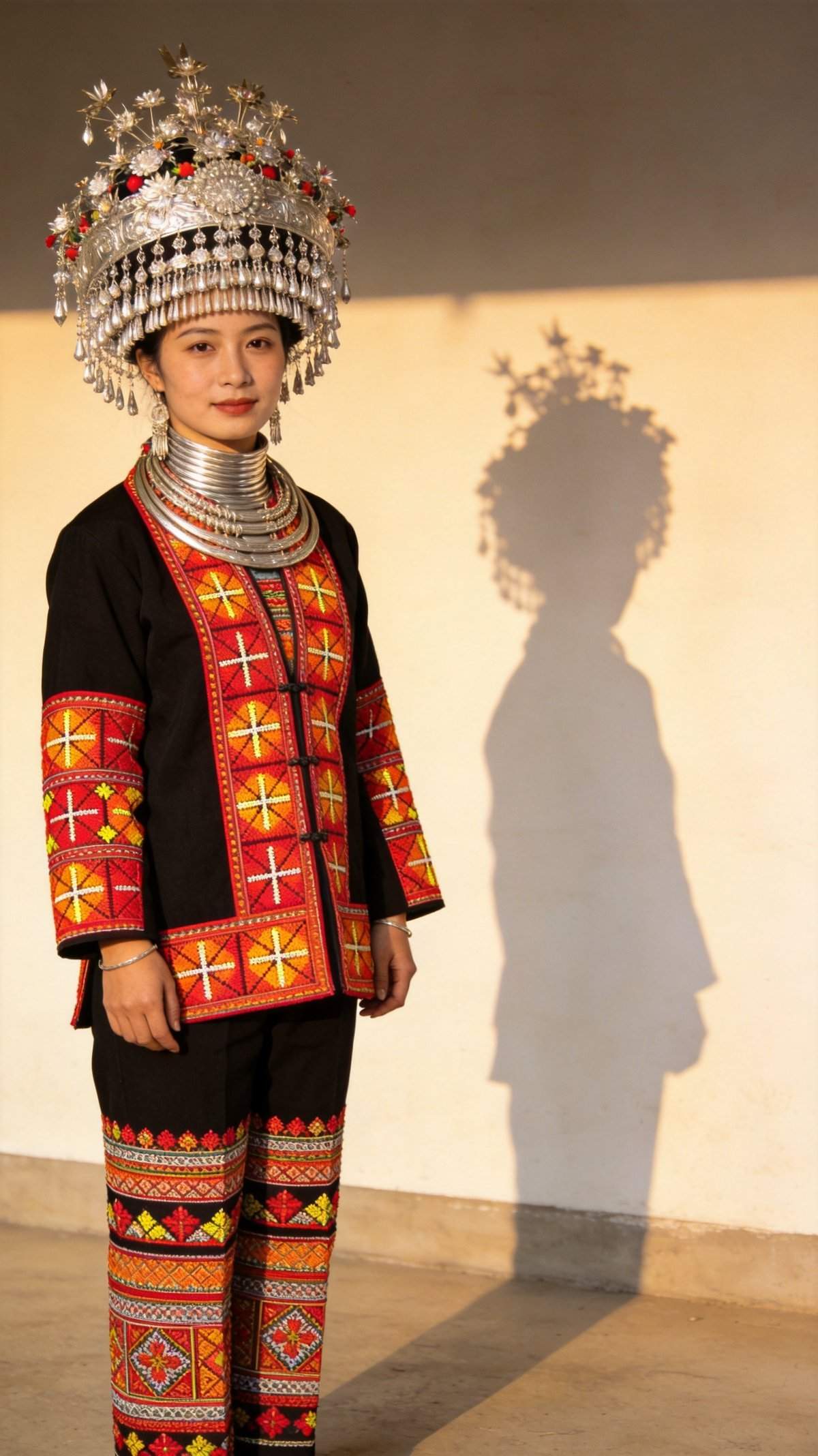
Yao traditional clothing is remarkably diverse across its many subgroups, unified by a shared emphasis on indigo dyeing, extensive silver ornaments, and leggings. The Yao are known for their elaborate festival headdresses and distinctive jacket styles that vary dramatically between subgroups.
Historical and Cultural Context
The Yao people, numbering over 2.8 million, are one of China's most visually distinctive ethnic minorities due to their clothing diversity. Originating from the mountainous regions spanning Guangxi, Hunan, Yunnan, Guangdong, Guizhou, and Jiangxi provinces, the Yao developed their varied clothing traditions over centuries of migration and adaptation to different environments. Each subgroup's attire served both practical purposes and identity functions in regions where multiple ethnic groups coexisted. The Yao are sometimes called "anthropologists' delight" because their clothing differences are so pronounced that subgroups are primarily identified and named by their dress characteristics rather than linguistic or genetic differences. This clothing-based identity system may be unique among the world's ethnic groups.
Traditional Yao society maintained a strong oral history tradition, and many embroidery patterns and clothing designs encode historical narratives about migration routes, legendary ancestors, and important cultural events. The Pangu King, a central figure in Yao mythology and creation stories, appears frequently in embroidery motifs, and his story is visually recounted through patterns stitched onto festival garments.
Key Features of Yao Attire
- Distinctive headdresses that vary by subgroup - from flat caps to tall conical structures
- Indigo-dyed fabric decorated with colorful embroidered bands at cuffs, collars, and hems
- Heavy silver neck rings, bracelets, and earrings in signature styles
- Embroidered leggings and leg bindings worn by women
- Red, blue, and white geometric embroidery on jacket front panels
Traditional Garments
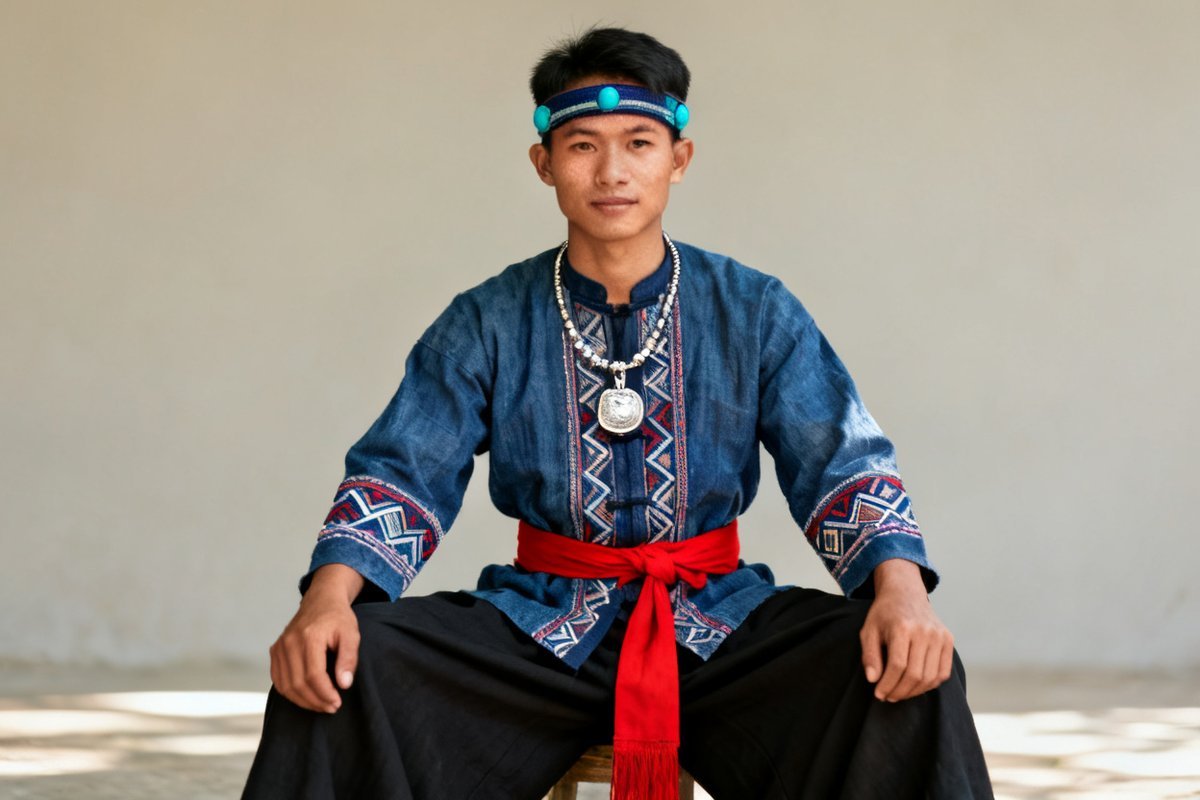
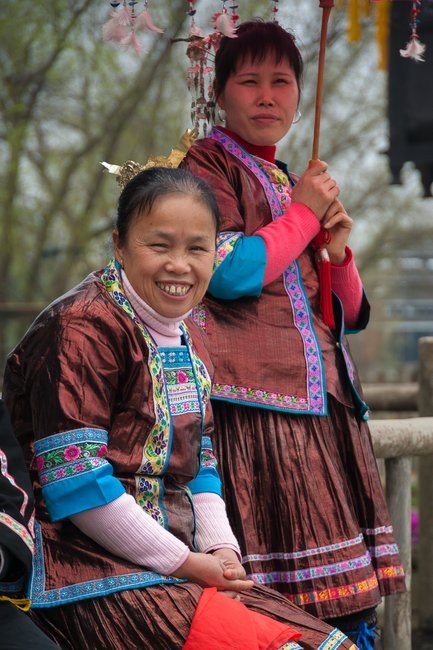
Women wear a collarless jacket in indigo black, with the front opening, cuffs, and hem decorated with multicolored embroidered bands, over loose trousers or a wraparound skirt with embroidered hem. The indigo dyeing process itself is a skilled craft: Yao women grow their own indigo plants, ferment the leaves to create dye paste, and repeatedly dip and oxidize handwoven cotton fabric to achieve the deep blue-black color that characterizes Yao clothing. This process can take weeks for a single garment. Embroidered leggings cover the lower legs and are often the most elaborately decorated garment component, featuring dense cross-stitch patterns in red, white, and yellow against the dark indigo background. Men wear front-fastening jackets in indigo with simple embroidered trim and loose trousers. Both men's and women's jackets are designed without buttons; instead, cloth ties or silver clasps are used for closure, allowing the embroidered front panels to flow open partially when walking.
Headwear and Adornments
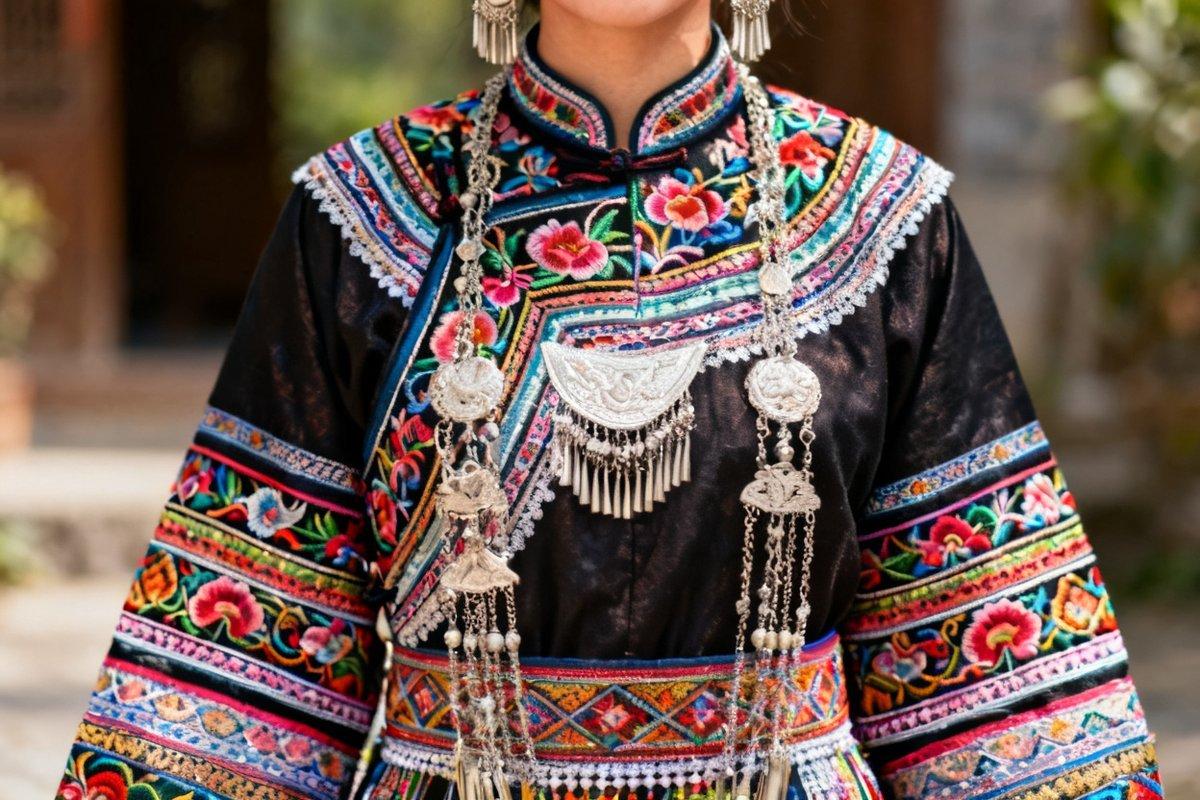
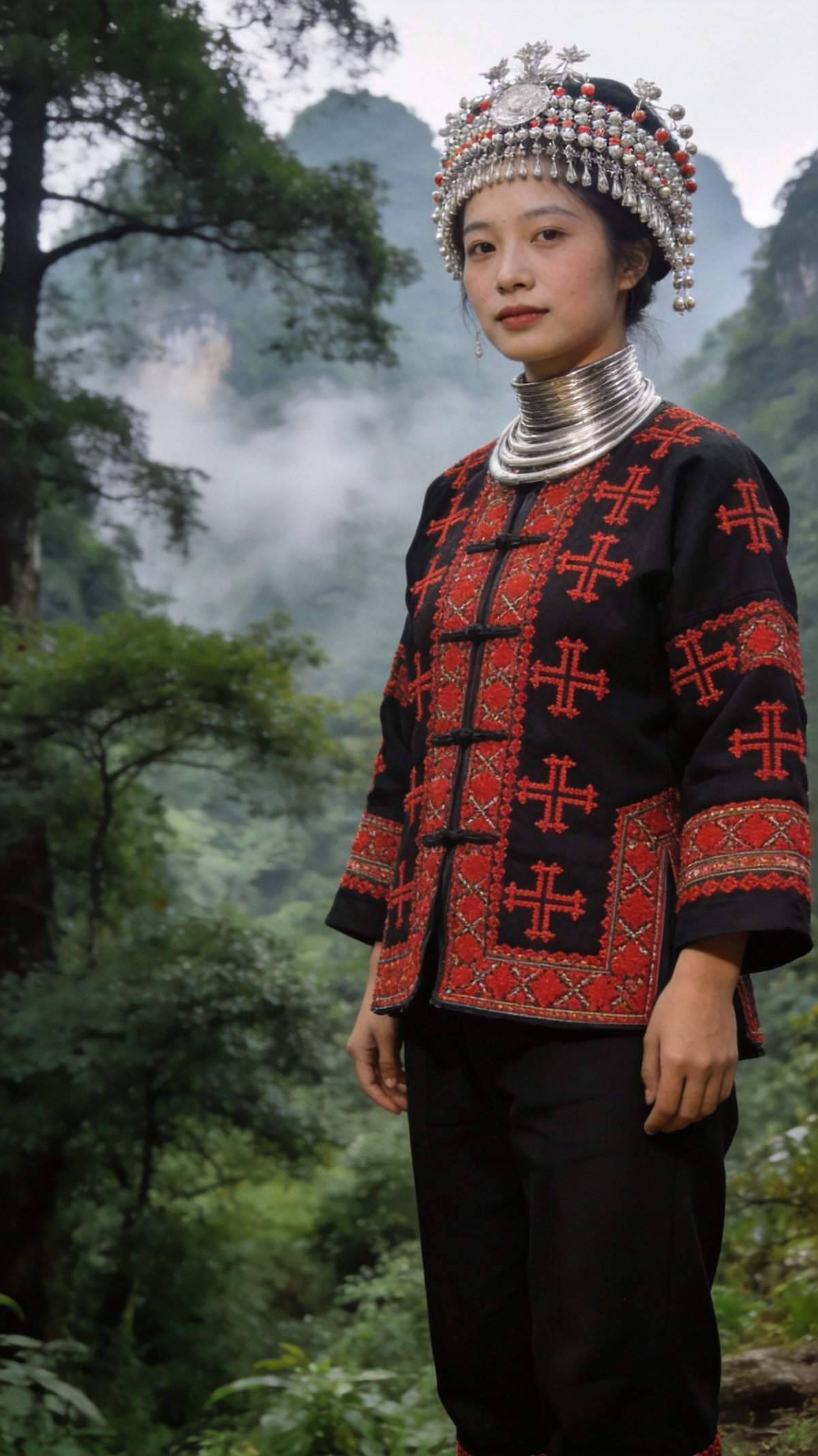
Yao headdresses are the most diverse among China's ethnic groups. The Hongtou Yao (Red Head Yao) wear towering red felt crowns that can reach 30 centimeters in height, constructed over a bamboo frame and covered with red wool. The Pangu Yao wear horn-shaped caps symbolizing their mythical ancestor. The Baiku Yao (White Trousers Yao) wear simple white headwraps. Unmarried women's headdresses are typically more elaborate than those of married women. Silver ornaments are equally important: heavy silver neck rings, often worn in sets of three to seven, are a signature of Yao jewelry, along with large hoop earrings and elaborate silver chest plates worn during festivals. The weight of a Yao woman's festival silver can exceed five kilograms, with family wealth displayed through the quantity and quality of silver worn.
Embroidery and Decorative Arts
Yao embroidery features geometric patterns including diamonds, zigzags, human figures, and stylized flowers in bright colors on indigo fabric. Cross-stitch and applique are dominant techniques, with the legendary Pangu king motif appearing in many designs. The embroidery of each subgroup is distinct enough that anthropologists can identify a garment's village of origin by analyzing its stitch patterns. Yao women begin learning embroidery as children, and a completed set of festival clothing, with its dense embroidered surfaces, represents years of accumulated work. The craft is traditionally taught mother-to-daughter, with pattern knowledge encoded in memorized counting systems rather than written diagrams. Today, Yao embroidery has attracted attention from textile researchers worldwide for its mathematical precision and cultural complexity.
With over thirty recognized subgroups distinguished primarily by clothing, the Yao represent what anthropologists call a confederation of dress - the headdress alone can instantly communicate subgroup, marital status, and village of origin.
Color Symbolism
Indigo black and deep blue dominate. Embroidery in bright red, yellow, blue, white, and green. Red is especially significant for many Yao subgroups, who use it extensively in headwear and jacket trim.
Festival Attire
During the Pangu Festival (Yao New Year) and the Danu Festival, subgroups display their most distinctive headdresses - the Red Yao towering headpieces, the Baiku Yao white trousers, and the Flowery Yao fully embroidered jackets.
Modern Influence and Preservation
Yao embroidery and indigo-dyeing techniques are preserved through cultural heritage programs across several provinces. The Yao's diverse headdress styles are frequently featured in Chinese ethnic photography and have become iconic representations of China's cultural diversity in both domestic and international media. Several Yao communities have established embroidery cooperatives that sell handcrafted textiles to collectors and tourists, providing economic incentives for younger generations to learn traditional skills. The indigo-dyeing process, with its multiple immersion cycles and characteristic blue-black color, has attracted interest from sustainable fashion advocates who value natural dyeing techniques. However, the sheer number of Yao subgroups means that some of the rarer clothing traditions are at risk as elder artisans pass away. Documentation efforts are underway to record the distinctive dress characteristics of each subgroup before traditional knowledge is lost.
Did You Know?
The Yao have more distinct named subgroups defined by clothing than any other Chinese ethnic group - including the Red Yao, White Trousers Yao, Flowery Yao, Blue Indigo Yao, Flat Cap Yao, Horn Yao, and Long Shirt Yao, each with a completely different headdress or jacket style.
Red Turbans and Embroidered Leggings of the Yao
The Yao people, distributed across Guangxi, Hunan, Yunnan, Guangdong, and Guizhou, maintain diverse clothing traditions that share common elements while varying significantly between subgroups. Among the most distinctive shared features is the emphasis on red in men's headwear, with red turbans or headwraps being a near-universal element across Yao communities. The turban-wrapping technique varies by subgroup, with some achieving a tall, conical shape and others producing a flat, wide arrangement. The red fabric is often imported or specially dyed for this purpose.
Yao women's embroidery is among the most recognized textile arts among China's ethnic minorities, characterized by small-scale geometric patterns executed in cross-stitch on dark indigo fabric. The patterns include stylized human figures, animals, trees, and geometric arrangements that together create narrative scenes on apron panels, leg bands, and sleeve cuffs. An experienced Yao embroiderer can identify the subgroup and home village of another Yao woman by reading the pattern combinations on her clothing.
Red Turbans and Embroidered Leggings of the Yao
The Yao people, distributed across Guangxi, Hunan, Yunnan, Guangdong, and Guizhou, maintain diverse clothing traditions that share common elements while varying significantly between subgroups. Among the most distinctive shared features is the emphasis on red in men's headwear, with red turbans or headwraps being a near-universal element across Yao communities. The turban-wrapping technique varies by subgroup, with some achieving a tall, conical shape and others producing a flat, wide arrangement. The red fabric is often imported or specially dyed for this purpose.
Yao women's embroidery is among the most recognized textile arts among China's ethnic minorities, characterized by small-scale geometric patterns executed in cross-stitch on dark indigo fabric. The patterns include stylized human figures, animals, trees, and geometric arrangements that together create narrative scenes on apron panels, leg bands, and sleeve cuffs. An experienced Yao embroiderer can identify the subgroup and home village of another Yao woman by reading the pattern combinations on her clothing.
Regional Diversity in Yao Clothing
The Yao people's wide distribution across five provinces has produced remarkable diversity in clothing styles, with each Yao subgroup maintaining distinct garment forms, color preferences, and decorative techniques. The Pan Yao of Guangxi wear predominantly indigo blue with elaborate embroidered leg bands and large silver earrings that distinguish them from the Red Yao of the same region, who favor red wool pompoms and white linen headdresses. The Flat Hat Yao, named for their distinctive headwear, maintain completely different garment traditions from the Blue Indigo Yao who live in adjacent valleys. This diversity within a single ethnic group is unusual among China's minorities and reflects the Yao pattern of settlement in dispersed mountain communities with limited inter-community contact.
Despite regional variation, certain elements unite Yao clothing across subgroups. The preference for indigo-dyed fabric is nearly universal, as is the use of geometric embroidery in bright contrasting colors. Silver ornaments appear in some form across all Yao communities, though the specific forms vary dramatically. The social function of clothing as an indicator of age, marital status, and regional origin is consistent across Yao subgroups, as is the importance of textile skills in female social evaluation. These shared characteristics, expressed through diverse regional forms, create a Yao textile identity that is recognizable across the group's wide geographic distribution.