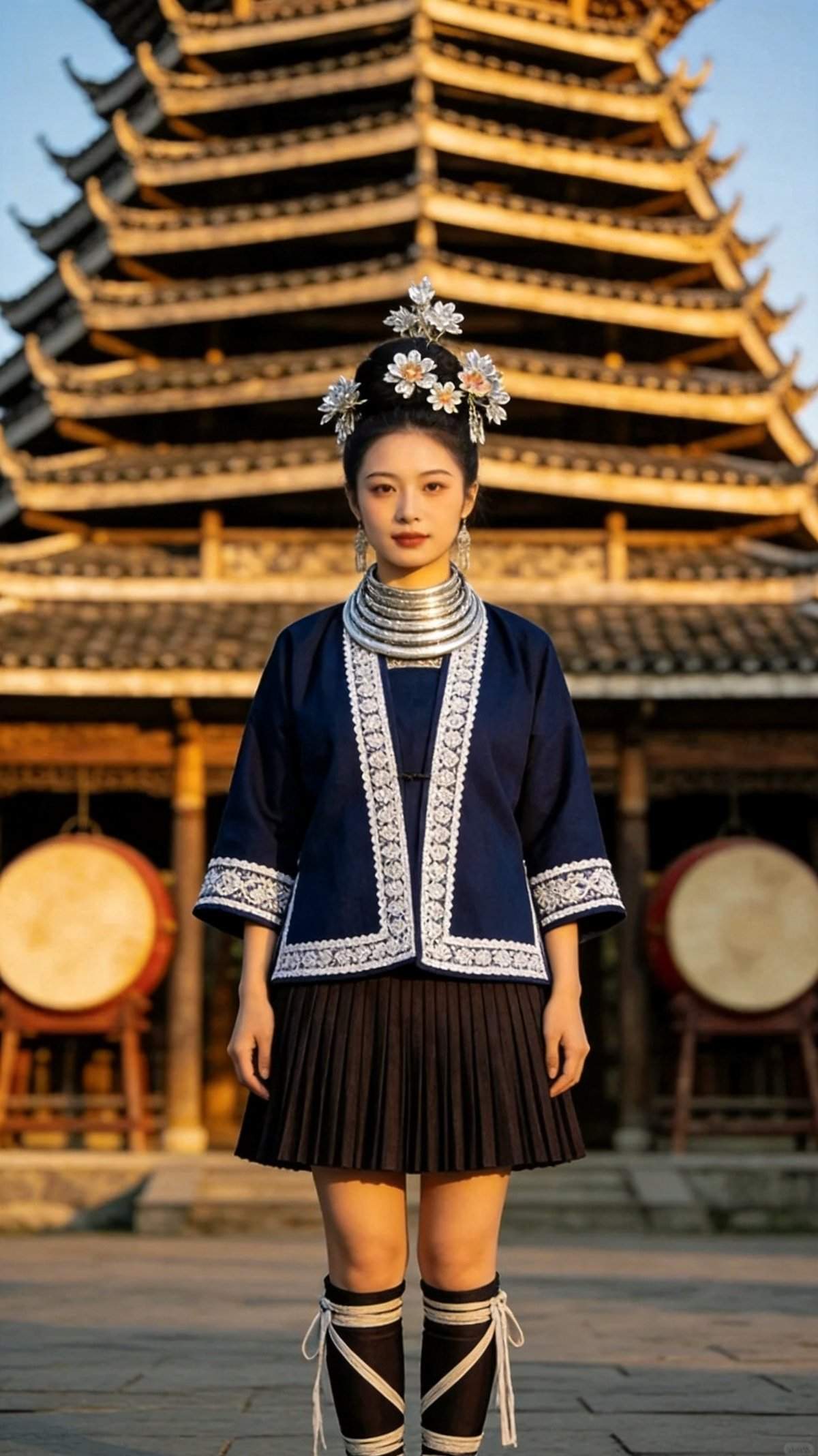
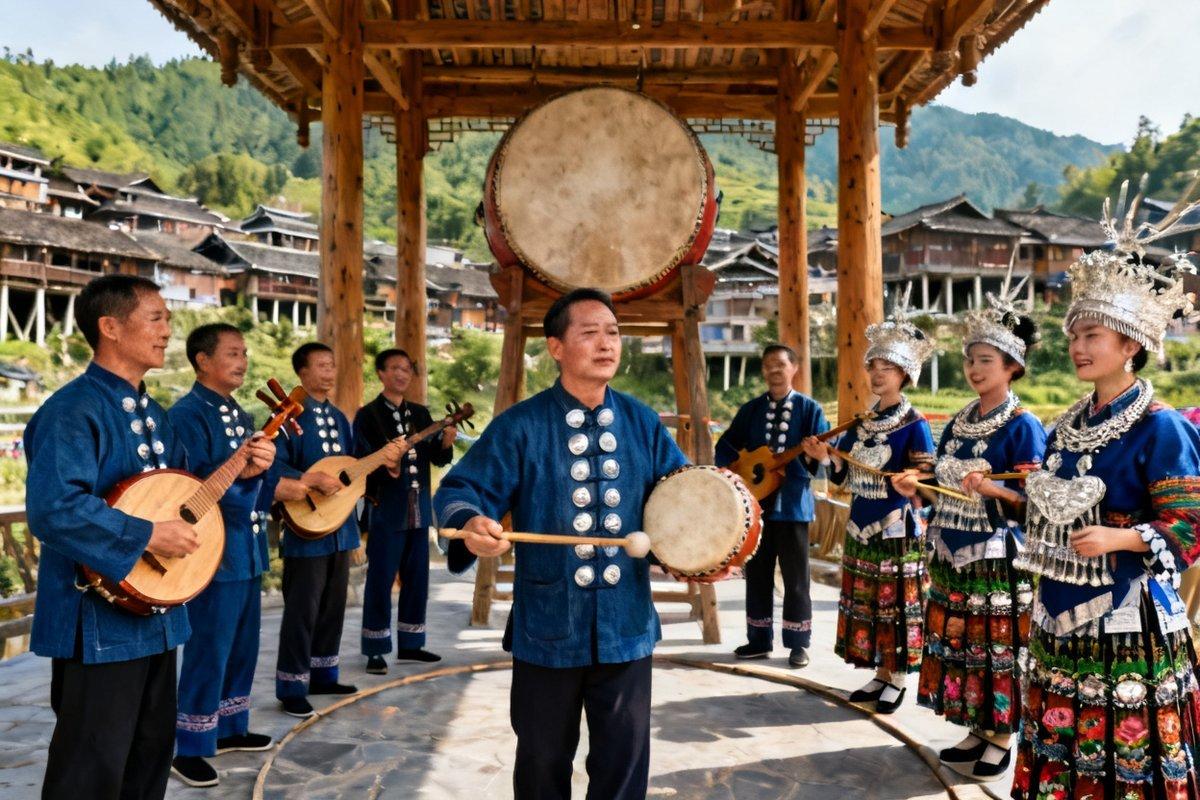
The Dong people, numbering nearly three million, inhabit the mountainous border region where Guizhou, Hunan, and Guangxi provinces meet, in villages celebrated for their drum towers and wind-rain bridges that represent the highest achievements of wooden architecture without nails. Dong textile culture is equally distinguished: their indigo-dyed fabric achieves a glossy metallic blue-black sheen through a labor-intensive process involving repeated immersion in fermented indigo vats followed by pounding with wooden mallets and coating with egg white, producing a surface that resembles polished leather. Dong women wear exquisitely embroidered jackets and intricately pleated skirts paired with massive silver ornaments that may collectively weigh several kilograms during festivals. The full ceremonial ensemble, with its towering silver crown, multiple neck rings, breastplate, and layered embroidered garments, represents one of the most visually spectacular expressions of ethnic dress anywhere in Asia.
Key Features of Dong Attire
- Glossy indigo fabric achieved through repeated dyeing and stone-beating
- Heavily pleated ankle-length skirts with embroidered waistbands
- Elaborate floral embroidery on jacket fronts and cuffs
- Massive silver headdresses with cascading ornaments
- Hundreds of silver ornaments including neck rings and breastplates
Traditional Garments
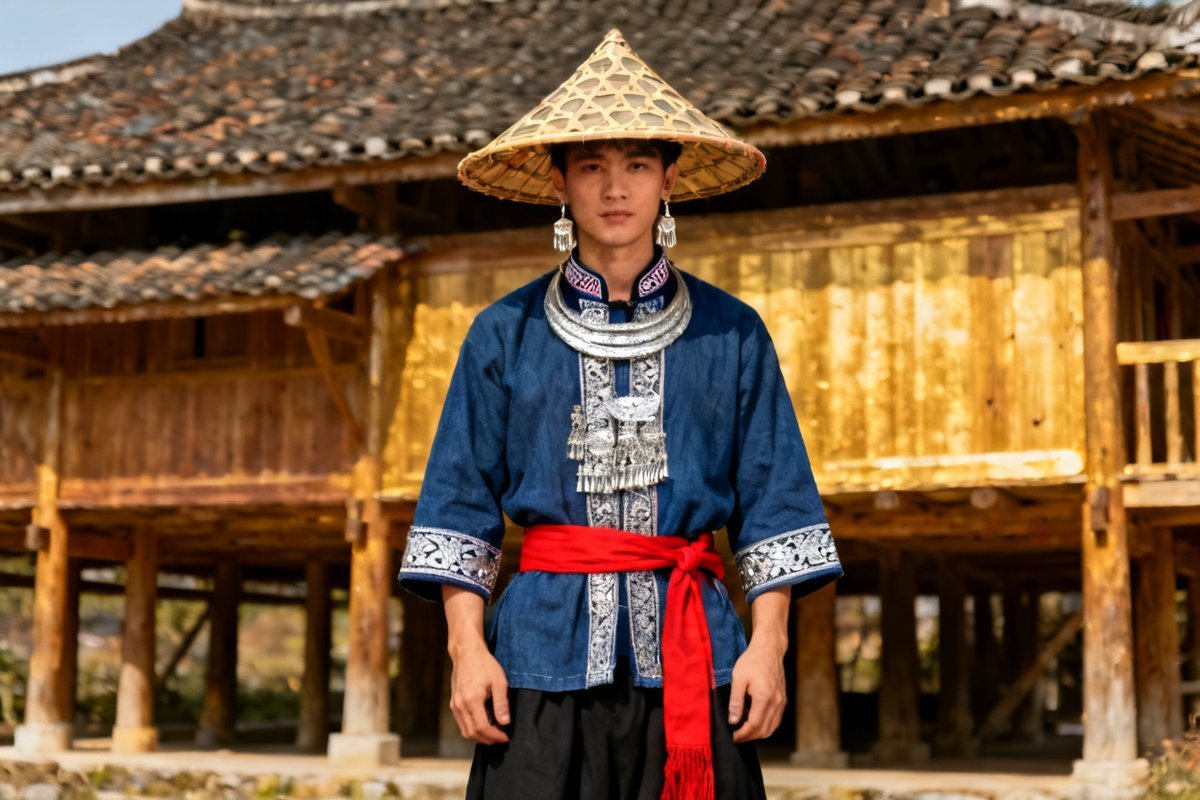
Women wear collarless or right-opening jackets in the distinctive glossy indigo black Dong fabric, with embroidered trim at collar bands, front opening edges, and cuffs featuring colorful floral and geometric patterns. A white inner blouse provides a crisp contrast visible at the neckline. The jacket is worn over a heavily pleated ankle-length skirt whose individual pleats, each perhaps a centimeter wide, are set by hand and held in place by stitching at the waistband, creating a fabric sculpture of extraordinary precision. An embroidered apron covers the front, tied with a woven waistband. Men wear front-fastening short jackets in the same glossy indigo fabric with wide-leg trousers and a simple cloth belt. Regional styles vary across Dong territory: the southern Dong of Guizhou favor the full silver-and-embroidery festival look, while northern Dong communities typically wear less silver and more embroidery. The daily wear version simplifies ornamentation while maintaining the distinctive fabric quality that immediately identifies Dong textiles.
Headwear and Adornments
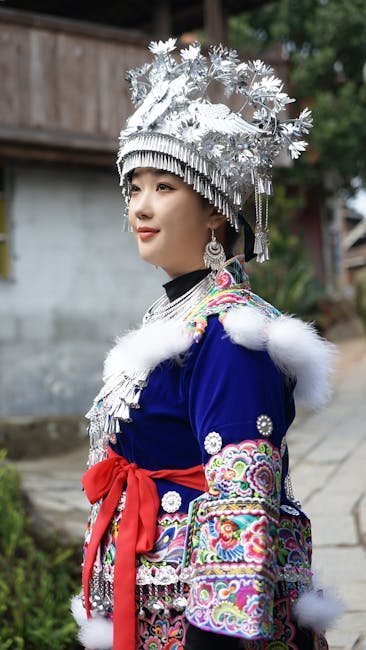
Unmarried Dong women wear elaborate silver crowns during festivals that tower above the head in arrangements of dangling butterflies, flowers, fish, and phoenix figures, each suspended from fine silver chains that tremble with the wearer's movement. These crowns can contain dozens of individual silver pieces crafted by village silversmiths, and a complete crown may represent years of accumulated work and significant family investment. The hair is arranged in a distinctive style with the crown secured on top. Married women transition to wrapped cloth turbans, exchanging the dazzling silver display for a more restrained presentation that nonetheless maintains Dong identity through the quality of fabric and wrapping technique. Beyond headwear, the Dong silver ensemble includes multiple graduated neck rings worn stacked from the collarbone upward, sometimes reaching the chin, and a large silver breastplate engraved with floral and animal motifs that covers the chest. Bracelets, earrings, and hairpins complete the set, with a full festival complement numbering over a hundred individual silver pieces weighing as much as five kilograms.
Embroidery and Decorative Arts
Dong embroidery is exceptionally fine and densely worked, featuring dragons symbolizing power and protection, phoenixes representing beauty and feminine virtue, lotus flowers drawn from Buddhist influence, fish signifying abundance, butterflies referencing Dong creation mythology, and geometric patterns including swirling spirals and interlocking diamonds. These designs are executed in brilliantly colored silk threads on the dark glossy indigo fabric ground, the contrast making the embroidery appear to float above the textile surface. Split stitch, satin stitch, and couched metallic threads create multi-textured surfaces that catch light differently as the viewer moves. The embroidery is concentrated on jacket fronts, collar bands, cuff edges, apron panels, and the borders of baby carriers, which receive the most elaborate decoration as expressions of maternal love and hope for the child's future. Dong women begin learning embroidery as young girls and continue developing their skills throughout life, with the finest work produced by elder women whose accumulated expertise produces embroidery of extraordinary precision and complexity. The Dong distinction between embroidery for daily wear, festival wear, and once-in-a-lifetime ceremonial pieces like wedding garments and baby carriers establishes a hierarchy that organizes a woman's entire textile production across her lifespan.
The Dong peoples drum-song culture is matched by their visual artistry - a single festival garment may carry over two hundred individual silver pieces, each hand-crafted by village silversmiths.
Color Symbolism
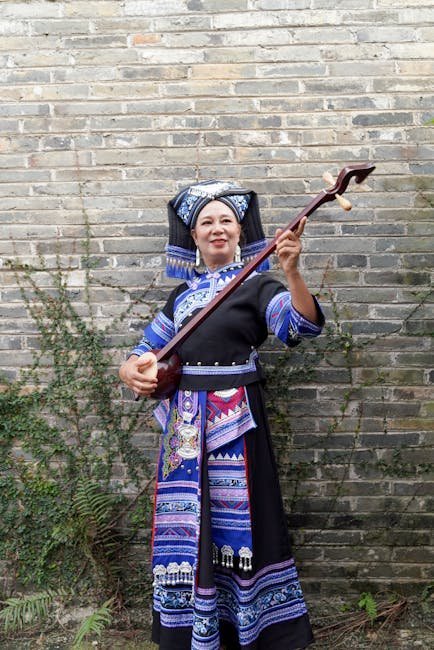
Glossy indigo black and deep blue dominate Dong clothing, the distinctive fabric sheen itself functioning as a color value that distinguishes Dong textiles from the matte indigo of neighboring groups. This glossy black represents the night sky, the depths of water, and the mysterious beauty prized in Dong aesthetics. White appears primarily in inner collars visible at the jacket neckline, providing sharp contrast and representing purity and new beginnings. Embroidery introduces an explosion of color against the dark ground: bright red for life force and celebration, yellow for the sun and prosperity, green for the rice terraces and forested mountains of the Dong homeland, pink for feminine beauty, purple for spiritual authority, and blue for the rivers that sustain Dong communities. The silver of ornaments, polished to mirror brightness, carries its own color symbolism as the metal of the moon, of ancestral connection, and of the wealth that Dong families accumulate in wearable form. The Dong color system achieves its power through contrast: the interplay between the dark, glossy fabric ground and the vivid embroidery, between the solid weight of silver and the lightness of silk thread, between the restrained daily palette and the polychrome explosion of festival dress.
Festival Attire
During the Dong New Year and the Grand Song Festival celebrating the Dong tradition of polyphonic choral singing recognized by UNESCO as intangible cultural heritage, women wear complete silver ornament sets that may collectively weigh over five kilograms: the towering phoenix crown with dangling silver chains and ornaments, multiple graduated neck rings stacked from collarbone to chin, the large silver breastplate engraved with protective motifs, and multiple earrings, bracelets, hairpins, and finger rings. The process of dressing requires assistance from female relatives and can take over an hour, with each piece placed in prescribed order and secured to prevent tangling during the vigorous circle dances that accompany Dong song performances. The visual and auditory spectacle created by hundreds of women in full silver regalia dancing and singing in unison, their ornaments producing a rhythmic shimmer and delicate chiming sound, is among the most powerful expressions of Dong cultural identity. Young women's debut at these festivals in full dress marks their entry into adult social life, and the quality and completeness of their silver set is assessed by the community as a reflection of family prosperity and commitment to tradition.
Modern Influence and Preservation
Dong indigo-dyeing techniques and silver-crafting skills are recognized as national intangible cultural heritage, with master practitioners designated at provincial and national levels. The Dong Grand Song tradition has provided a platform for textile display, as international performances of Dong choral music invariably feature singers in full traditional dress, making Dong clothing among the most internationally visible of Chinese ethnic costume traditions. Village silversmiths continue to produce traditional ornaments, though the rising price of silver has made full festival sets increasingly expensive, and some families now use partial sets or silver-plated alternatives for younger members still accumulating their lifetime collection. Dong indigo fabric has attracted fashion industry attention, with designers experimenting with the glossy textile for modern garments, though the labor-intensive production process limits commercial scalability. The Dong population's relative size and the cultural pride associated with their architectural and musical achievements have supported stronger clothing tradition retention than among smaller groups, with festival dress remaining a living practice rather than a museum piece for many communities in the Dong heartland of southeastern Guizhou.
Did You Know?
Dong fabric undergoes repeated indigo dyeing followed by beating with a stone roller and coating with egg white - this creates a distinctive blue-black sheen resembling polished leather.
Architectural Influence on Dong Textile Patterns
The Dong people of Guizhou, Hunan, and Guangxi are famed for their architectural woodworking, and the geometric precision of Dong carpentry finds direct expression in their textile patterns. The lattice work of Dong drum towers and wind-rain bridges translates into woven diamond and grid motifs on Dong garments, creating a visual dialogue between architecture and clothing. Dong weavers incorporate these architectural patterns into the collars, cuffs, and front panels of women's jackets using supplementary weft techniques that produce raised patterns on the fabric surface. The most complex patterns require months of planning and weeks of weaving time.
Dong textile production is a communal activity, with women gathering in groups to spin, dye, and weave together while socializing and sharing knowledge. The indigo dyeing process is particularly important in Dong culture, with fabric being dyed, dried, and beaten repeatedly until it develops a deep blue-black color and a glossy surface sheen. The beating process can take several days and produces a distinctive metallic luster that is highly prized.