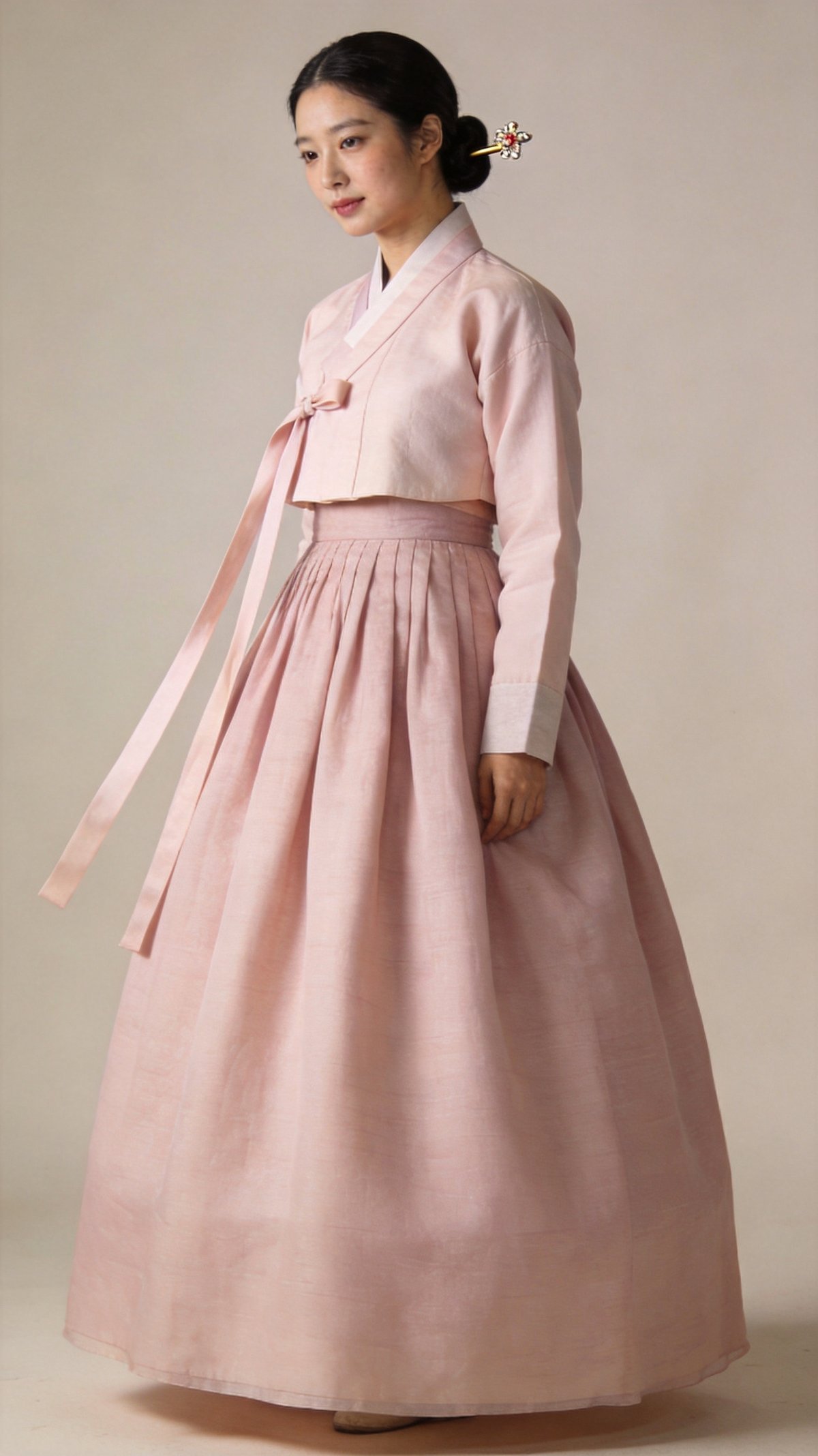
Korean traditional clothing (hanbok) is characterized by clean, elegant lines and vibrant colors. The Chaoxian (Korean) ethnic group in China numbers over 1.8 million, concentrated primarily in the Yanbian Korean Autonomous Prefecture of Jilin Province, with significant populations in Heilongjiang and Liaoning. Their ancestors migrated from the Korean Peninsula beginning in the late 17th century, bringing with them a sophisticated textile tradition rooted in Confucian aesthetics. Women wear the iconic jeogori jacket and chima skirt, while men wear jeogori with baji trousers, distinguished by graceful curves and a silhouette that emphasizes the wearer's breathing space rather than body contours.
Historical and Cultural Background
The Chaoxian ethnic group preserves clothing traditions that trace back to the Three Kingdoms period of Korean history (57 BCE-668 CE). The basic structure of the hanbok remained remarkably stable for over 1,500 years, with the jeogori gradually shortening over time while the chima maintained its voluminous floor-length form. In Confucian society, clothing was a primary marker of social status, age, and occasion. White clothing was so universally worn by common people that Koreans became known throughout East Asia as the "white-clad people" (baekui minjok). The Chaoxian community in China maintained these traditions even as fashion evolved on the Korean Peninsula, making their clothing practices a valuable living archive of pre-modern Korean dress. Rice farming culture, which shaped the rhythms of Chaoxian life in the Yanbian region, influenced clothing practicality: garments needed to allow freedom of movement for agricultural work while maintaining dignity and modesty.
Key Features of Korean Attire
- Womens short bolero-style jacket with a long ribbon bow
- Full floor-length wrap-around skirt with voluminous silhouette
- Mens loose-fitting trousers tied at the ankles
- Outer coat for formal occasions with wide sleeves
- Bright white as the base color with vivid jewel-toned outer layers
Traditional Garments
Women wear a short jeogori reaching just below the armpit, with a long decorative ribbon (goreum) tied at the front in a distinctive single-loop bow, paired with a full-length chima skirt wrapped high under the arms and falling to the floor in a bell-like silhouette. The chima can be constructed from a single rectangular panel of fabric, creating a flat front and full back, or from multiple panels for maximum volume. Men wear a longer jeogori with roomy baji trousers tied at the ankle, and a durumagi overcoat for formal occasions. The durumagi is a full-length outer coat with wide sleeves and a straight cut, worn over the basic jeogori-baji combination and closed with a fabric tie. Children's hanbok mirrors adult styles but uses brighter rainbow-striped sleeves (saekdong) that symbolize the wish for a long and colorful life.
Headwear and Adornments
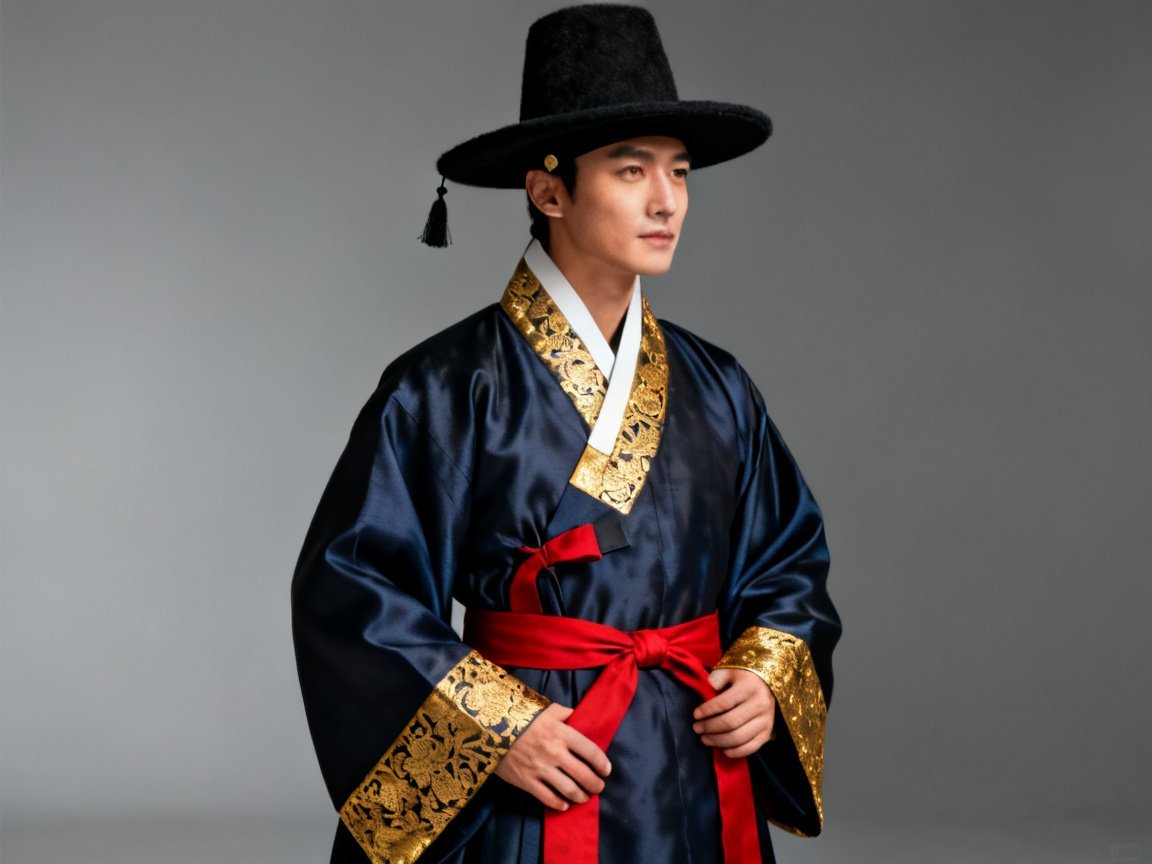
Women traditionally wore a ceremonial coronet (jokduri) for weddings -- a small crown-like cap of black silk decorated with gold embroidery, jade, coral, and pearls, secured with a decorative pin (dwikkoji). For daily wear, married women pinned their hair in a chignon held by a long ornamental hairpin (binyeo). Men wore a black horsehair hat (gat) for formal occasions with a wide brim and cylindrical crown, an extraordinarily fine mesh structure that was a triumph of craftsmanship. Beneath the gat, men wore a headband (manggeon) to keep hair in place after coming of age. The gat was so culturally significant that damaging another man's hat was considered a serious offense. Commoner men wore a simpler version while aristocrats displayed their status through increasingly fine mesh and taller crowns.
Embroidery and Decorative Arts
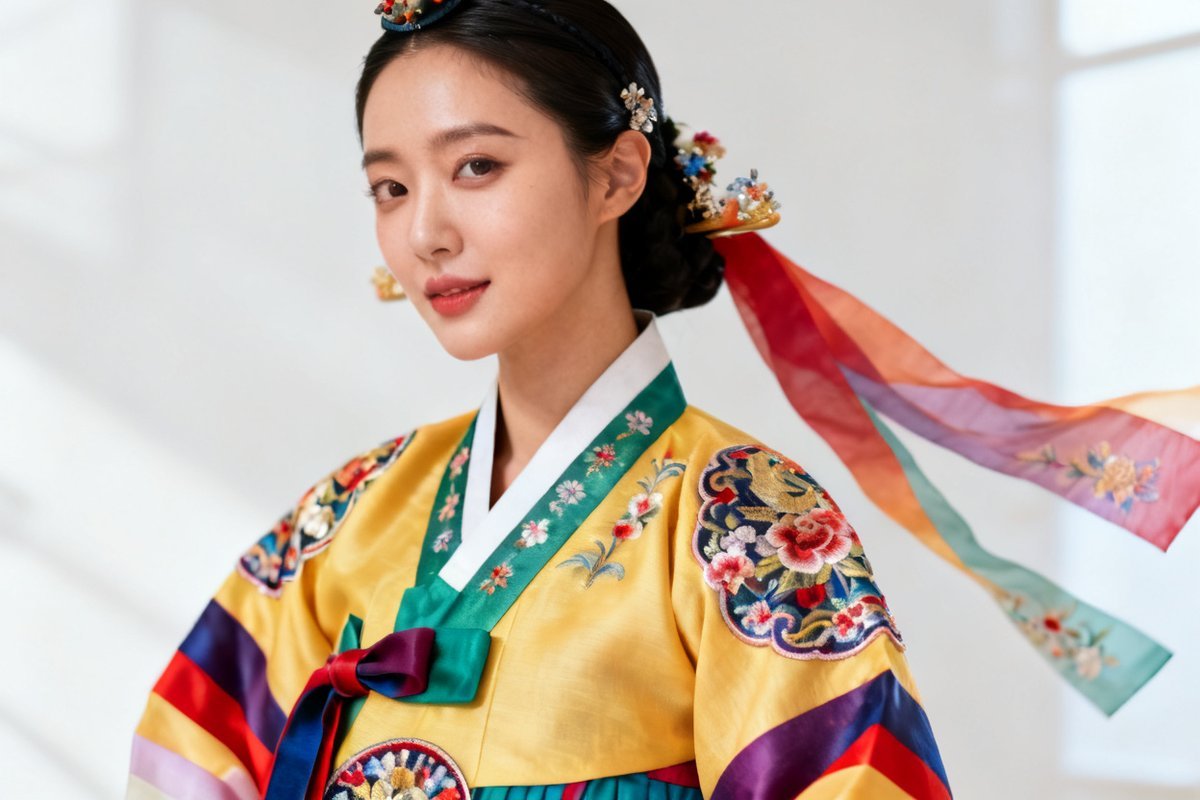
Korean embroidery features peonies, lotus flowers, butterflies, bats, and the ten symbols of longevity (sun, mountain, water, cloud, rock, pine tree, tortoise, crane, deer, and mushroom of immortality). Gold and silk threads on satin produce refined pieces for ceremonial garments. The embroidery on Chaoxian clothing tends toward restraint compared to other East Asian traditions: a single spray of plum blossoms on a jacket cuff, or a subtle cloud pattern on a collar, is preferred over dense all-over coverage. This aesthetic of controlled elegance reflects Confucian values that discouraged ostentation. Patchwork wrapping cloths (bojagi), made from fabric scraps assembled into geometric patterns, represent a uniquely Korean textile art form that transforms frugality into beauty.
The Korean hanboks genius lies in its restraint - where other traditions embroider exuberantly, the hanbok achieves its impact through pure color saturation and the lyrical curve of the jeogoris sleeve.
Color Symbolism
White is fundamental to Chaoxian identity, earning them the historical name "white-clad people" -- a preference rooted in the ancient worship of the sun and sky, as well as the practical availability of undyed hemp and cotton. Outer garments add jewel tones: deep red, royal blue, emerald green, purple, and golden yellow. Color follows strict social codes: bright yellow was reserved for the emperor, red for the queen and high-ranking noblewomen, while commoners wore white or muted earth tones. Unmarried women wore yellow jeogori with red chima, shifting to more subdued combinations after marriage. Children's clothing uses five directional colors (red, blue, yellow, white, black) in striped sleeves as protective talismans.
Festival Attire
During Seollal (Lunar New Year) and Chuseok (Harvest Moon Festival), families wear fine hanbok in vibrant colors to perform ancestral rites and visit elders. The first birthday celebration (doljanchi) features the child in a special striped-sleeve hanbok and a ceremonial headpiece. Brides wear a red chima with yellow jeogori, face decorated with red and black dots, while grooms wear blue formal ensembles. The Chaoxian community in Yanbian maintains all these traditions, with the added significance that their festival hanbok also serves as a statement of ethnic identity within China's multi-ethnic society. The Yanbian Korean Autonomous Prefecture holds annual cultural festivals where traditional hanbok competitions draw hundreds of participants.
Modern Influence and Preservation
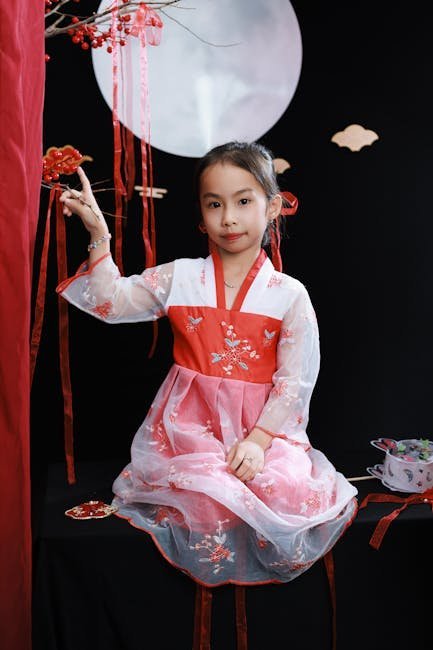
Hanbok has experienced a strong revival in global fashion, adapted into modern silhouettes by designers who retain the signature jeogori line and chima volume while simplifying the construction for everyday wear. Korean pop culture's global reach has driven international interest, with hanbok-inspired collections appearing at Seoul Fashion Week and in collaborations with Western luxury brands. Within the Yanbian Chaoxian community, efforts to preserve traditional hanbok-making techniques are supported by cultural heritage programs. Master artisans who can execute the fine horsehair work of the gat or the delicate gold-leaf decoration of ceremonial robes are nationally recognized. The hanbok rental industry in Yanbian has grown substantially, allowing younger generations to experience traditional dress for photographs and celebrations even as daily wear has modernized.
Did You Know?
The Korean jeogori has become progressively shorter over the centuries - modern womens jeogori barely covers the bust, while 500 years ago it reached the waist.
Color Symbolism and Seasonal Dress of the Korean Minority
The Korean minority in China, concentrated in the Yanbian Korean Autonomous Prefecture of Jilin Province, maintains clothing traditions rooted in the broader Korean Hanbok aesthetic with regional adaptations. Color symbolism plays a central role in Korean dress, with white being the foundational color that gives traditional Korean clothing its name and character. The color white represents purity, simplicity, and the Korean cultural ideal of cleanliness in both appearance and spirit. Colored trims and accessories add accents to the white base, with specific colors associated with different life stages and occasions.
Korean women's traditional attire consists of a short bolero-style jacket called a jeogori, fastened with a long ribbon that forms a decorative bow, paired with a full, high-waisted skirt called a chima. The jeogori has become progressively shorter over centuries of stylistic evolution, with modern versions ending well above the waist. Men wear a longer jacket over loose trousers called baji, with the outfit secured by a wide fabric belt. For formal occasions, men add an overcoat called a durumagi in darker colors.
Color Symbolism and Seasonal Dress of the Korean Minority
The Korean minority in China, concentrated in the Yanbian Korean Autonomous Prefecture of Jilin Province, maintains clothing traditions rooted in the broader Korean Hanbok aesthetic with regional adaptations. Color symbolism plays a central role in Korean dress, with white being the foundational color that gives traditional Korean clothing its name and character. The color white represents purity, simplicity, and the Korean cultural ideal of cleanliness in both appearance and spirit. Colored trims and accessories add accents to the white base, with specific colors associated with different life stages and occasions.
Korean women's traditional attire consists of a short bolero-style jacket called a jeogori, fastened with a long ribbon that forms a decorative bow, paired with a full, high-waisted skirt called a chima. The jeogori has become progressively shorter over centuries of stylistic evolution, with modern versions ending well above the waist. Men wear a longer jacket over loose trousers called baji, with the outfit secured by a wide fabric belt. For formal occasions, men add an overcoat called a durumagi in darker colors.