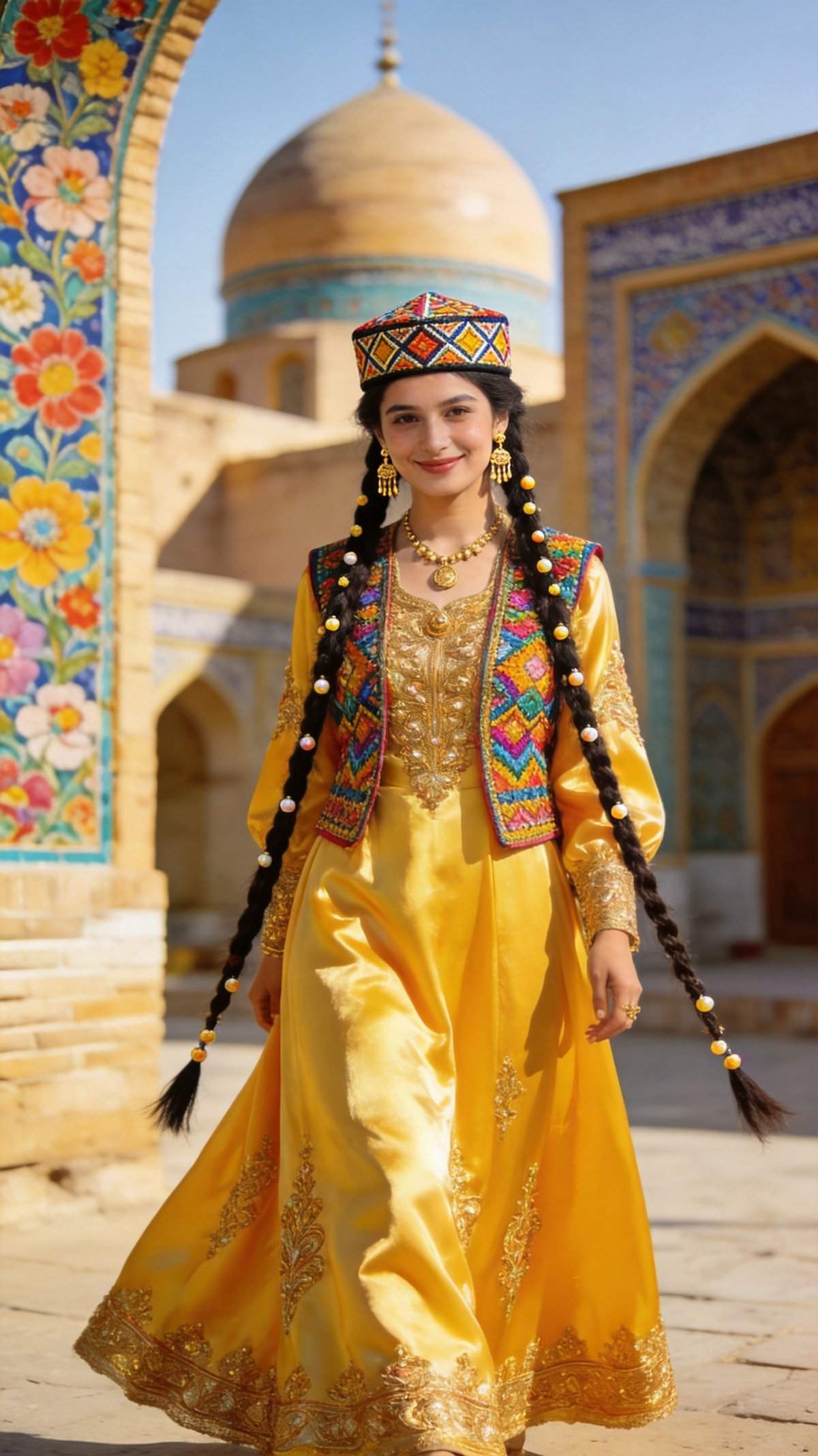
Uzbek traditional clothing in China retains Central Asian embroidery traditions with colorful doppa skullcaps, silk dresses, and richly embroidered vests. Their style closely resembles Uzbek traditions in Uzbekistan. The Uzbek community in China numbers approximately 14,000, concentrated in the cities of Yining, Tacheng, Urumqi, and Kashgar in Xinjiang. Despite their relatively small population, the Chinese Uzbek maintain a distinct cultural identity deeply connected to the broader Uzbek cultural sphere centered in Uzbekistan.
The Uzbek people trace their name to Öz Beg Khan, a 14th-century ruler of the Golden Horde who converted to Islam and established a powerful state across Central Asia. Uzbek identity crystallized in the 16th century when nomadic Uzbek tribes conquered the settled regions of Transoxiana, establishing the khanates of Bukhara, Khiva, and Kokand. These khanates became renowned centers of Islamic learning, poetry, architecture, and craft production. Uzbeks in China are primarily descendants of merchants and scholars who migrated from these khanates to Xinjiang during the 18th and 19th centuries for trade along the Silk Road.
Uzbek culture places high value on poetry, music, cuisine, and textile arts. The cities of Bukhara and Samarkand, though now in Uzbekistan, remain cultural reference points for Chinese Uzbeks, who maintain connections through cross-border family networks, cultural exchanges, and shared traditions. The Uzbek language belongs to the Karluk branch of the Turkic language family and is closely related to Uyghur, with which it shares significant mutual intelligibility. The Uzbeks were historically known as skilled merchants and artisans, and their clothing reflects the sophisticated urban culture of the Central Asian oasis cities.
Key Features of Uzbek Attire
- Womens brightly colored silk dresses with multiple ruffled hems
- Richly embroidered velvet vests over dresses
- Colorful doppa skullcaps with distinct regional embroidery
- Floral embroidery on collars, cuffs, and vest edges in silk thread
- Mens striped cotton robes fastened with cloth belts
Traditional Garments
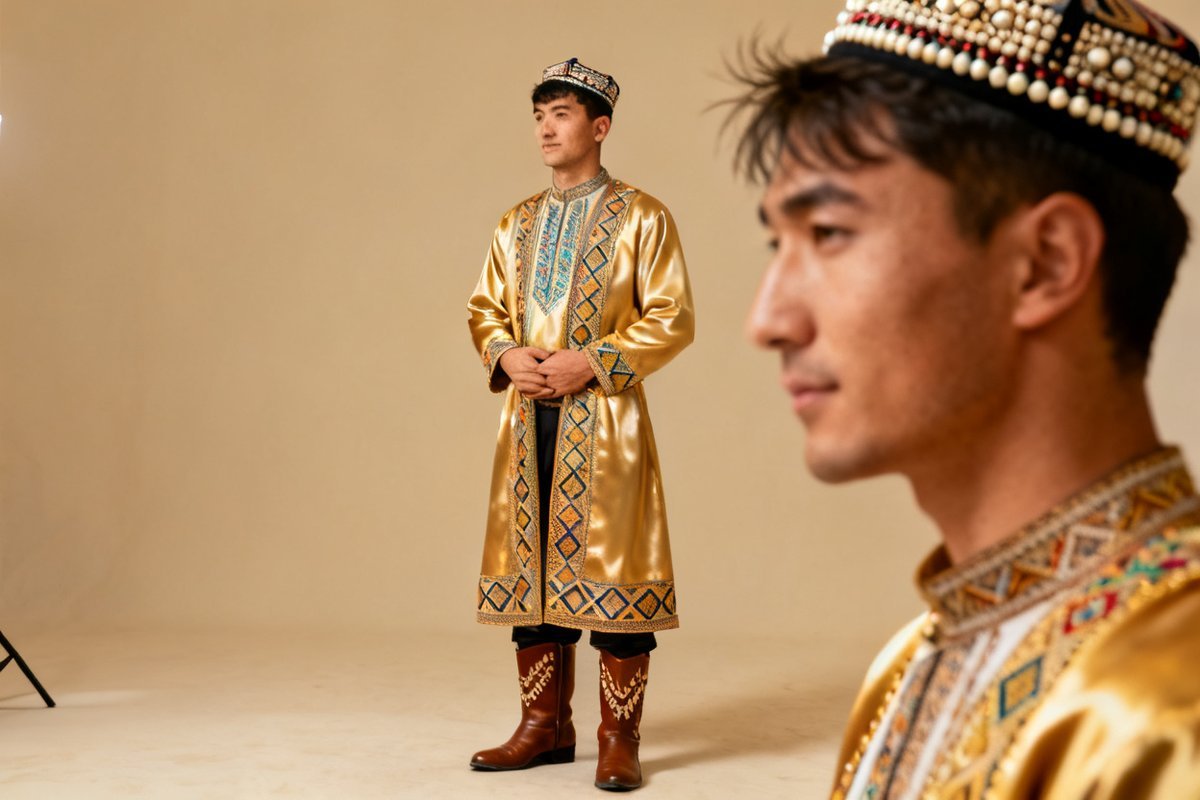
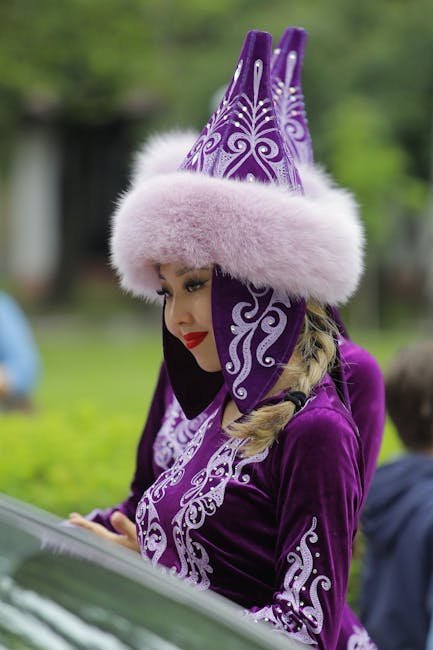
Women wear a long dress with a fitted bodice and full skirt with several layers of ruffles at the hem, in bright silk or cotton, covered by a short fitted velvet vest with dense floral embroidery. Men wear a white shirt under a dark jacket or long striped robe, with trousers and boots. The women's dress reflects the influence of settled urban life — the multiple ruffled tiers at the hem are a feature associated with leisure and refinement, as they are impractical for nomadic pastoralist activities and signal that the wearer belongs to a household of sufficient means to afford labor-intensive garment construction.
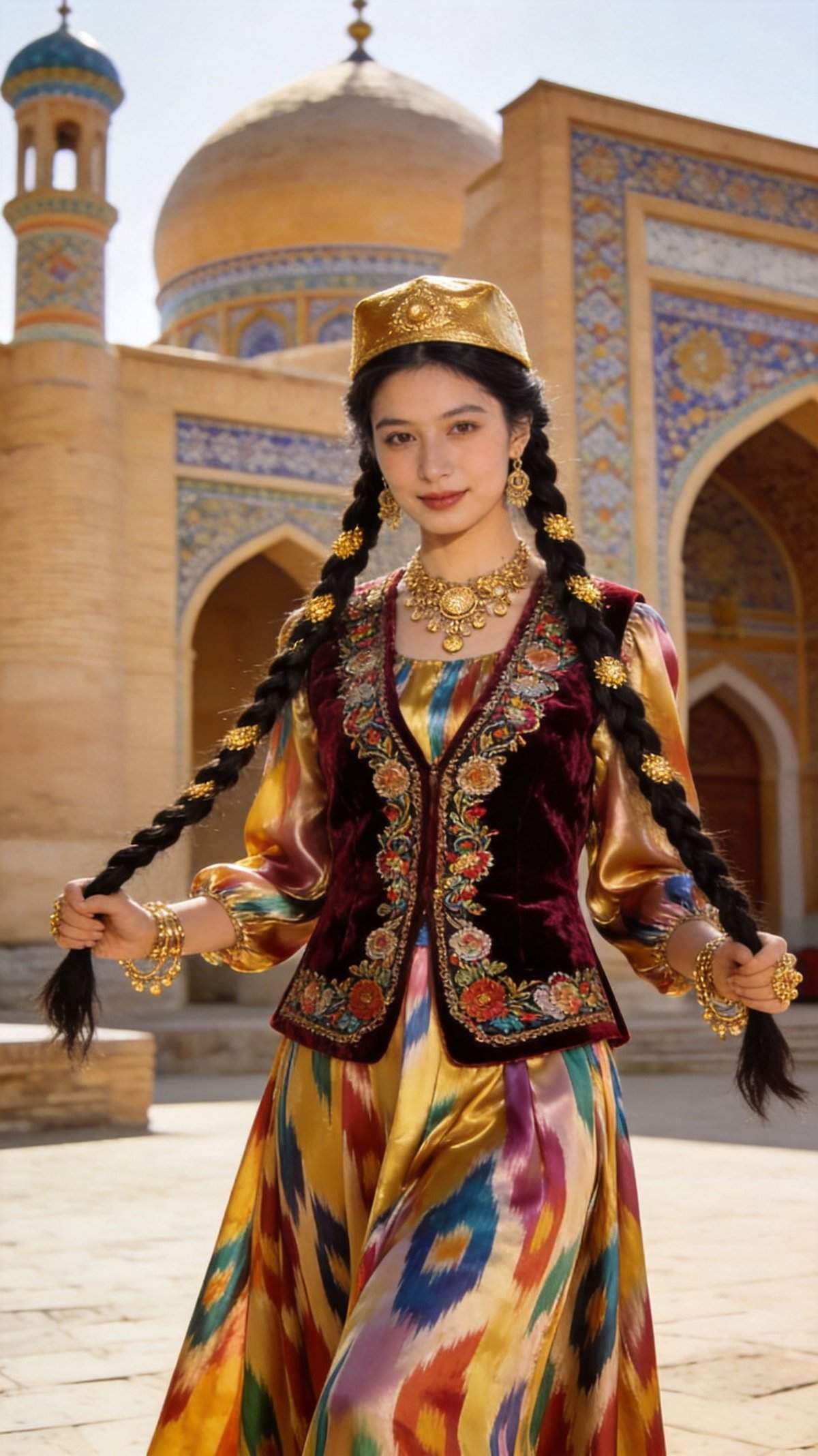
The velvet vest worn over the dress is a central element of Uzbek women's attire, and its quality is a marker of family status and the wearer's taste. The finest vests are made from silk velvet in deep jewel tones — ruby red, emerald green, sapphire blue — with the entire front surface covered in densely embroidered floral patterns. The embroidery is executed in silk thread using a combination of satin stitch, chain stitch, and couching techniques to create richly textured surfaces that shimmer with reflected light. Men's striped robes (known as chapan or khalat) are made from handwoven cotton or silk ikat fabric, with alternating bands of color creating a dynamic visual effect.
Headwear and Adornments
Women wear doppa skullcaps or brightly colored headscarves. The Uzbek doppa is typically square or slightly round with vibrant floral embroidery on a black or white background. Some women wear the doppa pinned to their hair as decoration. The Uzbek doppa differs subtly from Uyghur styles in its embroidery patterns — Uzbek designs tend toward larger, more naturalistic floral motifs, while Uyghur doppas often feature more densely packed geometric floral patterns.
Uzbek women's jewelry traditions favor gold over silver, a preference distinct from many other Central Asian groups where silver predominates. Gold earrings, necklaces, and brooches set with semi-precious stones such as carnelian and turquoise are worn for festive occasions. The amount of gold jewelry a woman wears signals her family's prosperity, and jewelry forms an important part of a bride's dowry. Men's adornment is more restrained, though finely crafted belt buckles and knife sheaths in silver or brass demonstrate male artisanship.
Embroidery and Decorative Arts
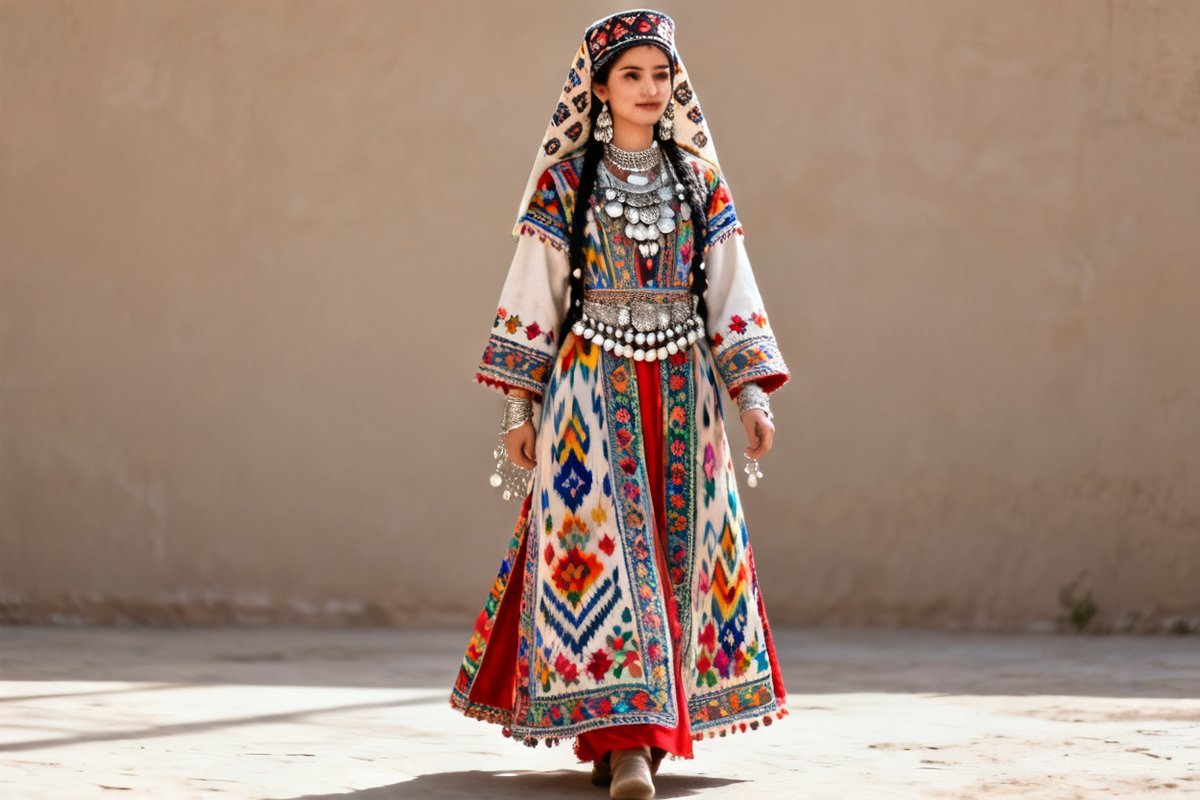
Uzbek embroidery features bold floral patterns, pomegranate and almond motifs, and geometric borders in silk thread on velvet or cotton. Satin stitch and chain stitch create raised surfaces on vests, doppas, and dress edges. The pomegranate motif, with its complex internal structure of seeds visible when the fruit is opened, symbolizes fertility, abundance, and the unity of diversity — a metaphor for the extended family and clan that is central to Uzbek social organization. The almond motif represents the awakening of life in spring and is associated with Nowruz, the Persian New Year celebrated by Uzbeks.
The embroidery tradition of the Uzbek people is part of a broader Central Asian textile complex that extends from Bukhara to Kashgar. Uzbek embroiderers are particularly known for suzani work — large embroidered wall hangings and textiles that traditionally formed part of a bride's dowry and were displayed in the home. While full-sized suzani are more commonly produced in Uzbekistan, Chinese Uzbek women maintain the embroidery techniques and adapt the patterns to clothing decoration. The transmission of embroidery skills through the female line — from grandmother to mother to daughter — ensures continuity of pattern repertoires and technical knowledge.
The Central Asian pomegranate motif, so prominent in Uzbek embroidery, traveled along the Silk Road from Persia to Xinjiang - each stitched pomegranate on a vest is a node in that ancient textile network.
Color Symbolism
Bright red, purple, green, blue, and yellow for dresses create a vivid palette that stands out against the arid landscapes of Xinjiang. Red represents life, celebration, and marital happiness. Purple, historically associated with royalty in Central Asian courts, conveys dignity and refinement. Green holds Islamic significance as the color of paradise, while blue protects against the evil eye according to traditional belief. Black or dark green velvet for vests provides a sumptuous dark background that intensifies the visual impact of the embroidery. Embroidery in bright multicolors with gold and silver thread for special occasions creates a visual language of abundance and blessing.
Festival Attire
During Nowruz and Eid, women wear their finest silk dresses with fullest ruffled skirts and most elaborately embroidered vests, men in new robes and doppas. Nowruz, celebrated on the spring equinox, is the most important secular festival for Uzbeks, marking the beginning of the new year according to the Persian solar calendar. The festival involves house cleaning, preparation of sumalak (a sweet wheat-germ paste cooked communally over 24 hours), and the wearing of new clothing to welcome renewal and good fortune.
Uzbek wedding celebrations are elaborate multi-day events during which traditional clothing plays a central ceremonial role. The bride typically wears several different ensembles over the course of the celebration, beginning with a white dress for the religious ceremony, transitioning to brightly colored silk dresses with embroidered vests for the feast, and concluding with gold-embroidered formal wear for receiving guests. The doppa features prominently, with both bride and groom wearing specially commissioned caps that coordinate with their wedding attire. These wedding garments are often preserved as family heirlooms, to be worn again by daughters and granddaughters on their own wedding days.
Modern Influence and Preservation
Uzbek textile traditions contribute to Xinjiangs diverse cultural landscape, with their distinctive doppa styles and embroidery techniques preserved in community workshops. The Uzbek Cultural Association in Xinjiang organizes embroidery workshops and cultural events where traditional clothing is worn and celebrated. Cross-border cultural exchanges with Uzbekistan have strengthened preservation efforts, with artisans and scholars traveling between the two countries to share techniques and document traditional patterns.
The global revival of interest in Central Asian textile traditions has created new appreciation for Uzbek embroidery and ikat weaving. International fashion designers have drawn inspiration from suzani patterns and Central Asian silhouettes, while museum exhibitions have introduced global audiences to the sophistication of Uzbek textile arts. For the small Chinese Uzbek community, maintaining their clothing traditions serves as both cultural preservation and community identity affirmation — wearing the doppa and embroidered vest declares membership in a cultural tradition that spans national borders and centuries of Silk Road history.
Did You Know?
The Uzbek in China, though small in number, maintain strong cultural ties to Uzbekistan - their traditional clothing is nearly identical to that worn in the Uzbek capital of Tashkent.
Did You Know?
The Uzbek in China, though small in number, maintain strong cultural ties to Uzbekistan - their traditional clothing is nearly identical to that worn in the Uzbek capital of Tashkent.
Ikat Weaving of the Uzbek Minority
The Uzbek people of Xinjiang maintain textile traditions rooted in the agricultural and urban heritage of Central Asia. Uzbek women's ikat weaving produces fabric with characteristic blurred patterns created by resist-dyeing the warp threads before weaving. The ikat technique requires precise planning and coordination, as the dyer must calculate how the dyed threads will align during weaving to form the intended pattern. The resulting fabric features bold, abstract designs in rich colors including deep red, royal blue, emerald green, and golden yellow. Uzbek ikat is recognized as among the finest in Central Asia.
Uzbek women's traditional attire includes a long cotton or silk dress with a fitted bodice and full skirt, worn over embroidered trousers that are visible at the hem. The dress is typically made from locally woven ikat or patterned fabric, with a solid-color velvet or brocade waistcoat worn over it for formal occasions. Headwear is an important element, consisting of a small embroidered skullcap called a doppi worn under a scarf. The doppi is densely embroidered in white cotton thread on a black ground, with the pattern indicating the wearer's home region.