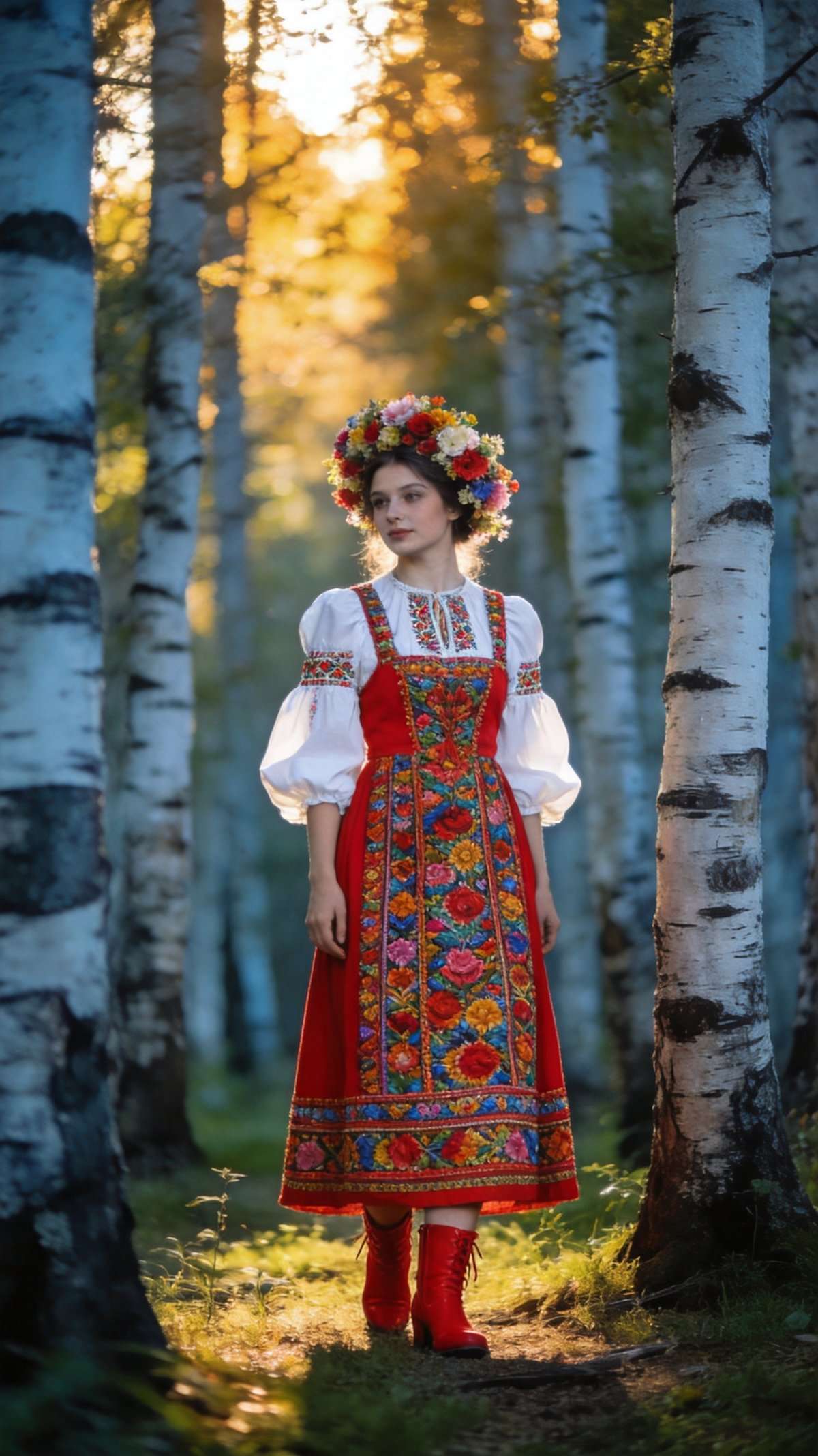
Russian traditional clothing in China retains classic Eastern Slavic elements including embroidered blouses (rubashka), sarafans, and kokoshnik headdresses, adapted with Chinese textile influences and Central Asian decorative touches. The Russian ethnic group in China numbers approximately 15,000 people, living primarily in the Ili Kazakh Autonomous Prefecture, Tacheng, and Altay regions of Xinjiang, as well as small communities in Inner Mongolia and Heilongjiang. They are descendants of Russians who migrated to China during the eighteenth and nineteenth centuries, and their clothing preserves styles that in some cases are now considered antique even in modern Russia.
Key Features of Russian Attire
- Womens sarafan - a long sleeveless dress worn over a white blouse
- Embroidered mens rubashka (tunic-style shirt) with standing collar
- Kokoshnik headdress - crescent-shaped crown worn for festivals
- Warm wool shawls with floral patterns (Pavlovo Posad style)
- Lapti-style embroidered footwear for traditional occasions
Traditional Garments
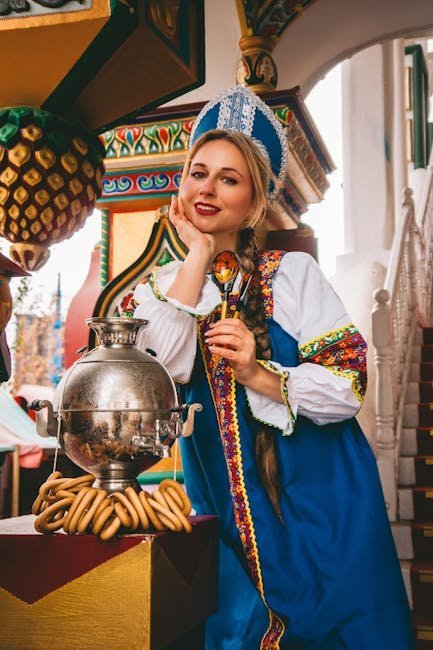
Women wear a white embroidered blouse (rubashka) with a kosovorotka-style collar — a standing collar that fastens at the side rather than the center front, a distinctively Russian design element. Over the blouse, they wear a long sarafan dress in red, blue, or green, a sleeveless garment that hangs from the shoulders with decorative buttons down the front. The sarafan is typically made from cotton or linen for summer and wool for winter, and its length reaches the ankle. A wool shawl with floral patterns, often in the Pavlovo Posad style featuring densely printed roses and foliage on a dark background, is draped over the shoulders, and an embroidered apron may be worn over the sarafan for daily work.
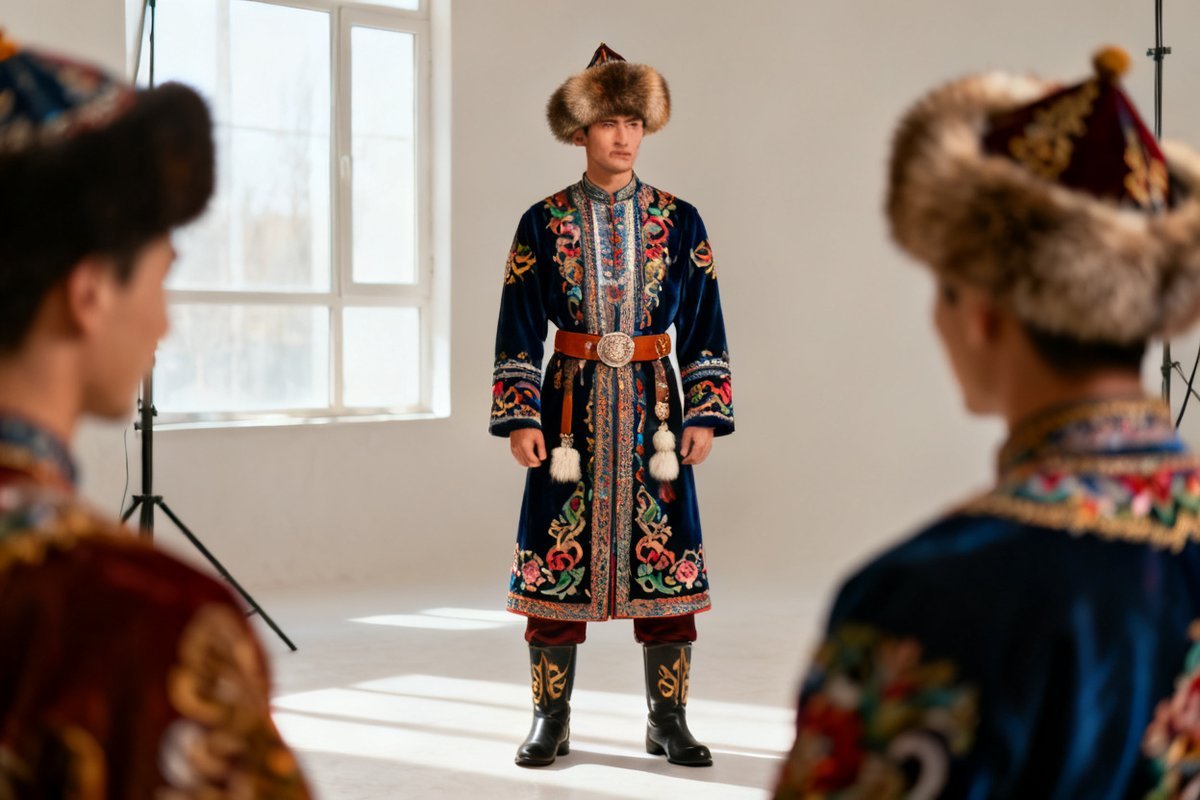
Men wear a rubashka tunic in white or blue with an embroidered collar and hem, worn over loose trousers tucked into knee-high leather boots. The rubashka is cut generously and gathered at the collar with a drawstring or elastic, creating a bloused effect over the waist. The standing collar and the front placket are the primary areas for embroidery, with red and black cross-stitch being the most traditional. A woven or leather belt is worn at the waist, and the shirt is typically worn untucked, falling to mid-thigh. For winter, both men and women add heavy wool coats and fur hats, with men's fur hats often being tall and cylindrical (shapka style) and women favoring fur-trimmed wool hats or tightly wrapped wool shawls.
Headwear and Adornments
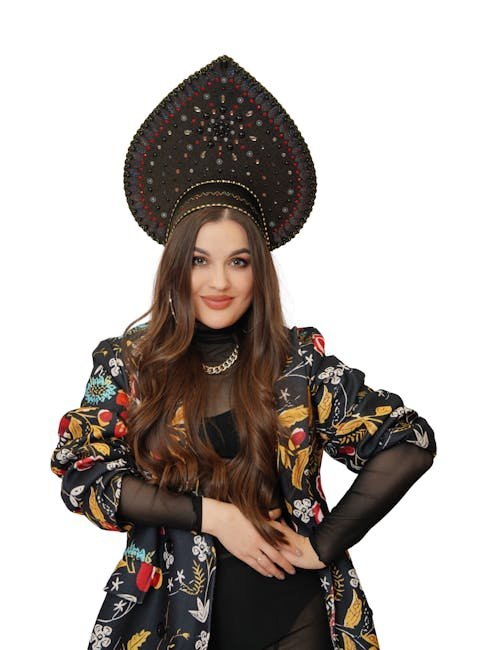
The kokoshnik headdress for festival wear is a crescent-shaped crown decorated with pearls, beads, gold thread, and floral embroidery. The kokoshnik is constructed around a stiff frame, traditionally made from thick paper or cardboard covered with fabric, which rises in a fan or crescent shape above the forehead. The surface is densely decorated with gold embroidery, seed pearls, glass beads, and sometimes small mirrors that catch and reflect light. In the Russian communities of Xinjiang, the kokoshnik styles tend to be somewhat simpler than the elaborate court versions seen in European Russia, reflecting the peasant origins of the original migrants.
For daily wear, married women cover their hair with a patterned scarf tied under the chin — in Orthodox tradition, a married woman's hair should not be visible in public, and the headscarf is both a religious observance and a practical garment. Young unmarried women may wear their hair uncovered or with a lighter headband, and the transition to the married woman's headscarf is an important part of the wedding ceremony. Men wear cloth caps in summer and fur hats in winter. Jewelry includes silver earrings, beaded necklaces, and silver crosses worn under the clothing as personal religious items. Coral and glass bead necklaces in multiple strands are favored for festivals, with the beads obtained through trade networks that historically connected Xinjiang to both Russia and Central Asia.
Embroidery and Decorative Arts
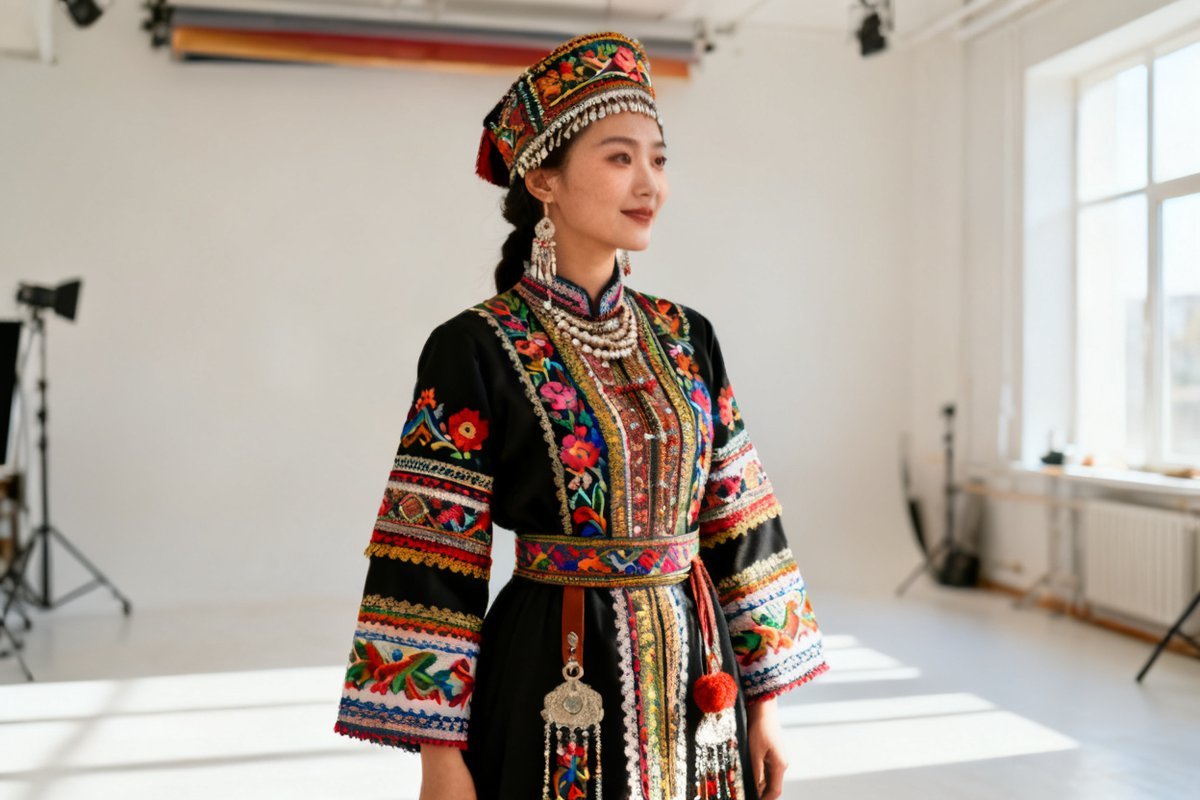
Russian embroidery features floral motifs, geometric patterns, and cross-stitch in red, black, and gold on white linen. The color combination of red and black cross-stitch on natural white fabric is the most traditional and recognizable Russian embroidery style, found on blouse collars, cuffs, and hem bands. Traditional stitches include cross-stitch, satin stitch for filling larger areas, and drawn-thread work where individual warp or weft threads are removed from the fabric and the remaining threads are bound into decorative openwork patterns. Floral motifs draw from both Eastern Slavic folklore and the natural vegetation of Xinjiang, with roses, sunflowers, and scrolling vine patterns being particularly common.
Embroidery is concentrated on blouse collars and cuffs, the front placket of the rubashka, the straps and hem of the sarafan, and the edges of aprons and shawls. Gold thread embroidery appears on festival garments, particularly on the kokoshnik and on the decorative aprons worn for Easter and Christmas celebrations. In the Chinese Russian community, some Central Asian influences have entered the embroidery vocabulary — geometric border patterns reminiscent of Uzbek and Kazakh designs appear alongside traditional Russian floral motifs, reflecting the multi-ethnic environment of Xinjiang. Women begin learning embroidery as children, and a young woman's hope chest of embroidered linens and garments was traditionally the measure of her preparedness for marriage and household management.
The Russian sarafan worn in Xinjiang represents what textile historians call a diaspora garment - preserving 19th-century Russian village styles that have since evolved differently in Russia itself.
Color Symbolism
Red is the most significant color in Russian traditional dress, symbolizing beauty, vitality, and the life force. The word for red in Russian, krasny, originally also meant "beautiful," and this linguistic connection underscores the color's cultural importance. White is essential for blouses and undergarments, representing purity and spiritual cleanliness. Blue and green are favored colors for sarafans, with blue associated with the Virgin Mary in Orthodox tradition and green with the fertility of the earth. Gold and silver thread appear in festive embroidery, signaling celebration and divine light. The traditional black and red cross-stitch combination on white fabric creates a dramatic contrast that remains visually striking across distances, important for clothing meant to be seen in church congregations and community gatherings. Floral shawls introduce a wider palette — deep burgundy, navy, forest green, and cream backgrounds with multicolored floral prints.
Festival Attire
During Easter (Pascha) and Russian Orthodox Christmas, celebrated on January 7 according to the Julian calendar, women wear their finest kokoshnik headdresses, red sarafans with gold embroidery, and multiple strands of coral or glass bead necklaces. Easter is the most important religious celebration in the Orthodox calendar, and the clothing worn to the midnight Easter service represents the community's finest textile artistry. The red sarafan is specifically associated with Easter, its color echoing the red eggs that are exchanged as symbols of Christ's resurrection. Women may spend the entire Lenten period preparing and repairing festival clothing, so that everything worn at Easter is in perfect condition.
Weddings in the Russian community of China are multi-day celebrations that require several changes of clothing. The bride's wedding ensemble typically includes a white embroidered blouse, a red or blue sarafan with gold embroidery, and a wedding kokoshnik that may incorporate additional elements like a veil of fine netting or lace. After the religious ceremony, the bride may change into a second sarafan in a different color for the wedding feast. The groom wears a new white rubashka with red embroidery, dark trousers, and polished boots. Funeral attire, by contrast, is simple white or undyed fabric without decoration, in accordance with Orthodox tradition that the deceased should be presented to God in the purest possible state. The body is dressed in white clothing, and a white cloth is placed over the face until the moment of burial.
Modern Influence and Preservation
Russian-Chinese cultural centers in Xinjiang, particularly in Yining (Ghulja) and Tacheng, preserve traditional garment-making skills through workshops and cultural programs. The small size of the Russian community in China means that maintaining distinct clothing traditions requires deliberate effort, and community organizations have prioritized the transmission of embroidery techniques and sarafan construction. The Russian sarafan and kokoshnik continue to be worn for community festivals and Orthodox celebrations, and Russian folk performance groups in Xinjiang regularly showcase traditional clothing in their programs. Cross-cultural exchanges between the Chinese Russian community and Russia have increased in recent decades, allowing for the sharing of preservation techniques and the import of authentic materials like Russian linen and specialty embroidery threads. While daily wear of traditional Russian clothing has largely been replaced by modern dress, the festival garments remain a cherished symbol of cultural identity, and young people in the community increasingly participate in traditional dance and music performances that keep the clothing traditions alive and visible.
Did You Know?
The Russian community in China, though small, has preserved 19th-century Russian peasant clothing styles that are now considered antique and rare even in modern Russia.