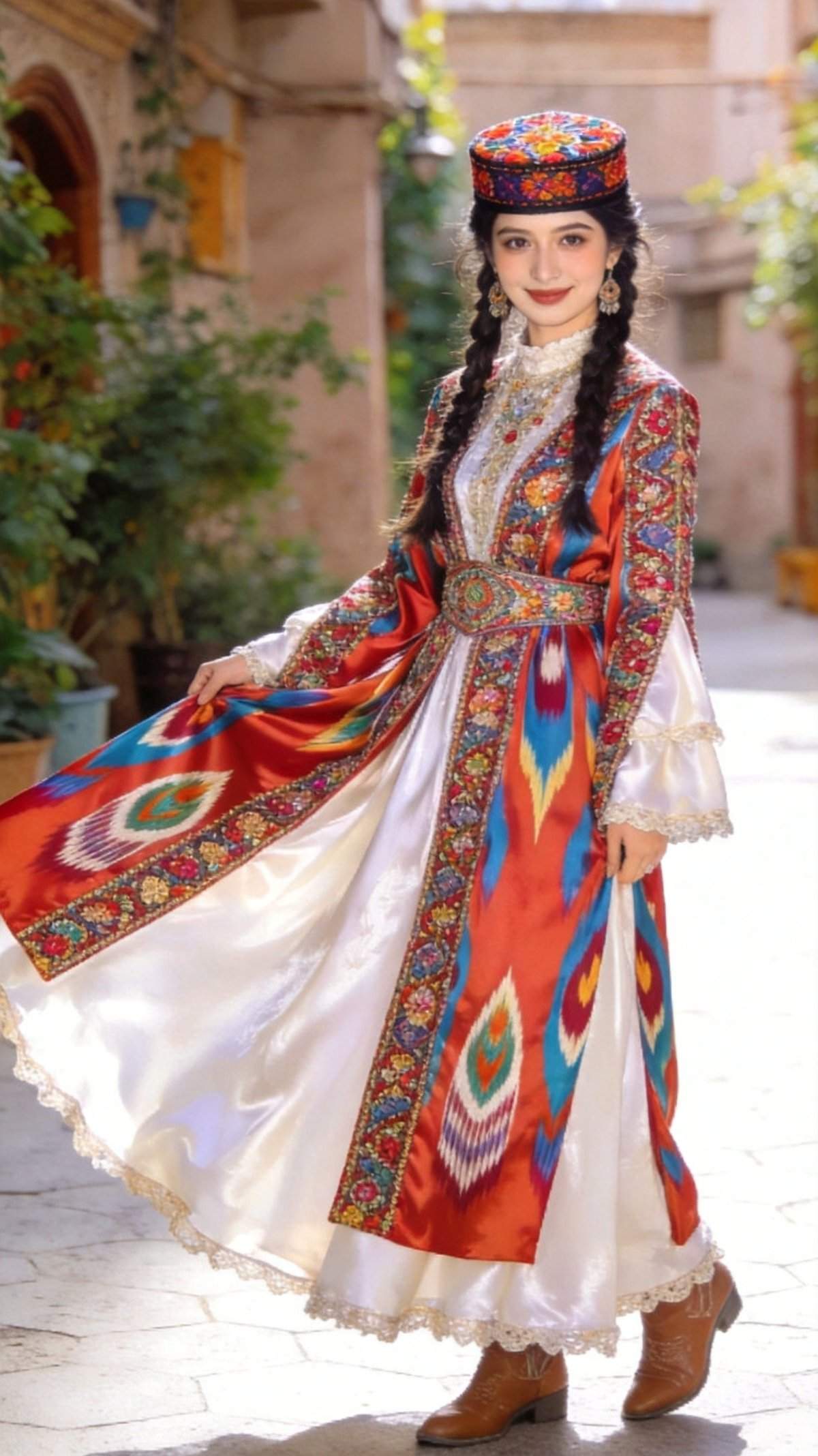
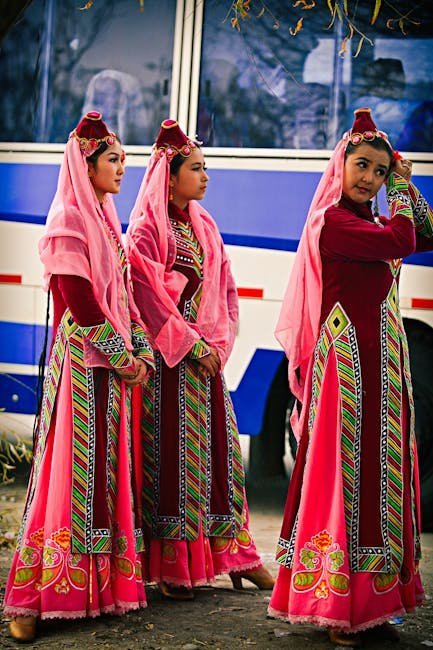
Uyghur traditional clothing reflects their Central Asian Silk Road heritage with vibrant colors, richly embroidered caps, and flowing fabrics. The doppa skullcap and women's colorful dress with vest are iconic symbols of Uyghur culture. The Uyghur people number approximately 11 million, making them one of China's largest ethnic minorities, with the vast majority residing in the Xinjiang Uyghur Autonomous Region — a territory of over 1.6 million square kilometers at the historic crossroads of Central Asia.
The Uyghur trace their ancestry to the ancient Uyghur Khaganate, a powerful Turkic empire that dominated the Mongolian steppe and Tarim Basin from the 8th to 9th centuries. After the fall of the Khaganate, Uyghur migrants settled in the oasis cities of the Tarim Basin — Kashgar, Hotan, Turpan, and Kuqa — where they transitioned from a nomadic pastoralist lifestyle to settled agriculture and urban commerce. This history of dual nomadic and sedentary traditions is reflected in their clothing, which combines the practicality of steppe garments with the refinement of Silk Road urban centers.
Xinjiang's position at the intersection of Chinese, Persian, Indian, and Central Asian civilizations made it one of the most culturally diverse regions on the Silk Road. Uyghur clothing absorbed influences from all directions: silk cultivation and weaving techniques from China, embroidery motifs from Persia, tailoring methods from Central Asia, and dyeing traditions from India. The result is a clothing tradition of extraordinary richness and regional variation, with each oasis city developing distinctive styles of doppa, dress, and embroidery that served as visual markers of local identity.
Key Features of Uyghur Attire
- Embroidered square or round skullcap (doppa) in various regional styles
- Women's long brightly colored dresses with fitted bodice and flared skirt
- Fitted embroidered velvet vests worn over dresses
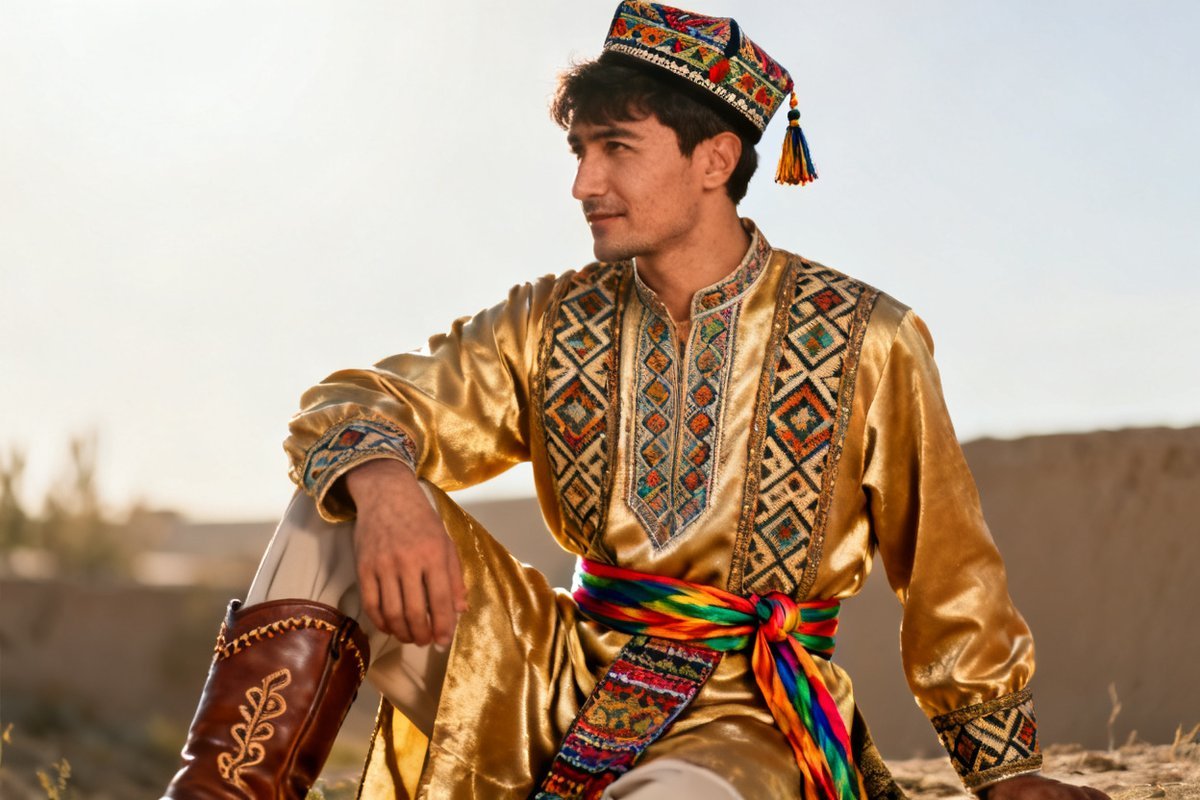
- Men's long robes (chapan) with striped fabric and cloth belt
- Thick braided women's hair with decorative hair accessories
Traditional Garments
Women wear a long dress in bright red, purple, blue, or green with a fitted bodice and flared skirt, often with embroidered collar and hem, covered by a short fitted vest richly embroidered in floral patterns. Men wear a white shirt under a short jacket or a long striped robe (chapan) with a cloth belt. Both genders wear the distinctive doppa skullcap. The women's dress is typically constructed from locally produced silk — Xinjiang has been a center of sericulture since the Silk Road era — or fine cotton, with the skirt designed to flare gracefully when the wearer walks or dances.
The velvet vest is a masterpiece of textile decoration, typically in black, dark green, or burgundy, with the front panels, hem, and armholes densely embroidered in silk thread. The embroidery patterns feature scrolling floral vines, pomegranates, and geometric medallions. Men's chapans are constructed from striped silk or cotton fabric (known as atlas or adras) produced on traditional looms in the oasis cities. The chapan reaches below the knee and is fastened with a long cloth sash rather than buttons, a design that allows ventilation in Xinjiang's hot summers while providing warmth in the cold desert winters.
Headwear and Adornments
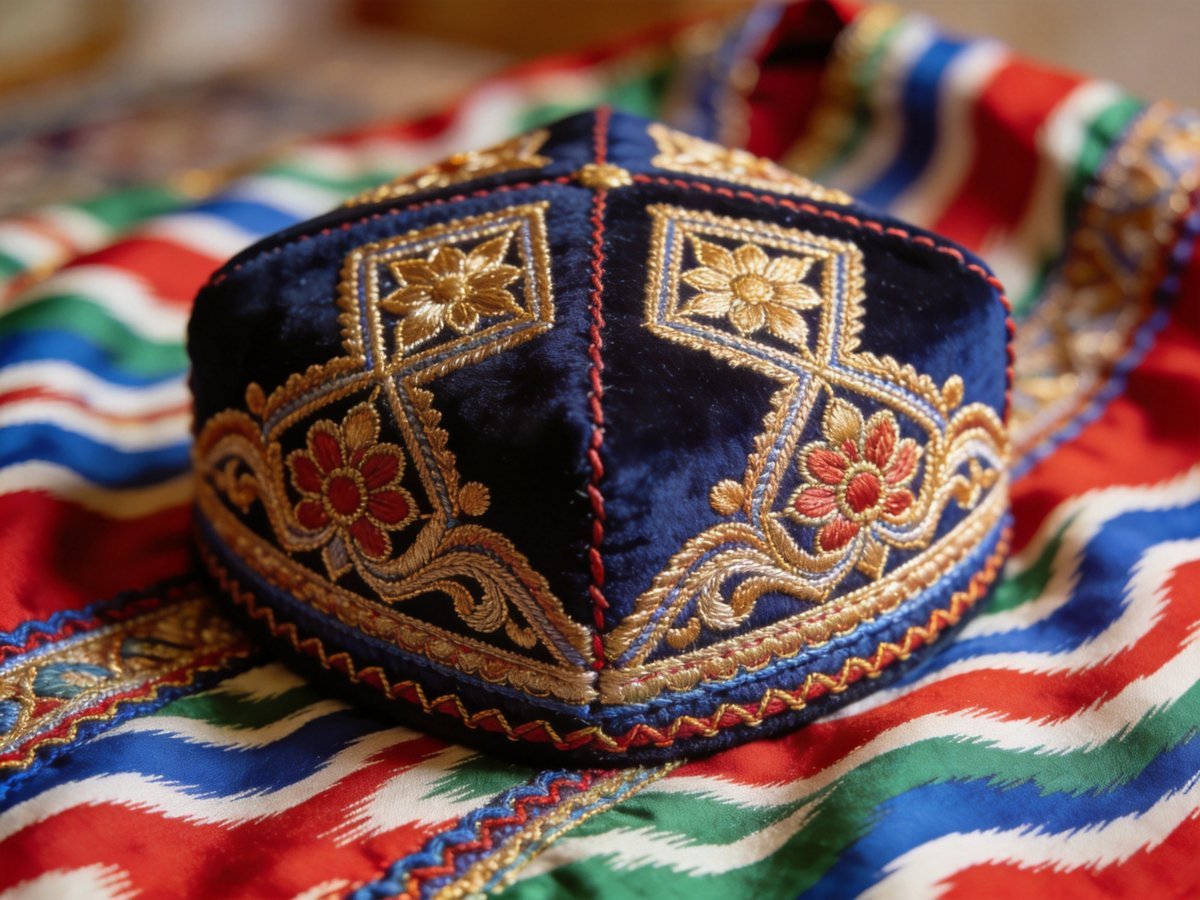
The doppa is the most iconic Uyghur garment - a square or round embroidered skullcap in various regional styles. The Hotan doppa features four pointed sections; the Kashgar doppa is round with floral patterns; the Turpan doppa is smaller and geometric. Women often wear several small doppas pinned together as a hair ornament. The doppa functions as a textile identity card — a knowledgeable observer can identify the wearer's home oasis city by the shape, color, and embroidery patterns of their cap, even from across a crowded bazaar.
The making of a doppa involves multiple specialized crafts: felt-making or weaving for the cap base, silk embroidery for the surface decoration, and finishing techniques that give the cap its distinctive shape. Master doppa makers in Kashgar and Hotan are respected artisans whose work commands premium prices. Women's hair is traditionally worn in multiple thick braids, with the number of braids indicating marital status — unmarried women wear many small braids, while married women typically wear two thicker braids. Decorative hair ornaments including silver pins, tassels, and small doppas are woven into the braids.
Embroidery and Decorative Arts
Uyghur embroidery is richly floral and geometric on doppas, dress collars, vests, and chapan edges. Satin stitch in silk or cotton thread creates dense patterns on velvet or cotton, with regional motifs varying from peonies to geometric stars. The embroidery vocabulary draws from multiple cultural sources: Persian floral arabesques, Chinese cloud and dragon motifs, Central Asian geometric medallions, and Islamic calligraphic abstractions. Pomegranates — a fruit cultivated in Xinjiang for millennia — appear frequently as symbols of fertility and abundance.
Beyond embroidery, Uyghur decorative arts include the production of atlas silk (ikat-dyed with distinctive blurred patterns), carpet weaving, felt-making for yurt coverings and saddle blankets, and metalwork for jewelry and utensils. The oasis city of Hotan has been famous for its carpets since the Silk Road era, while Kashgar is renowned for its doppa embroidery. Uyghur women traditionally begin learning embroidery in childhood, and a woman's needlework skill was once considered a reflection of her character and diligence.
The Uyghur doppa, with dozens of regional styles distinguished by shape, color, and stitch pattern, serves as a textile identity card - a Kashgar man can identify anothers home village from across a bazaar by the embroidery on his cap.
Color Symbolism
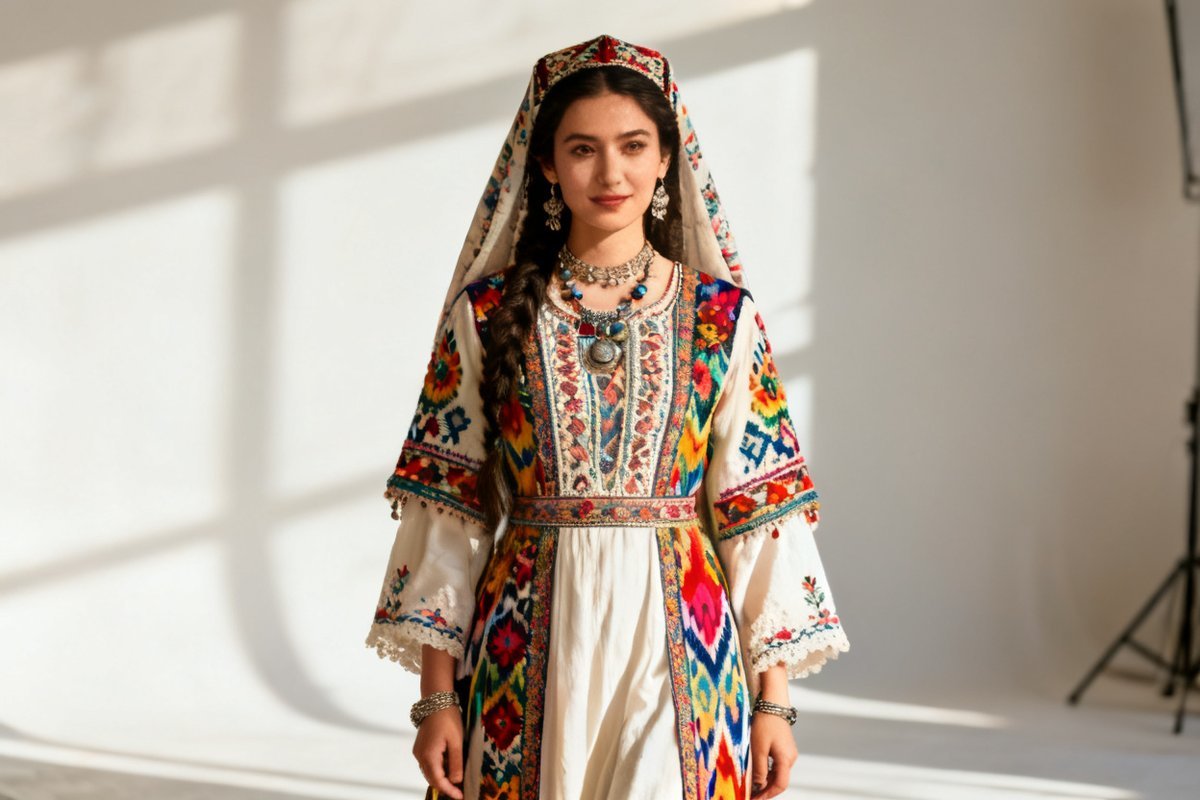
Vibrant red, purple, blue, green, and yellow for dresses and robes express the Uyghur appreciation for saturated color. Red symbolizes life, passion, and celebration — brides traditionally wear red dresses. Blue, particularly the deep lapis lazuli shade, represents the sky and spiritual protection, and is especially favored in Kashgar. Green carries Islamic significance as the color of paradise and renewal. White symbolizes purity and is worn by men during religious observances. Gold and silver embroidery thread for formal wear represents divine light and worldly prosperity. These colors, worn against the ochre and beige backdrop of the Taklamakan Desert, create a deliberate and dramatic visual contrast.
Festival Attire
During Corban (Eid al-Adha) and Rozah (Eid al-Fitr), Uyghurs wear their finest doppas, women in brilliantly colored new dresses with gold-embroidered vests, men in new striped chapans. Corban, commemorating Abraham's willingness to sacrifice his son, is the most important Islamic festival in the Uyghur calendar. After morning prayers at the mosque, families gather for feasting and visiting, with everyone dressed in their best clothing — often garments newly made or purchased specifically for the occasion.
The Uyghur Meshrep is a traditional community gathering that combines music, dance, poetry recitation, and socializing. During Meshrep, participants wear their finest traditional dress, with the doppa serving as a visible marker of participation in Uyghur cultural life. Weddings are multi-day celebrations involving multiple costume changes — the bride may wear a red dress for the ceremony, a blue dress for the feast, and gold-embroidered ensembles for receiving guests. The traditional Uyghur dance, the sanam, features rapid spins that cause the full skirts of women's dresses to flare dramatically, a visual effect that is central to the dance's aesthetic impact.
Modern Influence and Preservation
The Uyghur doppa is widely recognized as a symbol of Xinjiang. Uyghur textiles and embroidery influence regional fashion and are produced for the tourist market throughout Xinjiang. Traditional crafts including doppa-making, atlas silk weaving, and carpet production continue in the oasis cities, supported by both domestic and international demand. Cultural museums in Urumqi, Kashgar, and Turpan document and display traditional Uyghur clothing, while academic researchers study the regional variations of embroidery motifs and textile techniques.
Uyghur fashion designers are creating contemporary garments that incorporate traditional elements — doppa-inspired hats, atlas silk dresses with modern cuts, and embroidered vests in updated styles — bridging the gap between cultural heritage and contemporary fashion. The challenge facing Uyghur textile traditions is similar to that of many ethnic crafts worldwide: maintaining the quality and cultural meaning of handmade textiles while adapting to the economics of modern production. Artisan cooperatives and cultural heritage programs work to ensure that master craftspeople can earn sustainable livelihoods while training the next generation.
Did You Know?
The Uyghur doppa comes in over 20 distinct regional styles - the most famous is the Yengisha (new city) style from Kashgar, characterized by four raised points on the crown resembling an Islamic dome.
Did You Know?
The Uyghur doppa comes in over 20 distinct regional styles - the most famous is the Yengisha (new city) style from Kashgar, characterized by four raised points on the crown resembling an Islamic dome.
Silk Road Heritage and Uyghur Textile Arts
The Uyghur people of Xinjiang have inherited a textile tradition shaped by their position along the ancient Silk Road, where techniques and materials from Persia, Central Asia, and China converged and blended. Uyghur silk weaving, particularly the production of Atlas silk with its distinctive blurred patterns, represents the pinnacle of local textile art. Atlas silk is characterized by irregular, flowing patterns in bright colors that resist sharp outlines, created through a tie-dye technique applied to the thread before weaving. The resulting fabric has a soft, dreamlike quality that is unlike any other silk produced in China.
Uyghur women's traditional dress centers on a long dress worn over trousers, with the dress featuring a fitted bodice, long sleeves, and a full skirt. The dress is typically made from Atlas silk or other patterned fabric, with the pattern density varying by age and occasion. Younger women wear brighter colors with more dramatic patterns, while older women choose more subdued versions. A velvet or embroidered waistcoat is worn over the dress in cooler weather, adding warmth and another layer of decoration.