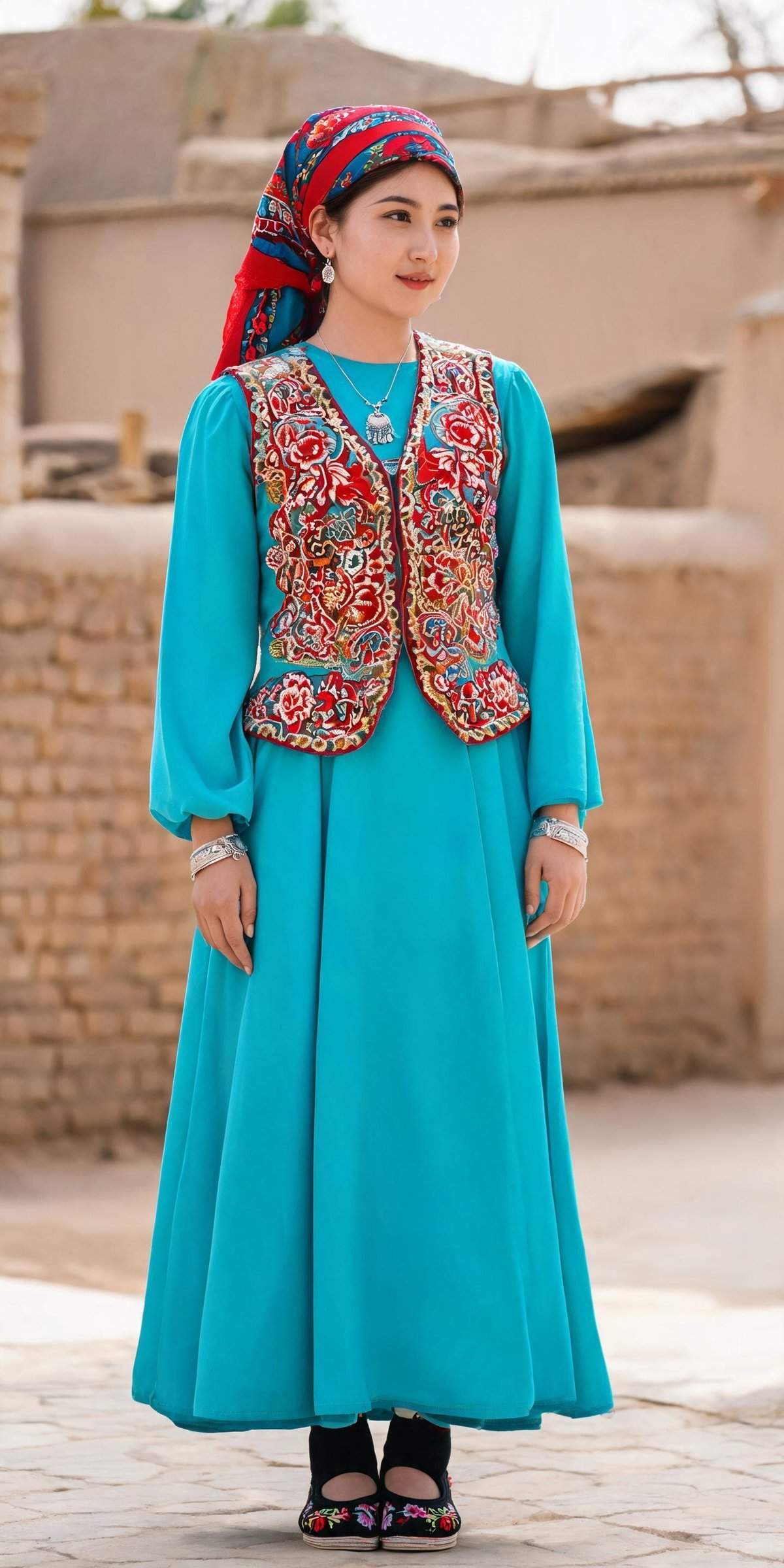
Salar traditional clothing combines Islamic dress codes with Turkic Central Asian heritage. Men wear white or black skullcaps, while women wear colorful headscarves and long embroidered jackets. The Salar people, numbering approximately 130,000, live primarily in Xunhua Salar Autonomous County in Qinghai Province, with smaller communities in Gansu and Xinjiang. They trace their ancestry to Samarkand in modern Uzbekistan, from which their forebears migrated during the Yuan dynasty in the thirteenth century, bringing with them Turkic language traditions, Islamic faith, and Central Asian textile arts that continue to shape Salar clothing today.
Key Features of Salar Attire
- Mens white or black embroidered skullcaps
- Womens long headscarves in green, black, and white by age
- Long front-fastening robes with embroidered chest panels
- Delicate floral embroidery on collar edges, cuffs, and skirt hems
- Silver or jade hairpins and earrings with filigree work
Traditional Garments
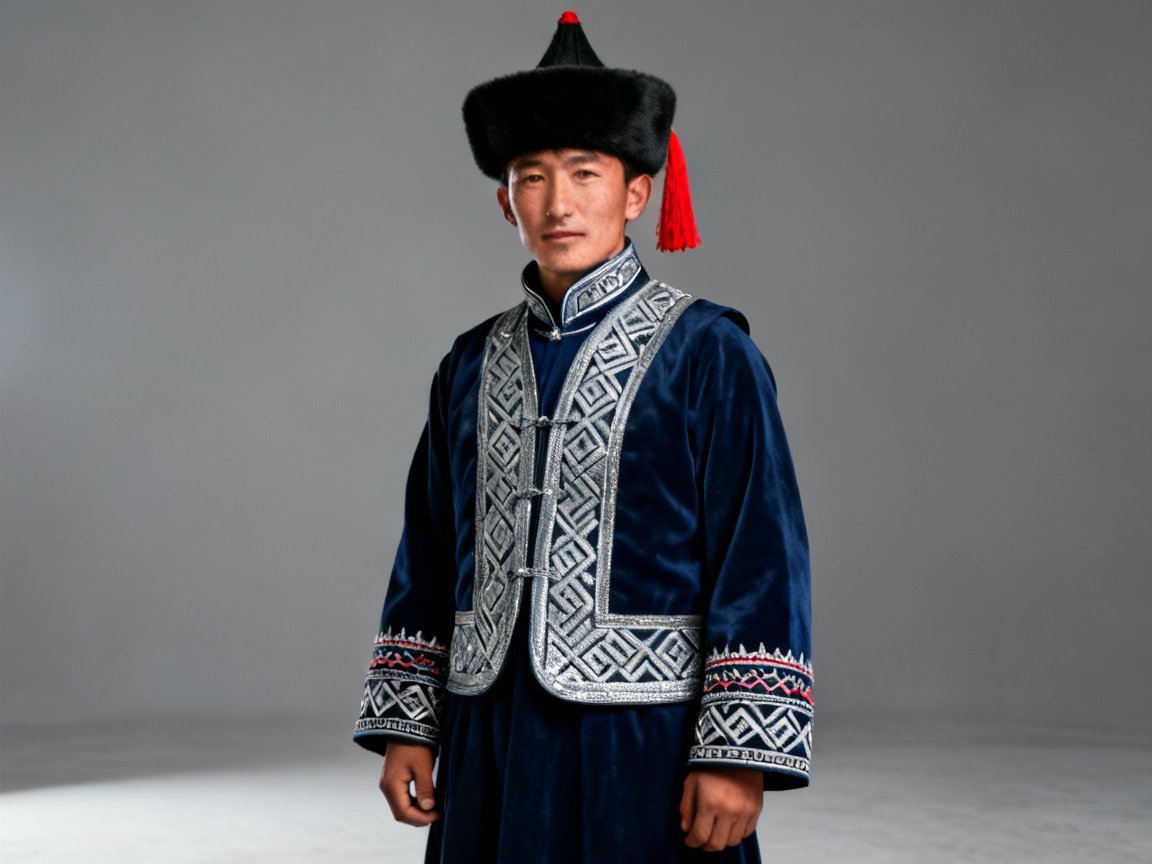
Men wear a white shirt under a short dark jacket or long robe, loose trousers, and leather shoes, with an embroidered skullcap. The robe, when worn, extends to mid-calf and fastens at the front with cloth buttons or loops. For daily wear, the short jacket style is more common, as it permits easier movement for agricultural work in the terraced fields of Xunhua. The jacket is cut simply, with a standing collar and straight sleeves, favoring dark blue, black, or charcoal gray. The white shirt underneath provides contrast and is visible at the collar and cuffs.
Women wear long high-collared jackets or gowns over wide trousers, always with a headscarf covering the hair and neck in accordance with Islamic practice. The jacket extends to mid-thigh or knee length and is cut to create a modest, straight silhouette. Decorative embroidery appears on the collar, the front chest panel, the cuffs, and the hem, with floral designs being the most common motif. The wide trousers worn underneath are gathered at the ankle with embroidered bands, and cloth shoes with simple embroidery complete the ensemble. In winter, a padded or fur-lined overcoat is added, and the headscarf may be supplemented with a heavier wool shawl wrapped over the shoulders. The layered nature of Salar women's dress — headscarf, high-collared jacket, wide trousers, and the modest overall silhouette — reflects the integration of Islamic modesty requirements with Central Asian and Chinese garment forms.
Headwear and Adornments
Women's headscarves follow Islamic practice and are color-coded by age and marital status: green for young or unmarried women, black for middle-aged married women, and white for elderly women. This color system is widely recognized within Salar communities and provides an immediate visual cue about a woman's social position. Green is associated with youth, growth, and the freshness of spring, and its use for young women connects them to ideas of vitality and potential. Black signals maturity, settled household status, and is the color most commonly seen in public among married Salar women. White represents wisdom, spiritual attainment, and the approach to the divine — elderly women in the white headscarf are accorded particular respect and are often the moral authorities within the household.
The headscarves are typically made from silk or fine cotton, and they are wrapped to cover the hair completely, with the ends either tucked in or allowed to hang over the shoulders. The edges of the headscarf may bear narrow embroidered borders in matching or contrasting thread. Men wear white or black embroidered skullcaps, the most distinctively Central Asian element of male Salar dress. These caps are closely fitted to the crown of the head and are embroidered with floral or geometric patterns, particularly around the band. The embroidery on a man's skullcap may be done by his wife or mother, and the quality of the embroidery reflects on the women of his household. Silver or jade hairpins, earrings with filigree work, and beaded necklaces are worn by women, with silver being the preferred metal for its association with purity in Islamic tradition.
Embroidery and Decorative Arts
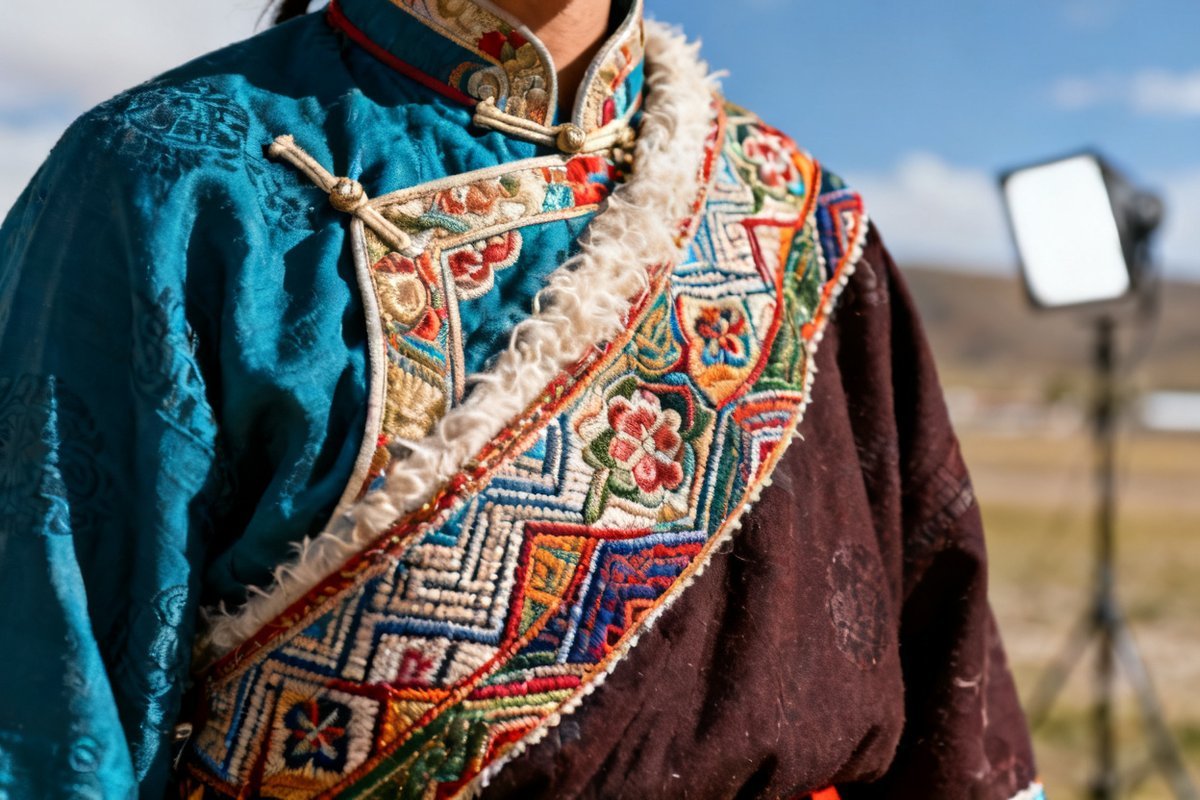
Salar embroidery features delicate floral patterns on skullcaps, collar edges, cuffs, and the borders of headscarves. The floral vocabulary draws from both Central Asian and Chinese traditions — peonies and roses appear frequently, alongside scrolling vine patterns and geometric borders. The embroidery is executed in silk thread on cotton or silk fabric, using satin stitch and chain stitch to create smooth, glossy surfaces that catch light. On men's skullcaps, the embroidery is typically worked in white or matching thread on white caps, or in colored thread on black caps, with the patterns concentrated around the circumference band.
Women's embroidery appears most prominently on the chest panel of the jacket, where a rectangular or shield-shaped area of dense floral stitching creates a focal point. This embroidered panel is worked before the jacket is assembled, on a separate piece of fabric that is then sewn into the finished garment. The panel designs combine stylized flowers with delicate leaf forms and occasionally incorporate Arabic calligraphic elements expressing religious blessings. Salar embroidery shares technical features with both Uzbek suzani embroidery and Chinese silk embroidery, reflecting the group's historical position at the intersection of Central Asian and Chinese cultural spheres. The peony, in particular, has become a signature Salar motif, representing prosperity and feminine grace in the hybrid aesthetic that characterizes Salar decorative arts.
The Salar, who trace their ancestry to Samarkand in Central Asia, maintain Turkic embroidery motifs in their collar decorations that are nearly identical to those found in Uzbekistan today - a thread of migration stitched in fabric.
Color Symbolism
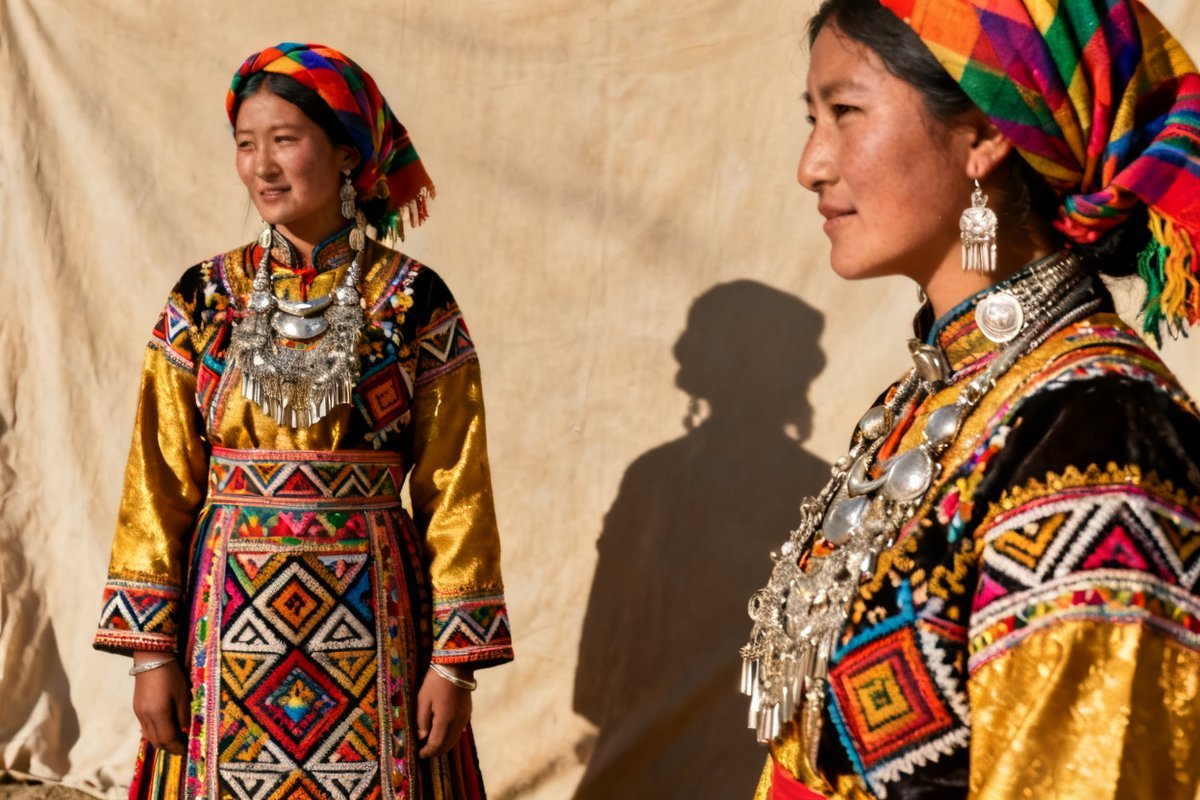
Black, white, dark blue, and gray form the foundation palette for base garments, colors that align with both Islamic preferences for modest dress and the practical needs of agricultural life. The dark colors of daily wear absorb light and heat in the cool highland climate of Xunhua. Headscarves introduce the most significant color coding in Salar dress: green for young women, associated with spring, growth, and the color traditionally favored in Islamic culture; black for married women at the height of their household responsibilities; and white for elderly women who have achieved spiritual maturity and community respect. Embroidery brings brighter colors into the ensemble — red, pink, yellow, green, and blue silk threads create vivid floral designs on the dark background fabric. The use of color in Salar dress is disciplined and codified, with personal expression occurring within clearly defined parameters that maintain the visual coherence and social legibility of the clothing system.
Festival Attire
During Eid al-Fitr, which marks the end of Ramadan, and Eid al-Adha, the Feast of Sacrifice, Salar communities dress in their finest traditional clothing. These are the two most important religious celebrations in the Islamic calendar, and the clothing worn reflects both spiritual devotion and community identity. Men wear new white shirts under freshly pressed dark jackets, with their best embroidered skullcaps — often a cap reserved exclusively for festival and mosque use. The white of the shirt and cap against the dark jacket creates a striking formal appearance appropriate for the morning Eid prayers, which are performed communally in open-air prayer grounds or mosques.
Women wear new silk headscarves in the color appropriate to their age, often with more elaborate embroidery on the edges than daily scarves. Their jackets are typically new or newly cleaned, with the most elaborate embroidery they possess. During the three days of Eid, families visit relatives in descending order of seniority, and the clothing worn for these visits is carefully chosen — the first day's outfit is the finest, with slightly less formal clothing worn on subsequent days. Weddings are the most elaborate clothing occasions in Salar life, with the bride wearing a completely new ensemble in which every element — headscarf, jacket, trousers, and shoes — is newly made for the occasion. The bridal jacket features the densest embroidery, and the bride's family's textile wealth is displayed through the quantity and quality of embroidered items brought as part of her dowry, including decorated bed linens, pillow covers, and clothing for her future children.
Modern Influence and Preservation
Salar embroidery is preserved through local craft workshops in Xunhua County, where older women teach younger generations the specific stitches and motifs that characterize Salar decorative arts. The county government has supported the establishment of women's embroidery cooperatives that produce traditional items for both cultural preservation and supplementary income. The embroidered skullcap remains the most consistently worn element of traditional Salar male dress, visible daily in Xunhua's streets and markets. The women's headscarf color system continues to function as a living social code, though younger women increasingly choose headscarf styles influenced by broader Islamic fashion trends alongside traditional Salar patterns. Salar embroidery has been recognized as provincial-level intangible cultural heritage in Qinghai, and documentation projects are recording the complete repertoire of traditional motifs before they are lost. The connection between Salar and Central Asian embroidery traditions has attracted academic interest, with comparative studies of Salar and Uzbek textile patterns illuminating the cultural journey of this small but historically significant community from Samarkand to the Yellow River valley.
Did You Know?
The Salar are believed to be descendants of Turkic people from Samarkand (in modern Uzbekistan) who migrated to Qinghai during the Yuan dynasty, bringing Central Asian embroidery traditions that survive today.