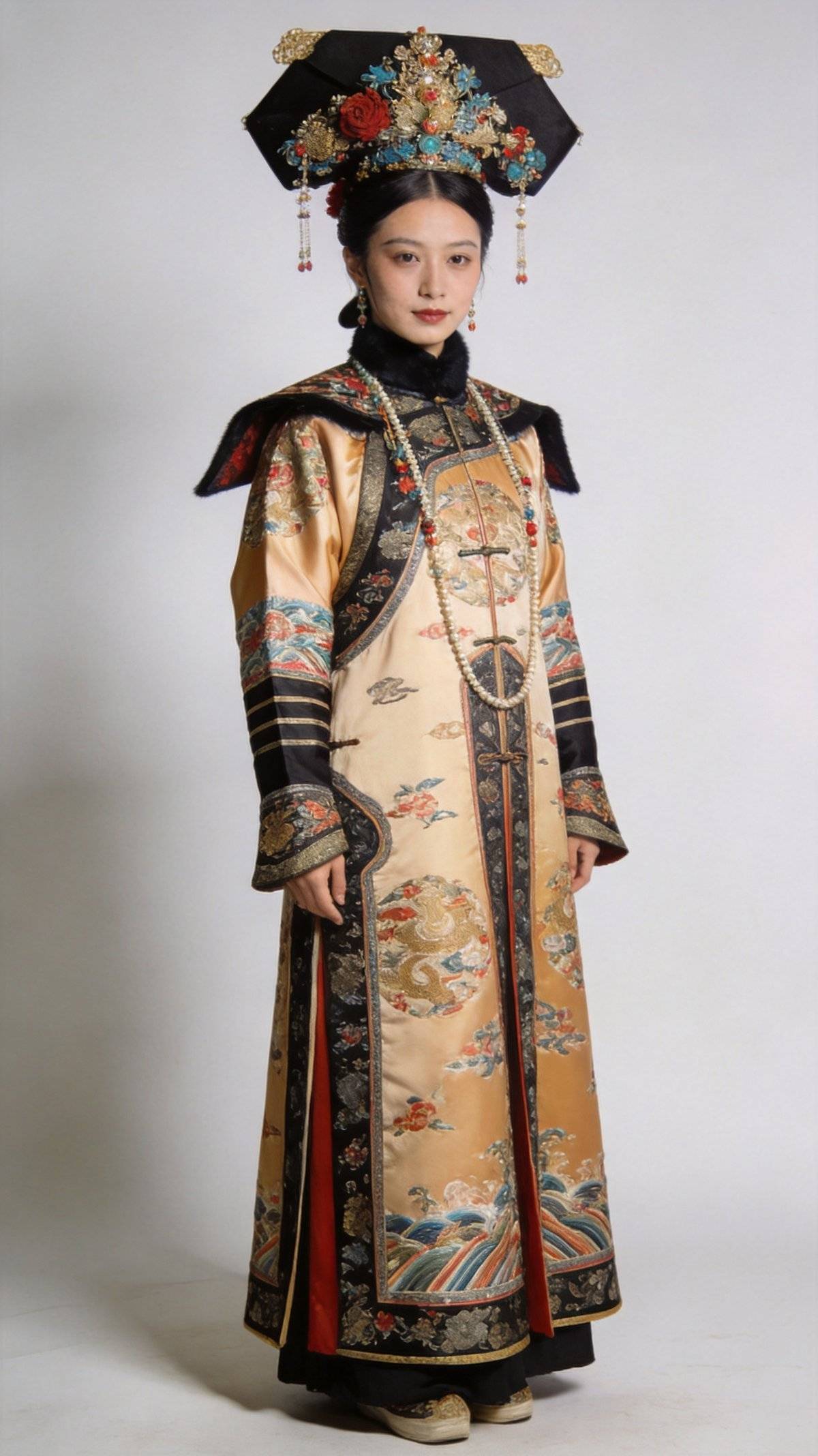
Manchu traditional clothing introduced the iconic qipao to Chinese fashion, along with distinctive horse-hoof cuffs. The Manchu, numbering over 10.4 million, are China's third-largest ethnic group, with populations spread across Liaoning, Jilin, Heilongjiang, Hebei, and Beijing. Originally a Tungusic people from the forests of Manchuria, the Manchu conquered China in 1644 and established the Qing dynasty, the last imperial dynasty of China, which ruled until 1912. Their clothing system became the foundation of Qing dynasty court attire and deeply influenced what the world recognizes as "traditional Chinese dress."
Historical and Cultural Background
The Manchu originated as semi-nomadic hunters and horse riders in the forests and grasslands of what is now northeastern China. Their clothing system was designed for mounted archery and cold-weather survival: close-fitting sleeves, side slits for riding, and layered construction for insulation. When the Manchu established the Qing dynasty, they imposed their clothing styles on the Han Chinese male population (the "queue order" requiring Manchu hairstyles and dress), creating a hybrid court culture that merged Manchu practicality with Chinese imperial symbolism. The Manchu imperial wardrobe was the most elaborate in Chinese history, codifying every garment by season, occasion, and rank through the "Illustrated Precedents for the Ritual Paraphernalia of the Imperial Court" (Huangchao Liqi Tushi). After the Qing dynasty fell in 1912, most Manchu abandoned traditional dress to avoid discrimination, but the qipao was preserved and transformed by Han Chinese fashion designers into the iconic garment known today.
Key Features of Manchu Attire
- Riding-style robes with side slits for equestrian mobility
- Distinctive horse-hoof cuffs covering the hands
- Womens one-piece qipao evolving from Manchu changpao
- Mens magua riding jacket worn over long robes
- Platform shoes for elite women
Traditional Garments
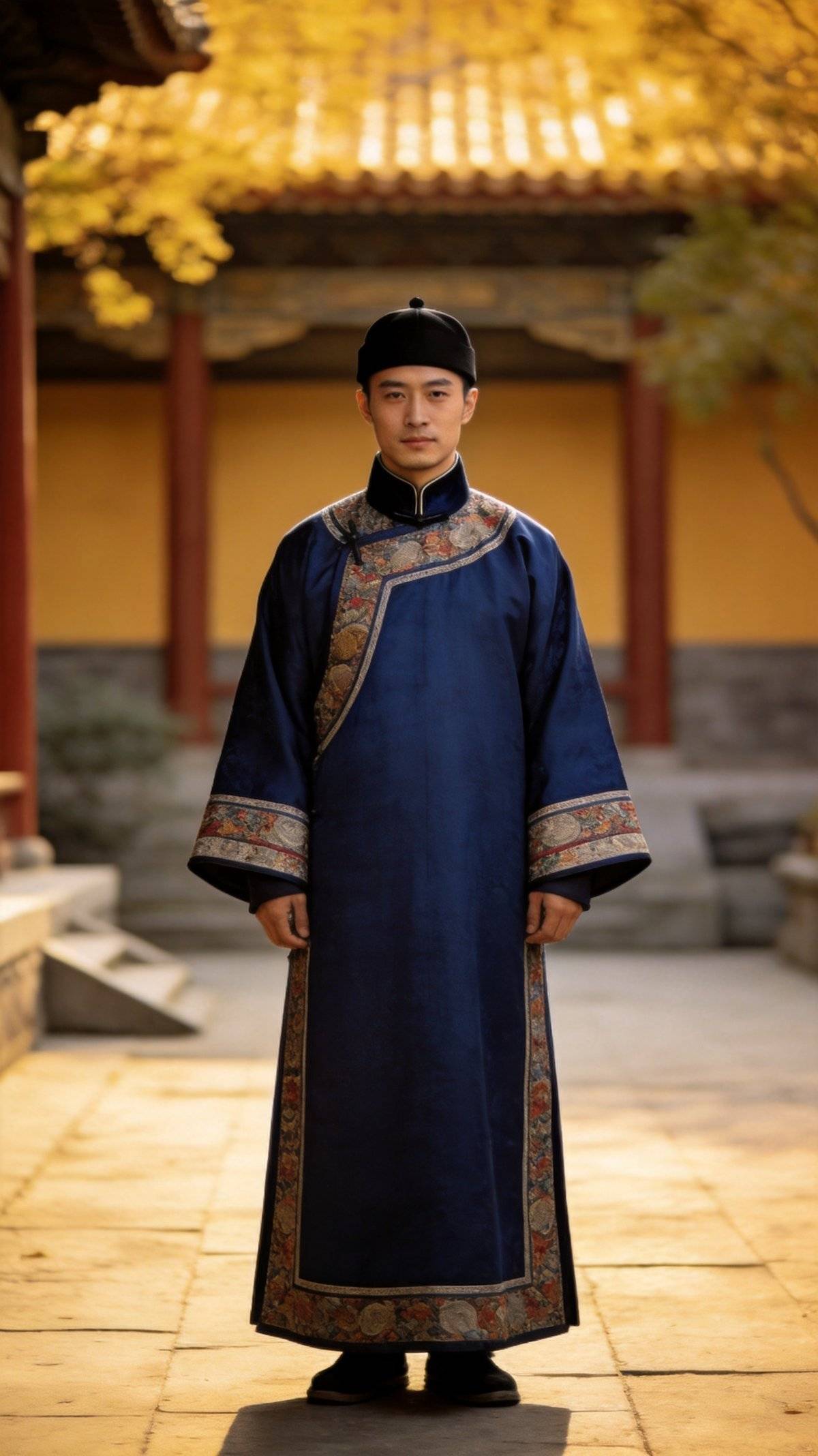
The foundation is the long robe (changpao) with right-side closure, horse-hoof cuffs (matixiu) that extend over the back of the hand in a distinctive flared shape, and side slits enabling freedom of movement on horseback. Men wear a shorter riding jacket (magua) over the changpao, initially a practical military garment that evolved into the formal "mandarin jacket" recognized by its upright collar and five-button front closure system. Women historically wore a similarly cut changpao, loose and straight, worn over trousers. The fitted qipao with stand-up collar and high side slits was a 20th-century Shanghai invention -- a dramatic modification of the original loose Manchu garment. The Manchu women's informal robe was the chenyi, a simpler version of the formal garment without the split skirts, worn for daily domestic activities.
Headwear and Adornments
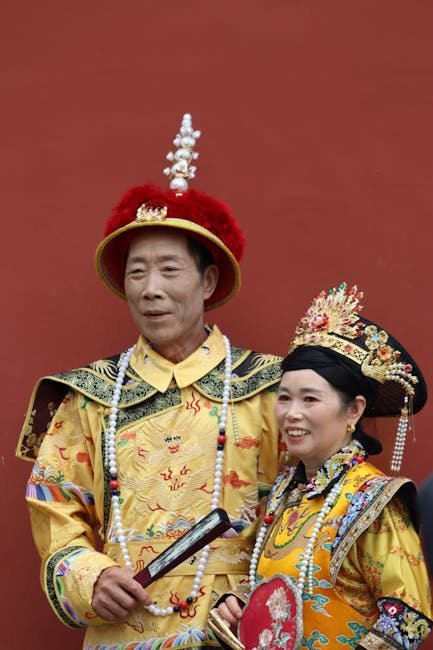
Men wore a conical cap with a tassel whose color and material indicated rank: red silk tassels for the imperial family, coral for high officials, and black silk for lower ranks. The crown finial (dingzhu) atop the cap was an even more precise rank marker, using ruby, coral, lapis lazuli, crystal, or gilt metal in descending order of status. Elite women wore the two-headed hair ornament (liangbatou) -- a large bifurcated headdress decorated with flowers, pearls, and tassels, supported by a black silk framework that could stand 30 to 40 centimeters high. This was complemented by the "nail-protector" (huzhi), long decorative metal sheaths worn over the fingernails of the ring and little fingers to demonstrate that the wearer did not perform manual labor. Manchu women did not bind their feet (unlike Han Chinese women), instead wearing flowerpot shoes with a distinctive elevated platform sole in the center, 5 to 15 centimeters high.
Embroidery and Decorative Arts
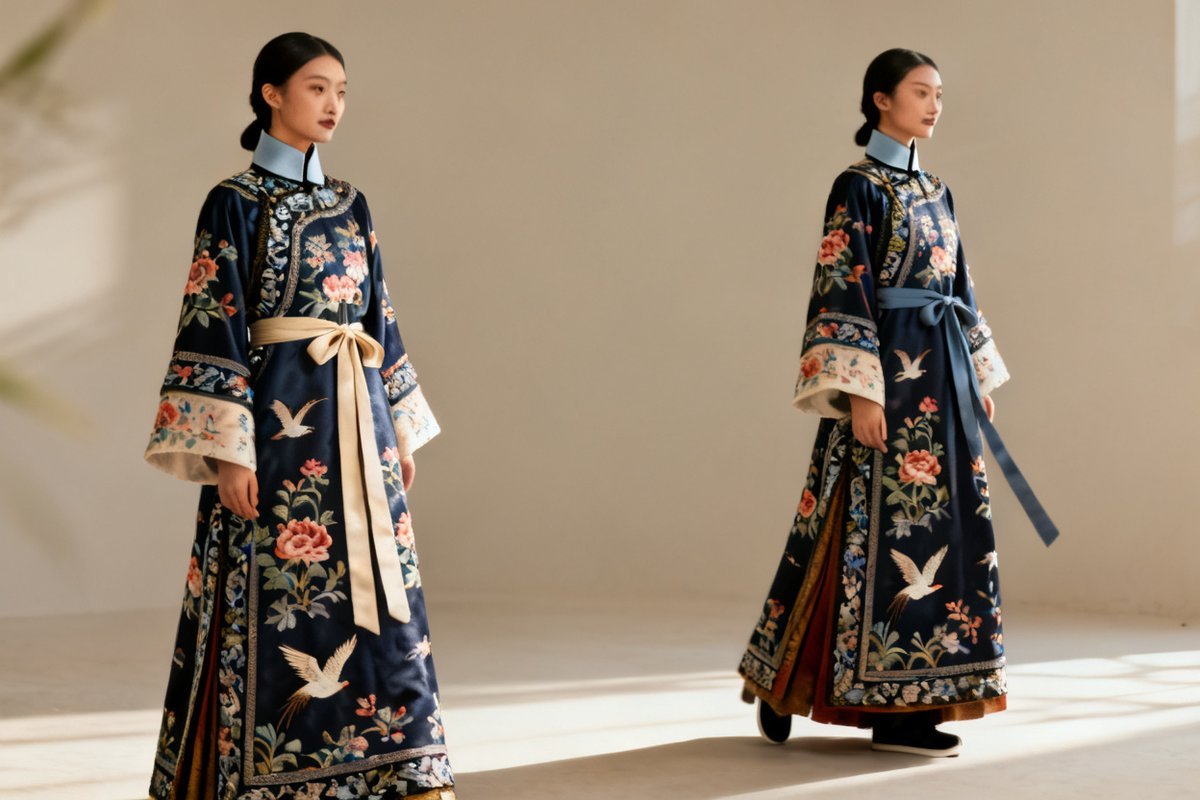
Qing dynasty Manchu embroidery set the standard for Chinese imperial embroidery, executed in imperial workshops (zaobanchu) in Beijing that employed the finest artisans from across the empire. Five-clawed dragons (reserved for the emperor and first-rank princes) and four-clawed dragons (for lower ranks), phoenixes (for the empress and imperial women), and the eight Buddhist treasures in silk and gold thread were the primary motifs. The "rank badge" (buzi) -- a square embroidered panel on the chest and back of formal robes -- was the ultimate status marker: civil officials wore birds (crane, golden pheasant, peacock, etc. in descending order of nine ranks), while military officials wore animals (qilin, lion, leopard, tiger, bear, etc.). This system allowed instant identification of any official's place in the imperial hierarchy from across a courtyard. The Manchu also developed kesi (silk tapestry weaving), an extraordinarily labor-intensive technique where each color was woven with a separate shuttle, producing pictorial designs of remarkable detail.
The Manchu horse-hoof cuff represents a remarkable synthesis of form and function - it simultaneously protected hands while riding and served as a canvas for embroidery announcing the wearers rank with every gesture.
Color Symbolism
Imperial yellow (minghuang) was reserved exclusively for the emperor, empress dowager, and empress -- unauthorized use was punishable by death. The heir apparent wore apricot yellow, while other imperial princes used gold-yellow. Bright blue was designated for the highest civil officials, red for second-tier officials, and progressively darker or duller shades for lower ranks. Commoners wore gray, blue, and brown by law, with the Qing sumptuary code (Da Qing Huidian) specifying permitted colors for every social class in exacting detail. Women's festive wear employed vibrant red, pink, and green, with red being the dominant wedding color for its associations with joy and good fortune. White was the color of mourning, the opposite of Han Chinese tradition where white was acceptable daily wear -- this conflict was a major point of cultural friction during the dynasty.
Festival Attire
During Spring Festival, the finest changpao or qipao with dragon, phoenix, or floral embroidery is worn with matching hair ornaments. The Manchu New Year celebration historically included a court ceremony where officials wore their formal court robes (chaofu) -- the most elaborate of all Qing garments, with a separate detachable collar (piling) and a heavy necklace of 108 beads (chaozhu) that served both ornamental and religious functions. Weddings involved a prescribed sequence of garment changes for the bride, beginning with the formal court dress and progressing through several increasingly comfortable but still elaborate ensembles. Modern Manchu cultural festivals, particularly in the three northeastern provinces, feature qipao fashion shows and traditional dress competitions that celebrate both the historical changpao and the evolved Shanghai-style qipao. The Banjin Festival (Manchu National Day, celebrated on the 13th day of the 10th lunar month) is the primary occasion for displaying traditional Manchu dress in public.
Modern Influence and Preservation
The qipao evolved into one of the most iconic Chinese garments worldwide, though the modern form bears little resemblance to its Manchu ancestor. The transformation occurred primarily in 1920s-1930s Shanghai, where designers stripped away the loose cut and introduced darts, zippers, and high side slits, creating the form-fitting silhouette now known globally. Qing court dress established the visual language of traditional Chinese clothing recognized internationally: the dragon robe, the mandarin jacket, and the horse-hoof cuff remain reference points for "Chinese style" in global fashion. In contemporary China, qipao is primarily worn as formal occasion wear for weddings and banquets, while the traditional loose changpao survives mainly in museum collections and historical reenactment. The Forbidden City's textile conservation laboratory in Beijing maintains the world's most comprehensive collection of Qing imperial garments, studying the weaving, dyeing, and embroidery techniques that reached their peak under Manchu patronage.
Did You Know?
The Manchu qipao was originally a loose straight-cut garment for both genders - it was not until the 1920s in Shanghai that it evolved into the form-fitting high-slit dress recognized today.
Riding Heritage and Court Attire of the Manchu
The Manchu people, who founded the Qing Dynasty that ruled China from 1644 to 1912, brought distinctive clothing traditions from their nomadic origins in what is now Northeast China. The riding jacket, or magua, was a short waist-length jacket worn over a longer robe, originally designed for horseback riding with its split sides and shortened hem. This garment became the standard formal wear for Qing officials and was adopted by Han Chinese as a symbol of court service. The magua was typically made of silk or satin in dark colors, with rank indicated by the color of the button at the collar rather than by fabric quality.
Manchu women did not practice foot binding, a significant cultural difference from their Han Chinese counterparts. Manchu women wore platform shoes with a central heel support that elevated the foot while keeping the toes flat, creating a distinctive walking gait. Headdress customs also differed, with Manchu women wearing the iconic three-pointed headdress decorated with flowers, pearls, and pheasant feathers for formal occasions. The single-floor-length robe worn by Manchu women was adapted over time into the cheongsam, which evolved into the fitted silk dress known internationally.
Riding Heritage and Court Attire of the Manchu
The Manchu people, who founded the Qing Dynasty that ruled China from 1644 to 1912, brought distinctive clothing traditions from their nomadic origins in what is now Northeast China. The riding jacket, or magua, was a short waist-length jacket worn over a longer robe, originally designed for horseback riding with its split sides and shortened hem. This garment became the standard formal wear for Qing officials and was adopted by Han Chinese as a symbol of court service. The magua was typically made of silk or satin in dark colors, with rank indicated by the color of the button at the collar rather than by fabric quality.
Manchu women did not practice foot binding, a significant cultural difference from their Han Chinese counterparts. Manchu women wore platform shoes with a central heel support that elevated the foot while keeping the toes flat, creating a distinctive walking gait. Headdress customs also differed, with Manchu women wearing the iconic three-pointed headdress decorated with flowers, pearls, and pheasant feathers for formal occasions. The single-floor-length robe worn by Manchu women was adapted over time into the cheongsam, which evolved into the fitted silk dress known internationally.