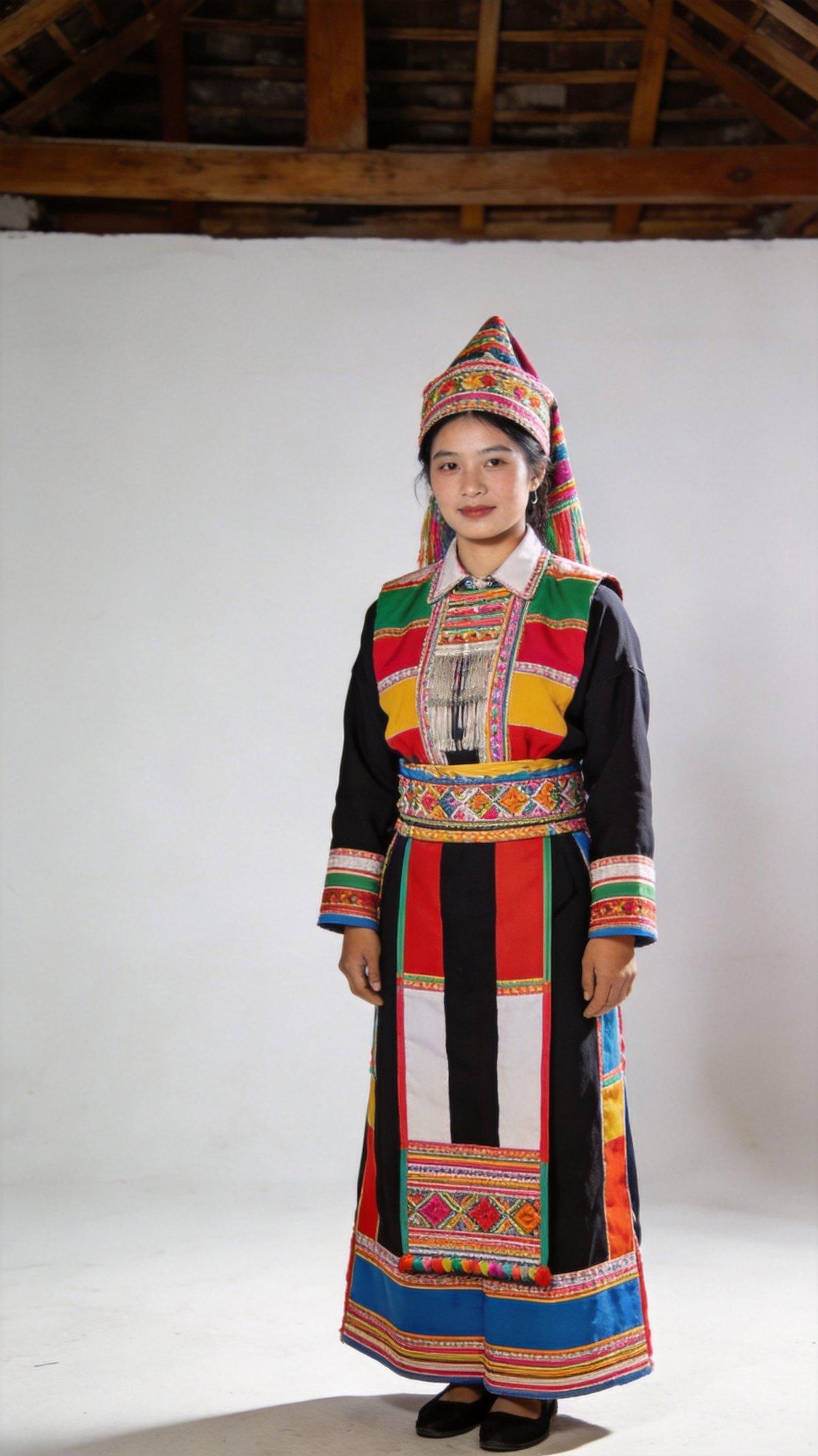
Monpa traditional clothing shows strong Tibetan Buddhist influence with local adaptations, featuring long robes, colorful striped woven aprons, and ornately embroidered hats with feathers. The Monpa people, numbering over 10,000, reside primarily in Cona County and Medog County in the Tibet Autonomous Region, within the high Himalayan valleys near the border with Bhutan and Arunachal Pradesh. Their textile traditions have evolved over centuries at altitudes exceeding 3,000 meters, where wool from yak, sheep, and goat provides essential insulation against the harsh mountain climate.
Key Features of Monpa Attire
- Long red or brown woolen robes with cloth belts
- Distinctive woven hats with upturned brims and peacock-feather ornaments
- Colorful striped woven aprons worn by women
- Handwoven hemp and wool fabrics with striped patterns
- Silver and turquoise earrings, necklaces, and amulet boxes
Traditional Garments
Women wear a long sleeveless robe in red or dark tones, fastened with a cloth belt, over a long-sleeved inner blouse. The striped apron is the most decorated garment, woven on a backstrap loom in horizontal bands of alternating colors. Monpa women may spend several months weaving a single apron, incorporating up to a dozen distinct color stripes into the fabric. The apron is not merely decorative — it serves as a practical garment that protects the robe underneath during daily work and signals the wearer's village affiliation through its specific stripe patterns.
Men wear a longer robe reaching below the knee, typically in deep red or brown wool, secured with a wide cloth belt wrapped multiple times around the waist. The belt functions as both a fastener and a carrying pouch for small daily items. Both men and women wear leather boots with upturned toes, and in winter, additional layers of sheepskin or felt are added beneath the robe for warmth. The cut of the Monpa robe is distinctively simpler than the Tibetan chuba, with a straight silhouette and minimal tailoring that reflects the practical needs of mountain agriculture and herding.
Headwear and Adornments
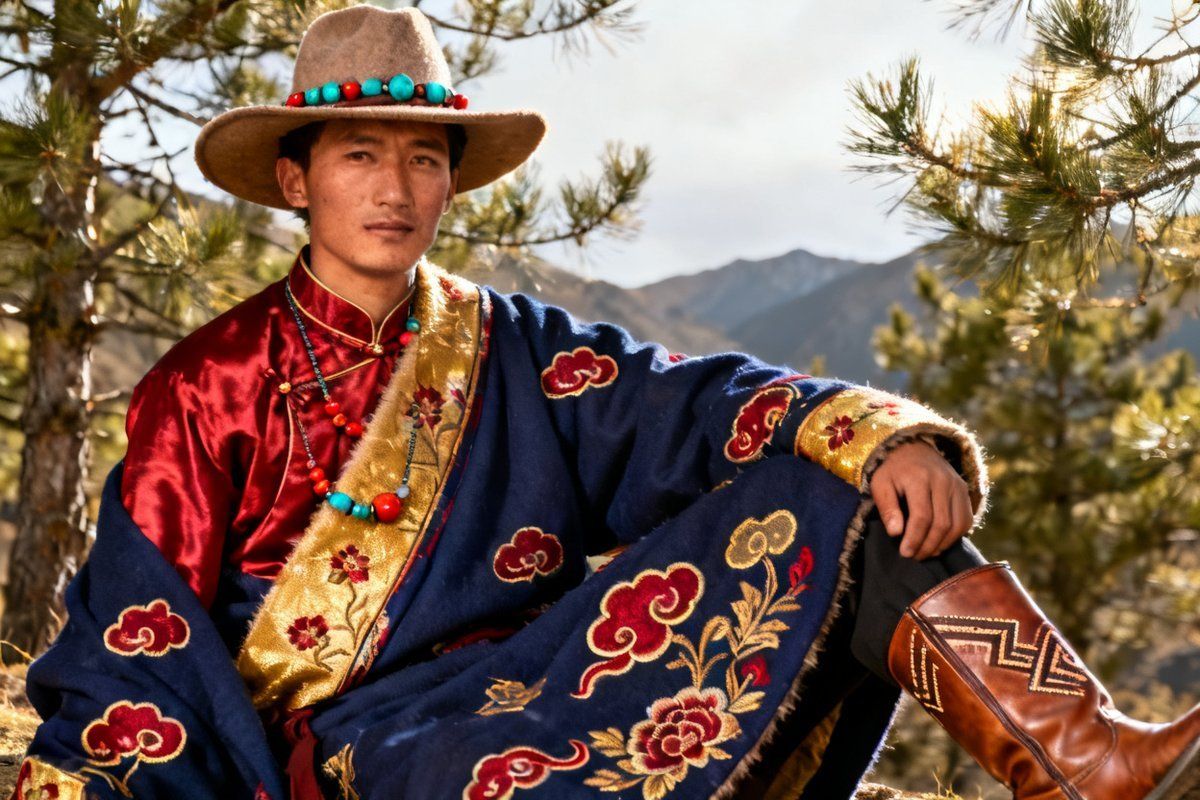
The signature Monpa hat is made from woven fabric with an upturned brim, decorated with a peacock or pheasant feather inserted at the crown. The hat color and the specific feather type used — peacock for southern valleys, pheasant for northern settlements — historically identified the wearer's community of origin. The hat is constructed from layers of wool felt covered with handwoven cotton or hemp fabric, with the brim reinforced by fine bamboo strips to hold its distinctive upward curve.
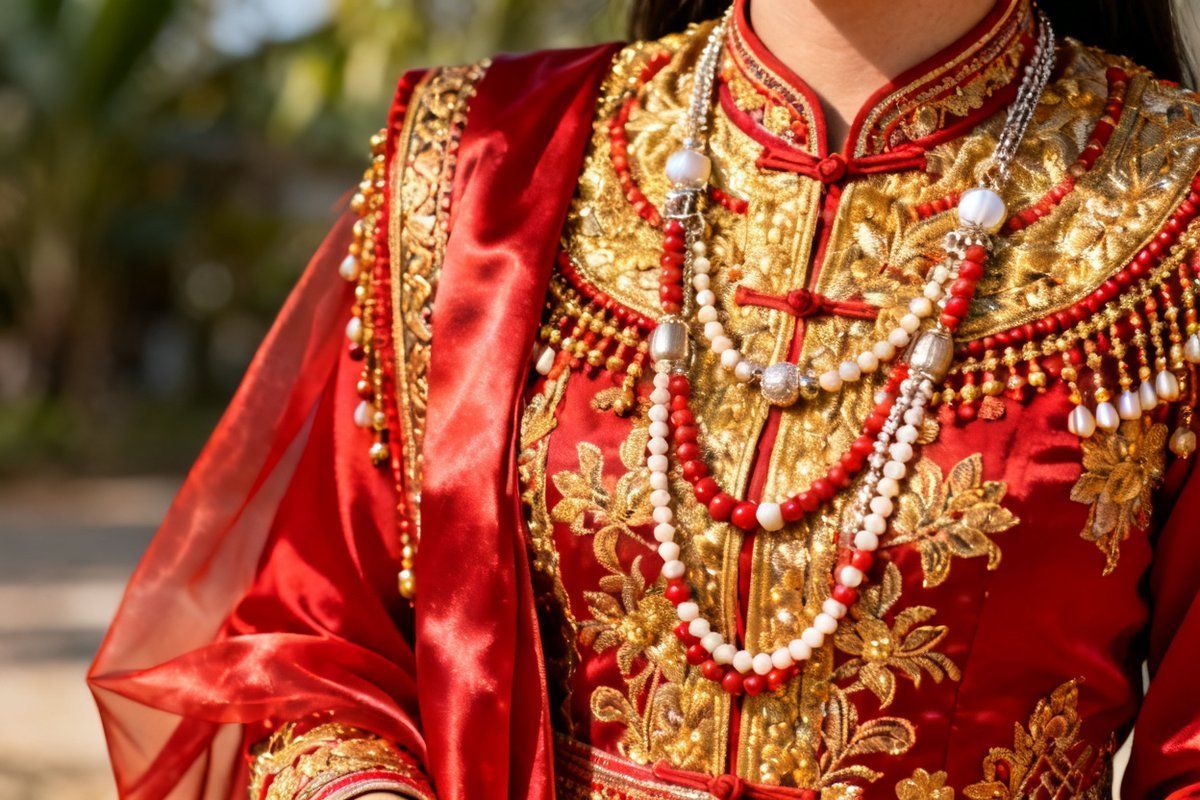
Women also wear headscarves or silver hair ornaments, including elaborate hairpins featuring repousse floral designs and inlaid turquoise. Silver amulet boxes called gau, worn on necklaces or pinned to the robe, contain Buddhist relics or protective prayers and double as decorative chest ornaments. Turquoise beads are the most prized form of jewelry — the Monpa believe turquoise changes color to warn the wearer of approaching illness or danger. Coral, amber, and dzi beads complete the jewelry ensemble, with wealthier families passing down multi-generational collections of these precious ornaments.
Embroidery and Decorative Arts
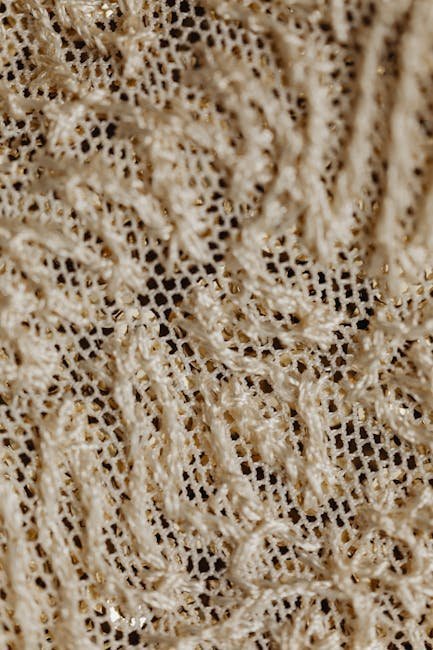
Monpa textile decoration relies more on woven patterns than embroidery, setting them apart from many neighboring ethnic groups who favor needlework. Their aprons feature woven horizontal stripes in precise color sequences, achieved by changing weft threads during the weaving process rather than applying surface decoration afterward. This technique, called pick-up weaving, requires the weaver to select individual warp threads by hand to create pattern bands — a labor-intensive method that produces designs visible on both sides of the fabric.
Silk thread appears in small floral motifs on hats, typically lotus flowers and endless knots drawn from Tibetan Buddhist iconography. Men's robes occasionally feature narrow embroidered borders at the collar and cuffs in contrasting colors, though restraint is the aesthetic principle — Monpa clothing derives its beauty from the quality of the wool and the integrity of the weave rather than from surface ornamentation. The backstrap loom used by Monpa women is a portable frame that can be set up anywhere, allowing weaving to continue during seasonal migrations between summer and winter pastures.
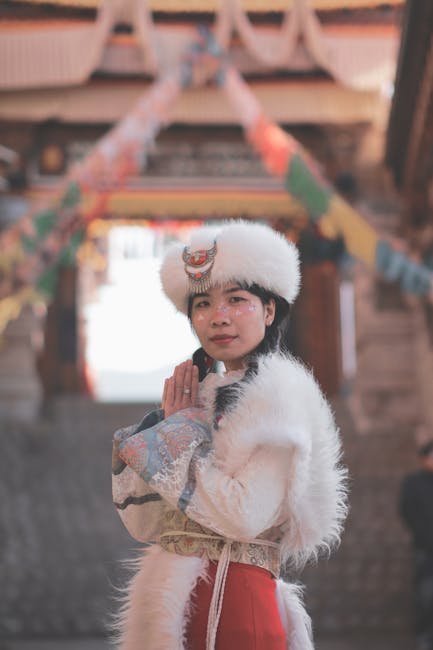
The Monpa hats upturned brim and single feather crest signal the wearers valley of origin in the high Himalayas where Monpa communities have lived for over a millennium.
Color Symbolism
Red, brown, and maroon dominate Monpa clothing, colors strongly associated with Tibetan Buddhist monastic tradition. Red symbolizes the robes of ordained monks and the protective energy of Buddhist deities. Brown represents the earth and the practical connection to agricultural life. Striped aprons introduce a wider palette — white for purity, blue for the sky, green for pastures, yellow for the earth's abundance, and black for protection against evil influences. The specific sequence and width of colored stripes on a woman's apron communicates subtle information about her marital status, village affiliation, and family lineage. Monpa weavers use natural dyes derived from local plants: madder root for red, walnut hulls for brown, indigo for blue, and various tree barks for yellow and green tones.
Festival Attire
During Losar, the Tibetan New Year, Monpa communities display their most elaborate traditional clothing. The finest red woolen robes, reserved exclusively for festival use, are brought out from household chests where they have been stored with dried herbs to repel insects. Women wear their most elaborately striped aprons with the widest color bands and greatest number of stripes — some festival aprons contain over thirty individual color bands. Full turquoise and silver jewelry sets are layered on, including multiple necklaces of graduated lengths, heavy silver earrings with turquoise drops, and hair ornaments that frame the face with dangling silver chains.
Beyond Losar, the Monpa also observe the Torgya Festival at Tawang Monastery, where ceremonial dances are performed in full traditional dress. During weddings, the bride receives an entirely new set of clothing from her family, including a specially commissioned apron that may take a year to weave. The wedding robe is always red with white trim, symbolizing the couple's bond under the protection of Buddhist blessings. Funeral attire, by contrast, is undyed natural wool without decoration, reflecting the Monpa belief that the deceased should return to nature in the simplest possible form.
Modern Influence and Preservation
Monpa weaving techniques are actively maintained in Cona and Medog counties through government-supported cultural heritage programs. Local weaving cooperatives have been established to train younger generations in backstrap loom techniques that were previously transmitted only within families. The distinctive Monpa hat and striped apron have been recognized as regional intangible cultural heritage items. While machine-made fabrics have largely replaced handwoven wool for everyday garments, traditional clothing remains the expected dress for festivals, weddings, and religious ceremonies. A small but growing market for Monpa handwoven textiles among collectors and museums in China has provided economic incentives for weavers to continue practicing and refining their craft, ensuring that these centuries-old techniques survive into the next generation.
Did You Know?
The Monpa are the only ethnic group in China practicing both Tibetan Buddhism and indigenous Bon shamanism.
Wool Weaving of the Monba People
The Monba people of the Tibet Autonomous Region maintain textile traditions that share elements with neighboring Tibetan communities while maintaining distinct Monba characteristics. Wool is the primary material for Monba garments, sourced from local sheep and processed through hand-spinning into thick, warm yarn. The wool is woven on horizontal looms into fabric called puk, which is used for both clothing and household textiles. Monba puk fabric is characterized by its dense weave and distinctive stripe patterns in earthy colors including brown, gray, and undyed white.
Monba women's traditional attire includes a long-sleeved woolen robe wrapped at the waist and secured with a fabric belt, worn over a cotton or silk blouse. Striped aprons worn over the front of the robe are among the most distinctive elements of Monba women's dress, with the stripe pattern indicating the wearer's home valley. Monba men wear a similar woolen robe in solid dark colors, secured at the waist with a sash that creates a pouch-like fold for carrying small items. Felt boots with leather soles and decorative stitching protect the feet during cold weather.
Wool Weaving of the Monba People
The Monba people of the Tibet Autonomous Region maintain textile traditions that share elements with neighboring Tibetan communities while maintaining distinct Monba characteristics. Wool is the primary material for Monba garments, sourced from local sheep and processed through hand-spinning into thick, warm yarn. The wool is woven on horizontal looms into fabric called puk, which is used for both clothing and household textiles. Monba puk fabric is characterized by its dense weave and distinctive stripe patterns in earthy colors including brown, gray, and undyed white.
Monba women's traditional attire includes a long-sleeved woolen robe wrapped at the waist and secured with a fabric belt, worn over a cotton or silk blouse. Striped aprons worn over the front of the robe are among the most distinctive elements of Monba women's dress, with the stripe pattern indicating the wearer's home valley. Monba men wear a similar woolen robe in solid dark colors, secured at the waist with a sash that creates a pouch-like fold for carrying small items. Felt boots with leather soles and decorative stitching protect the feet during cold weather.