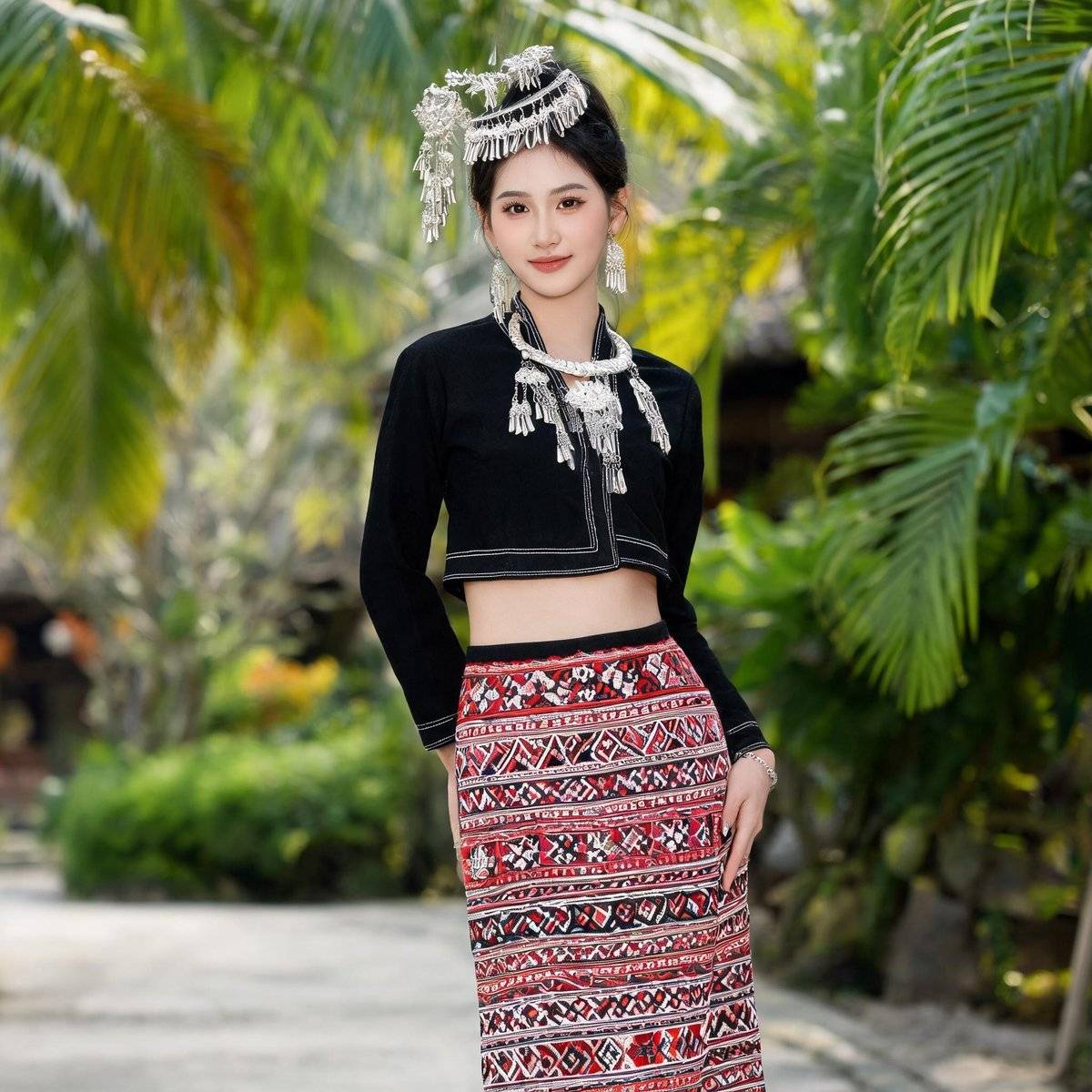
Li traditional clothing is famous for its exquisite brocade weaving, one of China's oldest textile traditions with roots stretching back over 3,000 years. The Li people, numbering approximately 1.4 million, are the original inhabitants of Hainan Island and are considered the island's earliest settlers, arriving by sea from the Asian mainland during the Neolithic period. Their geographic isolation on a tropical island produced a textile culture distinct from any mainland Chinese tradition. Women wear distinctive tubular skirts with intricate geometric patterns and shell jewelry, creating one of the most archaeologically significant continuous textile lineages in East Asia.
Historical and Cultural Background
The Li are divided into five main branches (Ha, Qi, Run, Sai, and Meifu), each with distinct clothing styles, weaving patterns, and dialects. Their textile tradition represents an ancient Austronesian-linked heritage that predates Han Chinese settlement of Hainan. The Li developed the waist-loom (a backstrap loom anchored by the weaver's body) independently, and their brocade technology was already highly sophisticated when recorded by Chinese chroniclers during the Han dynasty. Li women were responsible for every stage of textile production: growing cotton and hemp, spinning thread, preparing natural dyes from island plants, and executing the complex weaving that could take months for a single skirt panel. A Li woman's skill at brocade weaving was the primary measure of her marriageability and social standing. The geometric patterns woven into Li brocade encode ancestral knowledge, with specific motifs representing clan genealogy, cosmological beliefs, and the natural environment of Hainan's tropical forests.
Key Features of Li Attire
- Finely woven Li brocade with complex geometric patterns
- Womens short fitted jackets with colorful embroidered front panels
- Tubular skirts with intricately patterned woven bands
- Extensive shell, bead, and silver jewelry worn in multiple strands
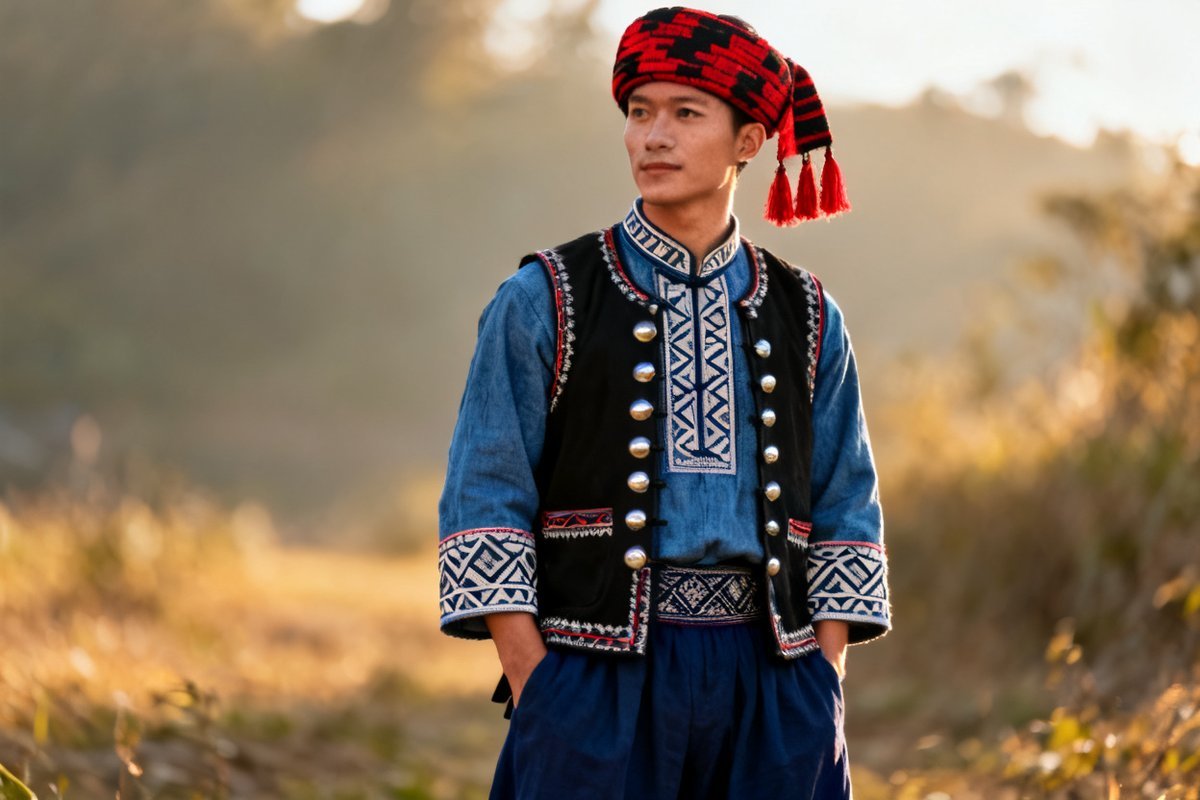
- Mens front-fastening jackets with fine fabric and minimal decoration
Traditional Garments
Women wear a short collarless jacket tied with strings, revealing an embroidered chest panel, paired with a tubular skirt with horizontal woven pattern bands. The tubular skirt (tongqun) is the centerpiece of Li women's dress, woven as a complete cylinder on the waist-loom and featuring up to five horizontal bands of different geometric patterns. Each band may take weeks to weave, with the most complex incorporating human figures, frogs, birds, and ancestral symbols. The width and number of patterned bands on a skirt historically indicated the wearer's clan affiliation and marital status. Men wear collarless front-fastening jackets with loose trousers, with the jacket often left open or tied with a simple cloth belt. Some Li subgroups historically practiced a tradition of minimal upper-body clothing for men during hot weather, wearing only a loincloth and a shoulder cape of woven palm fiber.
Headwear and Adornments
Women wear their hair in a bun secured with a bone or silver hairpin, with married women's buns positioned differently from unmarried women's. Some subgroups wear distinctive bamboo wide-brimmed hats for sun protection in the tropical climate. Shell and bead jewelry is central to Li adornment: multiple necklaces of small white shells, bracelets of silver and bone, and large circular earrings worn through stretched earlobes. The Li historically practiced tooth modification (filing or blackening) as a rite of passage into adulthood, a custom shared with other Austronesian cultures across Southeast Asia and the Pacific. Facial tattooing was practiced by Li women until the mid-20th century, with specific patterns indicating clan membership and marriage eligibility -- a tradition that has now completely ceased.
Embroidery and Decorative Arts
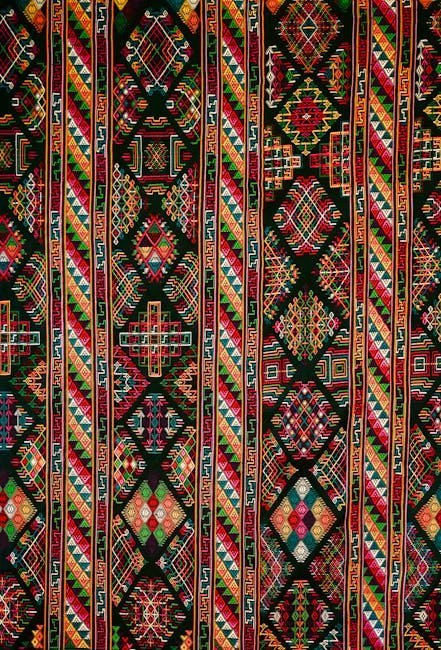
Li brocade uses a distinctive waist-loom technique for complex geometric patterns including human figures, ancestral symbols, frogs (associated with rain and fertility), and stylized representations of Hainan's native animals and plants. The waist-loom is tensioned by the weaver's own body, allowing precise control over warp thread spacing and enabling the creation of patterns of extraordinary complexity. Double-face embroidery -- where the pattern appears identically on both sides of the fabric -- is a prized skill mastered by only the most experienced weavers after decades of practice. The dyeing technique uses natural materials unique to Hainan's tropical ecology: wild indigo for blue, sappanwood for red, turmeric for yellow, and a local tree bark for dark brown. The entire process, from planting cotton to finishing a skirt, could take a year or more for the most elaborate pieces.
Li brocade represents what textile historians call a library woven in thread - each geometric motif encodes ancestral knowledge about cosmology, marriage, and lineage predating written language in Hainan.
Color Symbolism
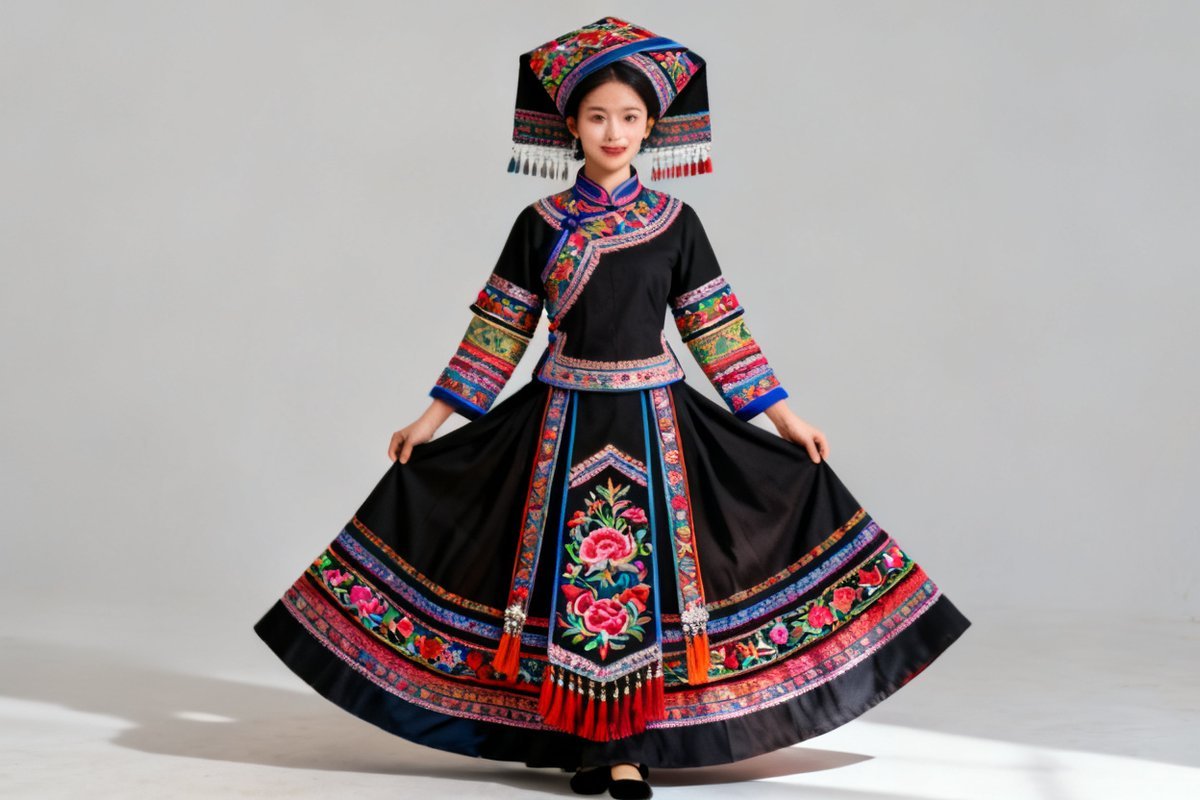
Black and dark blue dominate base garments, achieved through repeated indigo dyeing. Brocade uses vibrant red, yellow, green, white, and blue, with red being the most prestigious color due to the difficulty of producing a stable red dye from tropical plant sources. Coral and shell add natural tones. The five Li branches use color differently: the Ha Li favor dark blue grounds with red and white patterns, the Qi Li use more yellow and green, and the Run Li incorporate pink and purple shades obtained from island berries. The overall visual effect of Li brocade against the dark ground fabric has been compared to stained glass, with each colored section sharply defined by the warp-float weave structure.
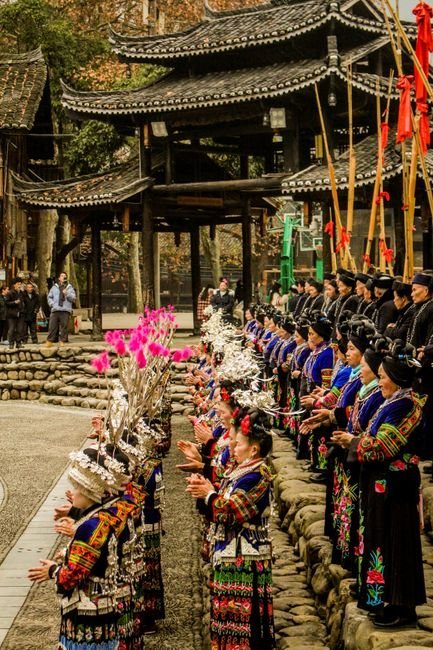
Festival Attire
During the March Third Festival (Sanyuesan), the most important Li celebration, women wear their finest Li brocade skirts with the most intricate woven patterns and full shell jewelry sets. The festival, which marks the arrival of spring and the planting season, includes courtship rituals where unmarried women display their weaving skills through their clothing, and young men compete in traditional sports. The occasion is the primary opportunity for displaying heirloom textiles passed down through generations. Weddings involve the bride presenting her own hand-woven brocade to the groom's female relatives as proof of her domestic skills. The Ox Festival, celebrating the water buffalo essential to Hainan's rice agriculture, sees men wearing indigo-dyed jackets with buffalo horn motifs woven into the trim.
Modern Influence and Preservation
Li brocade has been inscribed on China's national intangible cultural heritage list since 2006, and UNESCO recognized Li textile techniques as an Intangible Cultural Heritage in Need of Urgent Safeguarding in 2009. The Hainan provincial government has established Li brocade training centers where master weavers (average age over 70) teach younger Li women the techniques that were nearly lost during the rapid modernization of Hainan after it became a province in 1988. Li brocade has been exhibited at the Victoria and Albert Museum in London, the Metropolitan Museum of Art in New York, and the Musée du Quai Branly in Paris. Contemporary fashion designers have collaborated with Li weavers to incorporate traditional motifs into modern clothing, handbags, and home textiles. Hainan's tourism industry has created a sustainable market for Li brocade products, though concerns remain about the authenticity of mass-produced items versus the weeks-long process of true hand-woven brocade.
Did You Know?
The Li were the first people to cultivate coconuts on Hainan Island over 3,000 years ago, and their skirts often feature a coconut tree motif woven into the brocade.
Diamond Weave and Tattoo Traditions of the Li
The Li people of Hainan Province have preserved weaving techniques that are among the oldest in China, with archaeological evidence suggesting continuous textile production on the island for over three thousand years. The Li are particularly known for their double-face embroidery, where both sides of the fabric are embroidered simultaneously to create identical patterns on both surfaces. This demanding technique requires the embroiderer to work from both sides of the fabric, inserting the needle through precisely aligned positions. Li women also practice brocade weaving on floor looms, producing heavy cotton fabric with geometric patterns including diamonds, zigzags, and stylized human figures representing ancestors.
Li women historically practiced facial and body tattooing as a form of permanent adornment and ethnic identification, with the tattooing process beginning in early adolescence and continuing over several years. The tattoo patterns were applied using soot-based ink and bamboo needles, creating intricate geometric and spiral designs on the face, neck, chest, arms, and legs. While facial tattooing has not been practiced since the mid-twentieth century, elderly Li women with traditional tattoos are recognized as living cultural treasures.
Diamond Weave and Tattoo Traditions of the Li
The Li people of Hainan Province have preserved weaving techniques that are among the oldest in China, with archaeological evidence suggesting continuous textile production on the island for over three thousand years. The Li are particularly known for their double-face embroidery, where both sides of the fabric are embroidered simultaneously to create identical patterns on both surfaces. This demanding technique requires the embroiderer to work from both sides of the fabric, inserting the needle through precisely aligned positions. Li women also practice brocade weaving on floor looms, producing heavy cotton fabric with geometric patterns including diamonds, zigzags, and stylized human figures representing ancestors.
Li women historically practiced facial and body tattooing as a form of permanent adornment and ethnic identification, with the tattooing process beginning in early adolescence and continuing over several years. The tattoo patterns were applied using soot-based ink and bamboo needles, creating intricate geometric and spiral designs on the face, neck, chest, arms, and legs. While facial tattooing has not been practiced since the mid-twentieth century, elderly Li women with traditional tattoos are recognized as living cultural treasures.