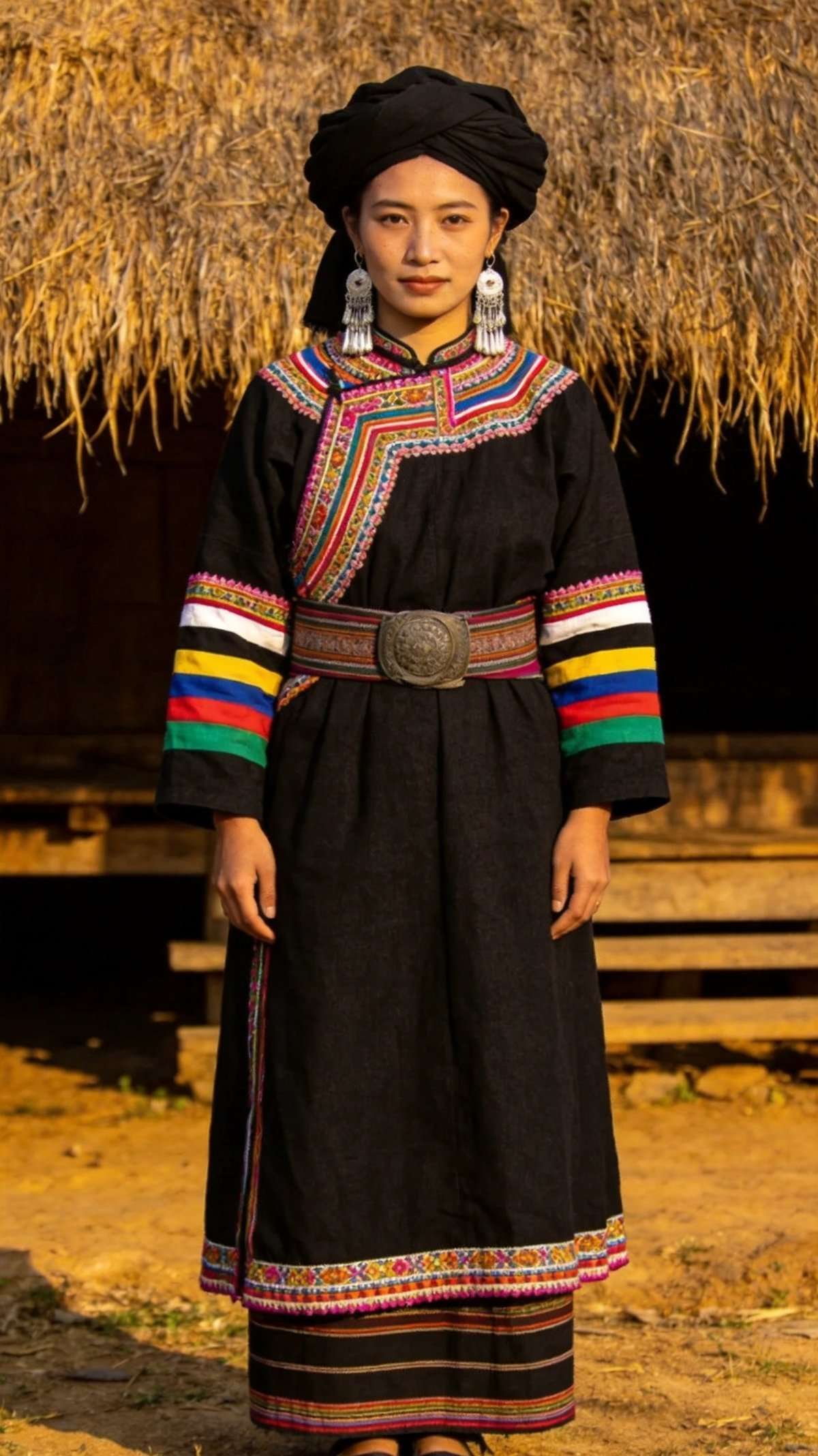
Lahu traditional clothing is dominated by black fabric with striking geometric applique and silver ornamentation. The Lahu people, numbering approximately 480,000 in China, primarily inhabit the Lancang Lahu Autonomous County in southwestern Yunnan Province, with smaller populations across the Myanmar and Thailand borders. Their name translates to "tiger-skin people," reflecting a founding myth in which their ancestors emerged from the union of a tiger and a human. Women's jackets feature a distinctive V-neck opening with extensive silver stud decoration, creating a monochrome aesthetic that anthropologists describe as one of the most refined among upland Southeast Asian textile traditions.
Historical and Cultural Background
The Lahu are a Tibeto-Burman speaking people who migrated southward from the Tibetan Plateau over the past millennium, eventually settling in the mountainous borderlands where Yunnan meets Myanmar, Laos, and Thailand. Their clothing tradition has been shaped by the ecology of monsoon forest highlands, where the availability of wild indigo plants provided the deep black dye that defines Lahu aesthetics. Historically, the Lahu were swidden agriculturalists and hunters, and their clothing reflects a practical adaptation to forest mobility: close-fitting silhouettes, minimal loose fabric that could catch on undergrowth, and hard-wearing materials. Silver was acquired through trade with lowland markets and transformed by Lahu silversmiths into the distinctive hemispherical studs and cylindrical beads that cover women's jackets. The Lahu social structure is notably egalitarian compared to neighboring groups, and this is reflected in their clothing: differences between everyday and festival garments are matters of degree (more silver, newer fabric) rather than entirely different garments.
Key Features of Lahu Attire
- Black fabric as the mandatory base color
- Extensive silver hemispheres on womens jacket fronts and collars
- Distinctive applique bands in red and white across jacket shoulders
- Geometric woven patterns on shoulder bags and headwraps
- Mens front-fastening black jackets with red and white piping
Traditional Garments
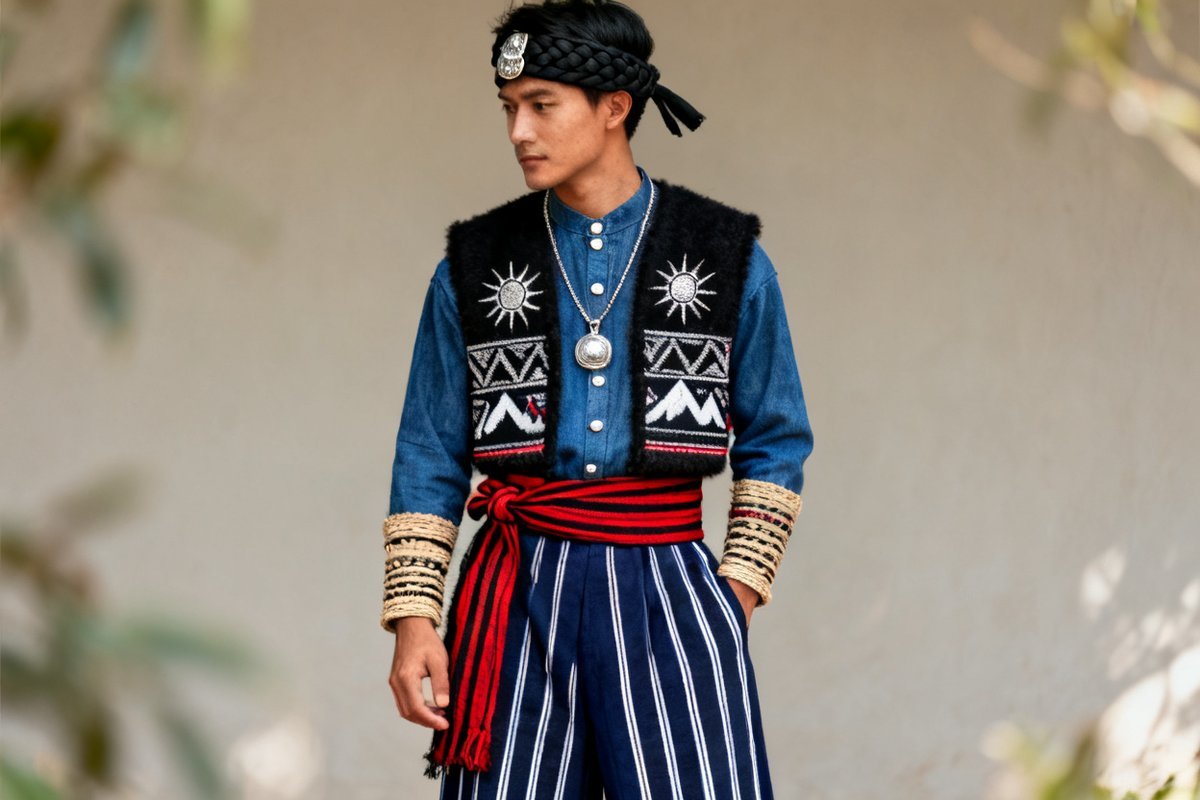
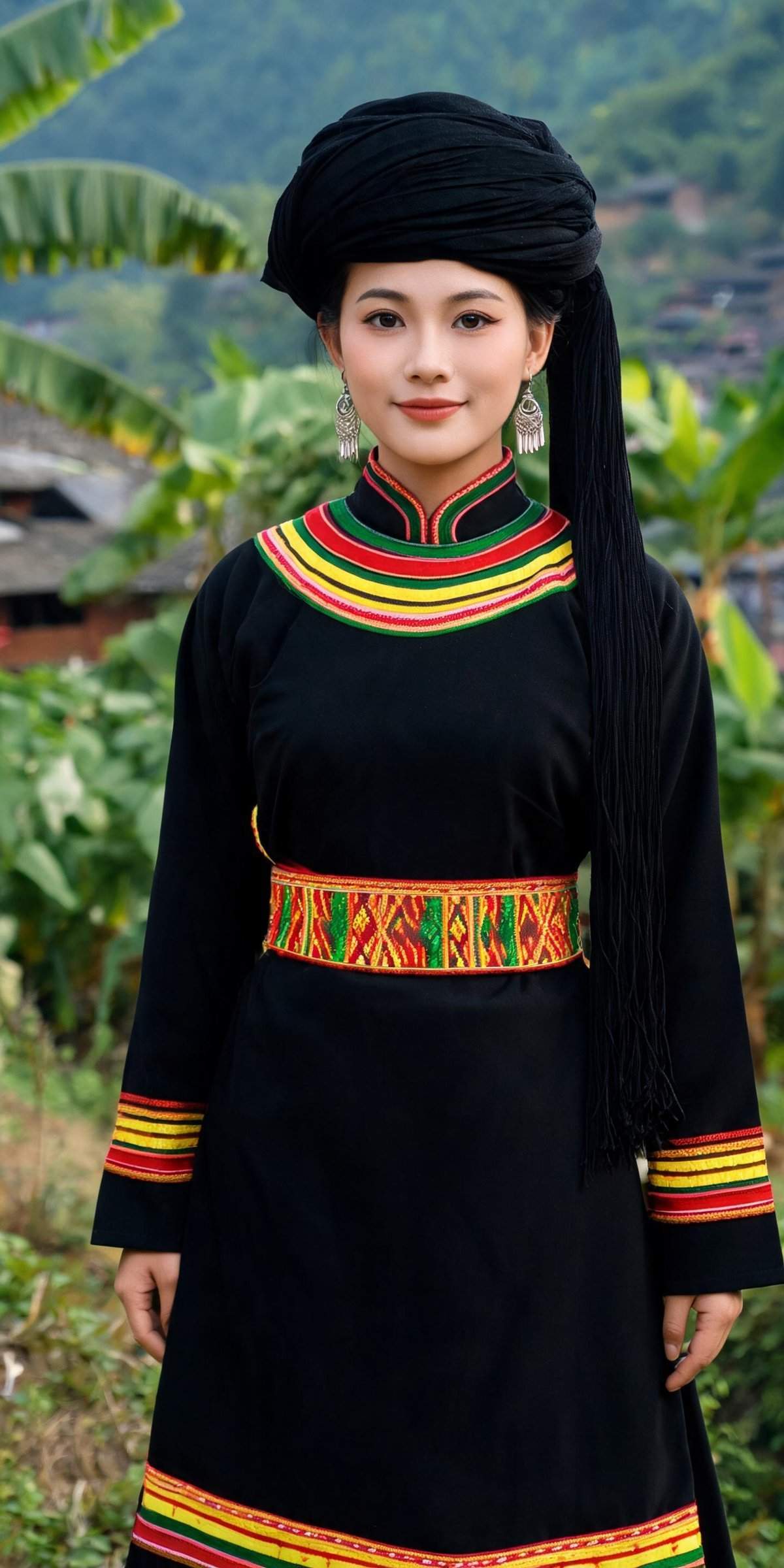
Women wear a collarless black jacket with a V-neck opening that reveals an inner panel densely covered in silver studs, paired with a black long skirt or trousers. The jacket fronts are decorated with horizontal bands of red, white, and yellow applique across the shoulders and around the hem. The silver studs are arranged in geometric patterns that differ by village, functioning as a subtle marker of community affiliation. Men wear black front-fastening jackets with colored trim at the collar and cuffs, and black wide-leg trousers secured with a fabric sash. The men's jacket is simpler than the women's, relying on the quality of the indigo-dyed cotton and the precision of the applique bands for its effect. Both genders carry shoulder bags woven with geometric patterns that incorporate the same red, white, and yellow palette as the clothing trim.
Headwear and Adornments
Men wear black cloth headwraps, sometimes with decorative woven bands in red and white. Women also wear black headwraps, with some subgroups adding colorful woven bands that incorporate glass beads and small silver bells. The headwrap is both a practical garment protecting against sun and a cultural marker: the manner of wrapping, the width of the cloth, and the arrangement of decorative elements vary noticeably between Lahu subgroups across Yunnan. Women typically wear their hair long, wrapped into the head cloth, with a silver hairpin or comb inserted as an ornament. The most distinctive female adornment is the heavy silver necklace composed of multiple graduated rings that cover the entire upper chest, with the largest and most elaborate pieces reserved for married women and festival occasions.
Embroidery and Decorative Arts
Lahu decoration emphasizes applique and woven geometric patterns rather than the dense embroidery seen in neighboring Miao and Yi traditions. Red, white, and yellow fabric strips are applied to jacket shoulders and hems in precise parallel bands, with the width of each band and the spacing between them governed by local aesthetic conventions. Silver studs provide ornamental detailing, arranged in diamond, triangle, and zigzag patterns. The shoulder bag (xhuto) is the most technically complex Lahu textile, woven on a backstrap loom with supplementary weft patterns that encode visual references to tiger stripes, mountain paths, and ancestral migration routes. The weaving of these bags is a key female skill, and a young woman's first completed bag traditionally served as a gift for her future mother-in-law.
The Lahu peoples devotion to black - rejecting all other colors as everyday wear - is so absolute that anthropologists describe their aesthetic as monochrome magnificence, where texture and silver alone provide the visual narrative.
Color Symbolism
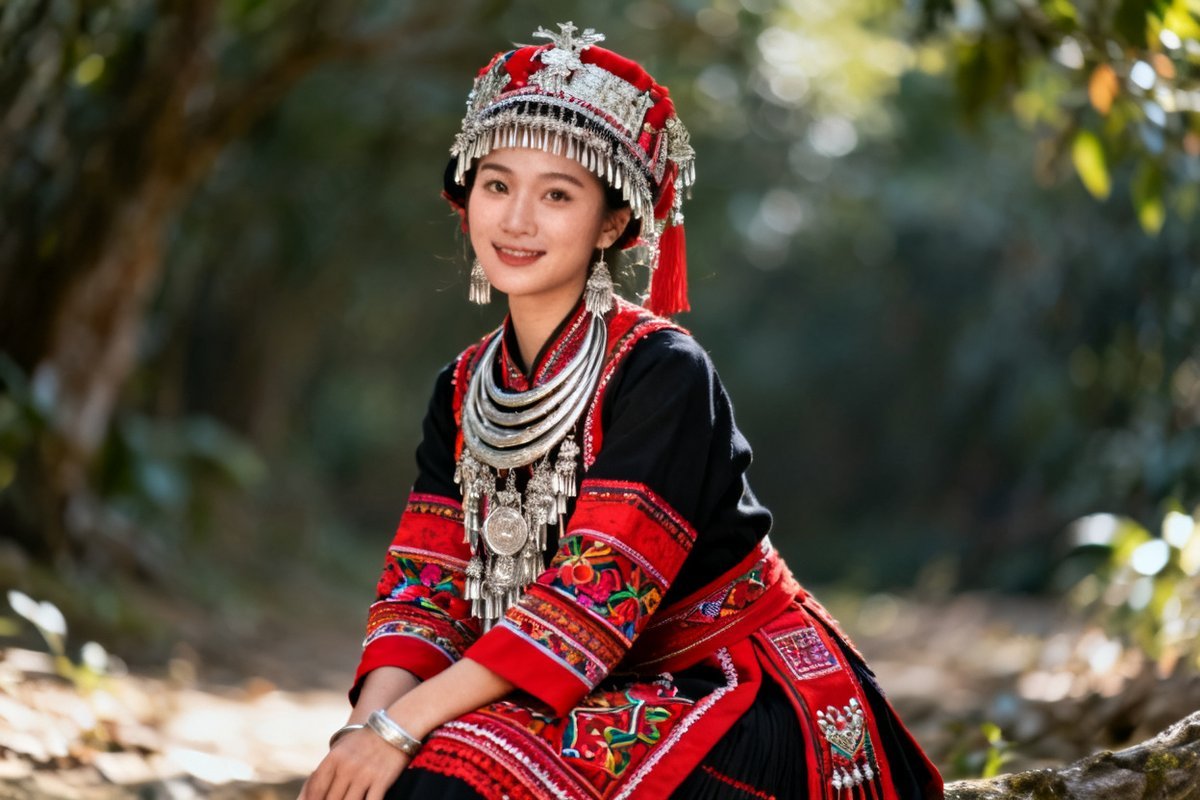
Black is virtually the only base color, achieved through repeated indigo dyeing that can turn fabric nearly blue-black. The cultural preference for black has several explanations: it provides maximum contrast for silver ornaments, it does not show dirt during agricultural work, and it reflects a spiritual association with the tiger's dark stripes from the Lahu origin myth. Applique and trim use red (representing the tiger and life force), white (purity and the spirit world), yellow (sunlight and prosperity), and occasionally blue. Silver provides the essential metallic contrast that transforms the somber black foundation into a striking visual statement. The Lahu aesthetic demonstrates that a severely restricted palette, when combined with sophisticated texture and reflective surfaces, produces results as compelling as any polychrome tradition.
Festival Attire
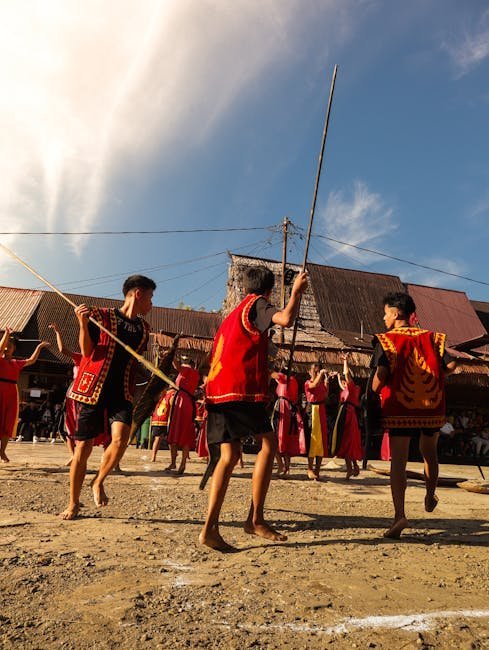
During the Lahu New Year (Kuidong Festival), new black garments with the most extensive silver ornamentation are worn. The festival occurs after the harvest and involves community dancing around a central pole, where the visual effect of dozens of women in identical black jackets with silver catching firelight creates a mesmerizing spectacle. The Harvest Festival similarly calls for full traditional dress. Weddings involve a negotiation between the bride's and groom's families that includes the public display of silver ornaments as a form of bride wealth. The Lusheng dance, performed at major gatherings, requires specific clothing coordination: male dancers wear black jackets with red sashes across the chest, while female dancers wear their fullest silver jewelry sets so the rhythmic clinking of metal becomes part of the percussive accompaniment.
Modern Influence and Preservation
Lahu silver-working traditions are preserved in Lancang County through government-supported artisan cooperatives that connect silversmiths with tourism markets. The backstrap loom weaving technique used for shoulder bags has been documented by ethnographers and textile conservators, with examples held in the Yunnan Nationalities Museum and the Smithsonian Institution. The Lancang Lahu Autonomous County government has established cultural heritage programs that pay master artisans to train apprentices, targeting the preservation of silver-stud application and supplementary weft weaving. Lahu clothing faces the same modernization pressures as other ethnic minority traditions, but the strong community identity associated with black dress has sustained a higher rate of daily traditional wear than is seen among many neighboring groups. The distinctiveness of Lahu monochrome aesthetics has also attracted the attention of international fashion researchers interested in alternative approaches to color and ornament.
Did You Know?
The Lahu name means tiger-skin people - legend says their ancestors were born from tiger and human union, and their black clothing with red applique honors the tigers dark stripes.
Weaving Patterns and Natural Dyes of the Lahu
The Lahu people of Yunnan Province maintain a textile tradition centered on homegrown cotton and natural dyeing techniques passed down through generations of women. The cotton is grown in small mountain plots, harvested, ginned, and spun into thread using hand-operated spinning wheels. The natural cream color of undyed cotton is valued for daily garments, while special occasion clothing is dyed using indigo to achieve deep blue and black tones. Lahu women also produce red and yellow dyes from local roots and bark, using these brighter colors for embroidery threads and decorative trim.
Lahu weaving on backstrap looms produces fabric with distinctive geometric patterns woven directly into the cloth. The most common motif is the zigzag, representing mountain ranges and the Lahu ancestral migration from higher elevations to their current homeland. Diamond patterns symbolize agricultural fields, and chevron bands represent the roofs of Lahu houses. These patterns appear most prominently on the borders of women's jackets and on daily shoulder bags.
Weaving Patterns and Natural Dyes of the Lahu
The Lahu people of Yunnan Province maintain a textile tradition centered on homegrown cotton and natural dyeing techniques passed down through generations of women. The cotton is grown in small mountain plots, harvested, ginned, and spun into thread using hand-operated spinning wheels. The natural cream color of undyed cotton is valued for daily garments, while special occasion clothing is dyed using indigo to achieve deep blue and black tones. Lahu women also produce red and yellow dyes from local roots and bark, using these brighter colors for embroidery threads and decorative trim.
Lahu weaving on backstrap looms produces fabric with distinctive geometric patterns woven directly into the cloth. The most common motif is the zigzag, representing mountain ranges and the Lahu ancestral migration from higher elevations to their current homeland. Diamond patterns symbolize agricultural fields, and chevron bands represent the roofs of Lahu houses. These patterns appear most prominently on the borders of women's jackets and on daily shoulder bags.