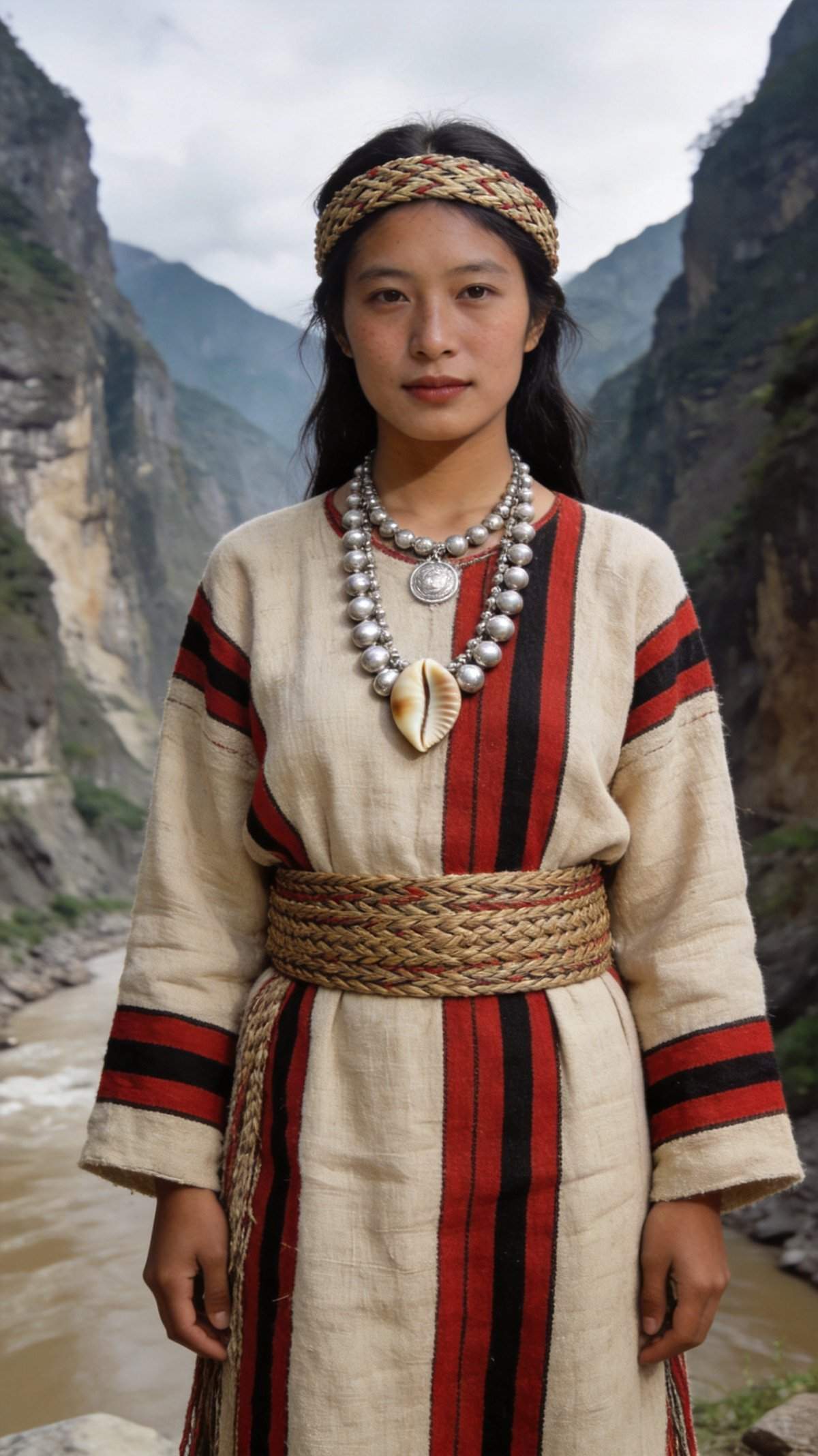
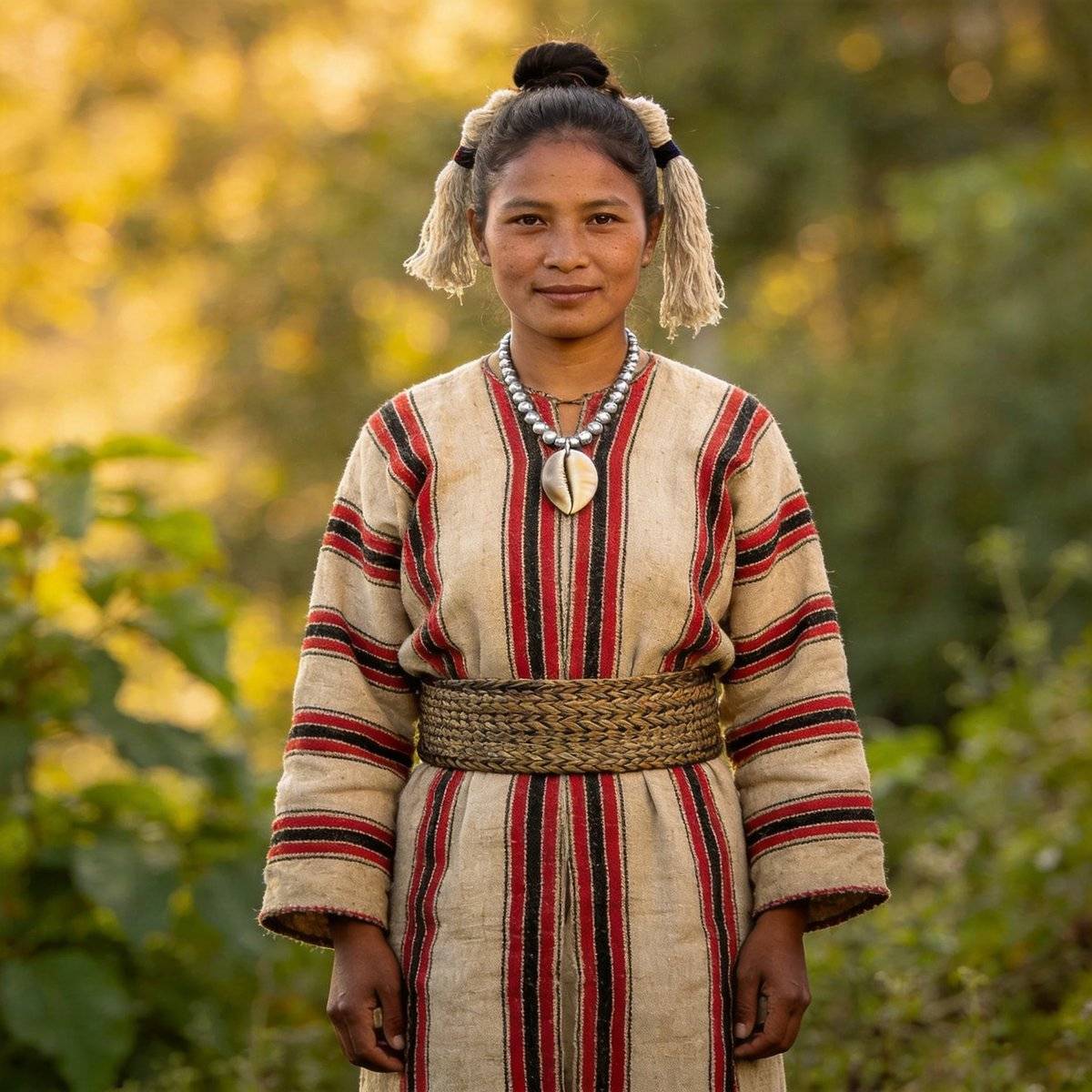
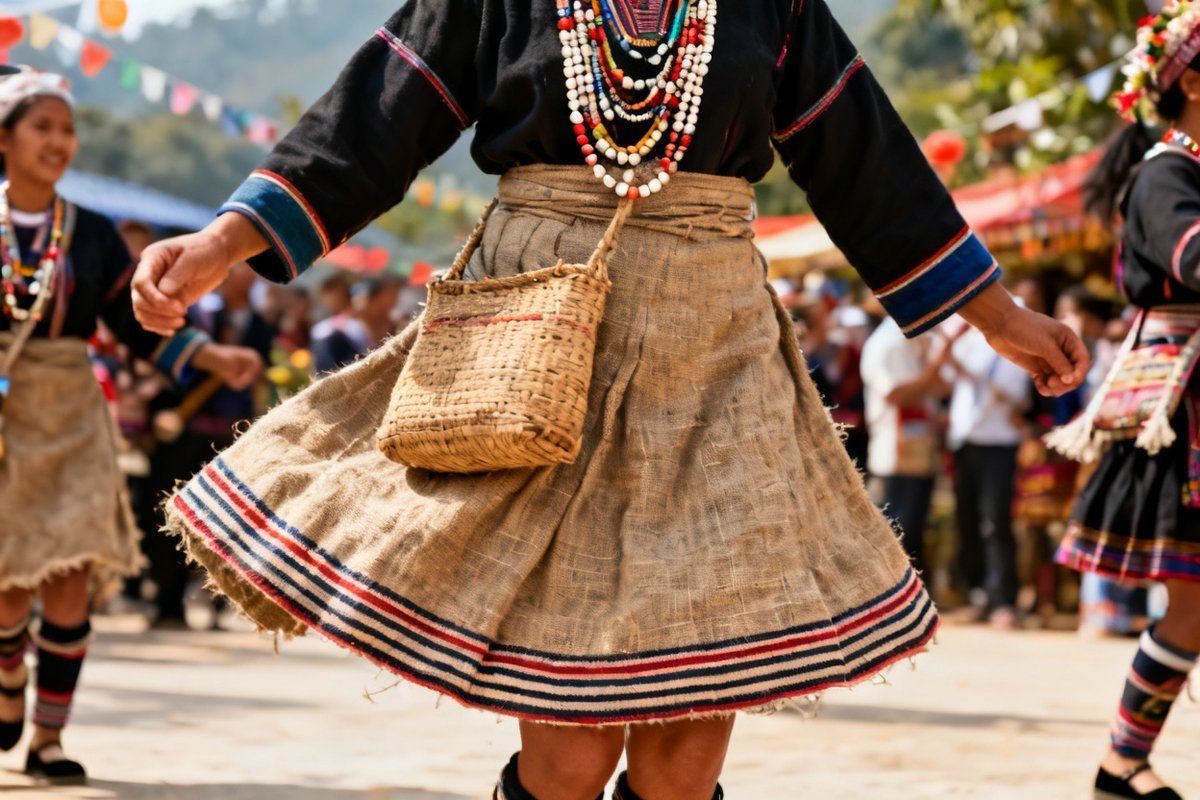
Nu traditional clothing is made from handwoven hemp and cotton fabric in natural tones, decorated with colorful geometric bands and beadwork. Women wear long skirts with distinctive striped hem bands. The Nu people, numbering around 37,000, inhabit the Nujiang Lisu Autonomous Prefecture in northwestern Yunnan Province, along the dramatic gorge of the Nujiang River (Salween River). This deep river canyon, with its steep slopes and isolated valleys, has shaped Nu culture for centuries, fostering a self-sufficient textile tradition based on locally grown hemp and cotton.
Key Features of Nu Attire
- Handwoven hemp and cotton fabric in natural brown and gray tones
- Womens long skirts with bold horizontal striped hem bands
- Colorful bead necklaces and bracelets in geometric arrangements
- Collarless front-fastening jackets with piping trim
- Men's cross-body shoulder bags with woven geometric patterns
Traditional Garments
Women wear a collarless jacket in dark blue or black with colored piping at the edges, paired with a long wraparound skirt featuring distinctive horizontal striped bands at the hem in red, blue, and white. The skirt is wrapped around the waist and secured with a woven belt, and its length extends to the ankles. The striped hem bands are not separately applied — they are woven directly into the fabric by changing weft thread colors during the weaving process, creating integral pattern bands that will never fade or peel away. The jacket is cut simply, with straight sleeves and a front opening fastened with cloth ties or simple buttons.
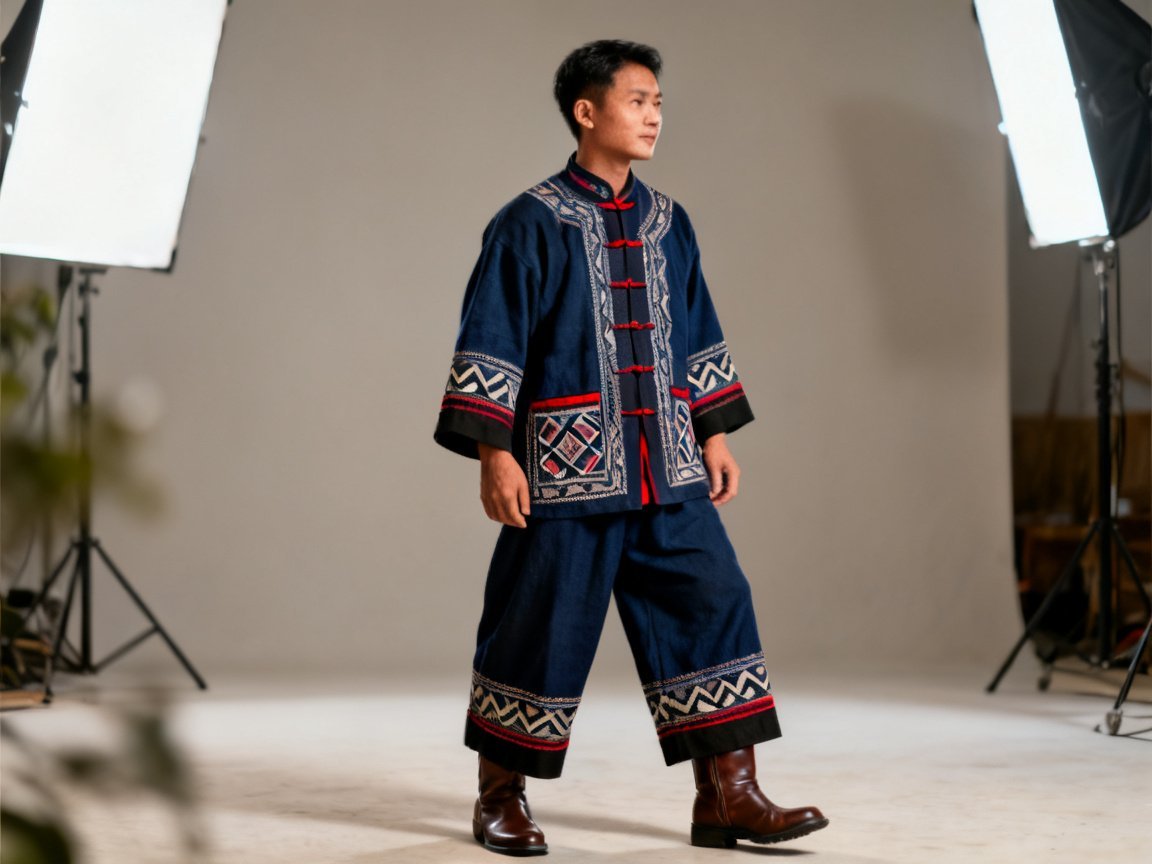
Men wear front-fastening jackets in dark tones with loose trousers, often accompanied by a cross-body shoulder bag called a tongba. These bags are woven on narrow-strip looms and feature geometric patterns in contrasting colors. The shoulder bag is more than an accessory — in Nu culture, a man's bag is a mark of his adulthood and his ability to contribute to the household economy. Bags are used to carry tools, seeds, food, and the bamboo tobacco pipes that many Nu men traditionally use. The woven strap of the bag is typically the most decorated element, with repeated diamond and zigzag motifs representing the mountain paths and river courses of the Nujiang landscape.
Headwear and Adornments
Women wrap their hair in black or blue cloth, sometimes with bead-decorated headbands worn across the forehead. The headwrap is wound directly around the hair, with the ends either tucked in neatly or allowed to hang at the side as a decorative element. Some Nu women favor woven headwraps with patterned ends that hang at the side, the patterns typically matching the striped bands on their skirts. The headwrap doubles as a practical sun shield during fieldwork on the steep terraced slopes of the Nujiang canyon.
Beaded necklaces and bracelets are the primary form of personal adornment for Nu women. These are strung from glass seed beads in bright colors, arranged in geometric patterns — stripes, diamonds, zigzags, and checkerboard arrangements. A single woman may wear multiple strands of different lengths, creating a graduated cascade of color against the dark fabric of her jacket. The beads are obtained through trade with lowland communities, as glass beads are not produced locally. Silver ornaments are less common among the Nu than among neighboring ethnic groups, reflecting the historical isolation and limited trade of Nujiang communities. Men wear simple cloth head wraps and may wear a single beaded bracelet or a carved wooden or bone pendant.
Embroidery and Decorative Arts
Nu decoration focuses on woven geometric bands on skirt hems and shoulder bags rather than needle embroidery. The woven bands are created on the loom by inserting contrasting weft threads in pre-planned sequences, producing stripes, diamonds, zigzag lines, and stepped pyramid patterns. This weaving-based approach to decoration is well-suited to the Nu's hemp fiber tradition, as hemp fabric's coarse texture makes fine needle embroidery difficult. Instead, Nu textile artistry is expressed through the loom itself, with skilled weavers able to produce remarkably complex geometric designs using only the basic mechanism of a backstrap loom.
Beadwork on necklaces and bracelets carries geometric patterns that complement the woven designs in clothing. The beaded patterns follow the same visual vocabulary — horizontal bands, diamond grids, and zigzag lines — creating a unified aesthetic across woven and beaded items. Red, white, blue, and yellow are the dominant bead colors. Some older women possess necklaces that incorporate older, larger beads of uncertain origin, possibly traded up the Nujiang valley from Myanmar or Tibet over generations. These heirloom necklaces are the most prized possessions in a Nu woman's jewelry collection and are worn only for the most important ceremonies.
Living along the wild Nujiang River gorge, the Nu people incorporate the rivers energy into their garments - the bold horizontal stripes on their skirts echo the bands of color seen in the canyon walls at sunset.
Color Symbolism
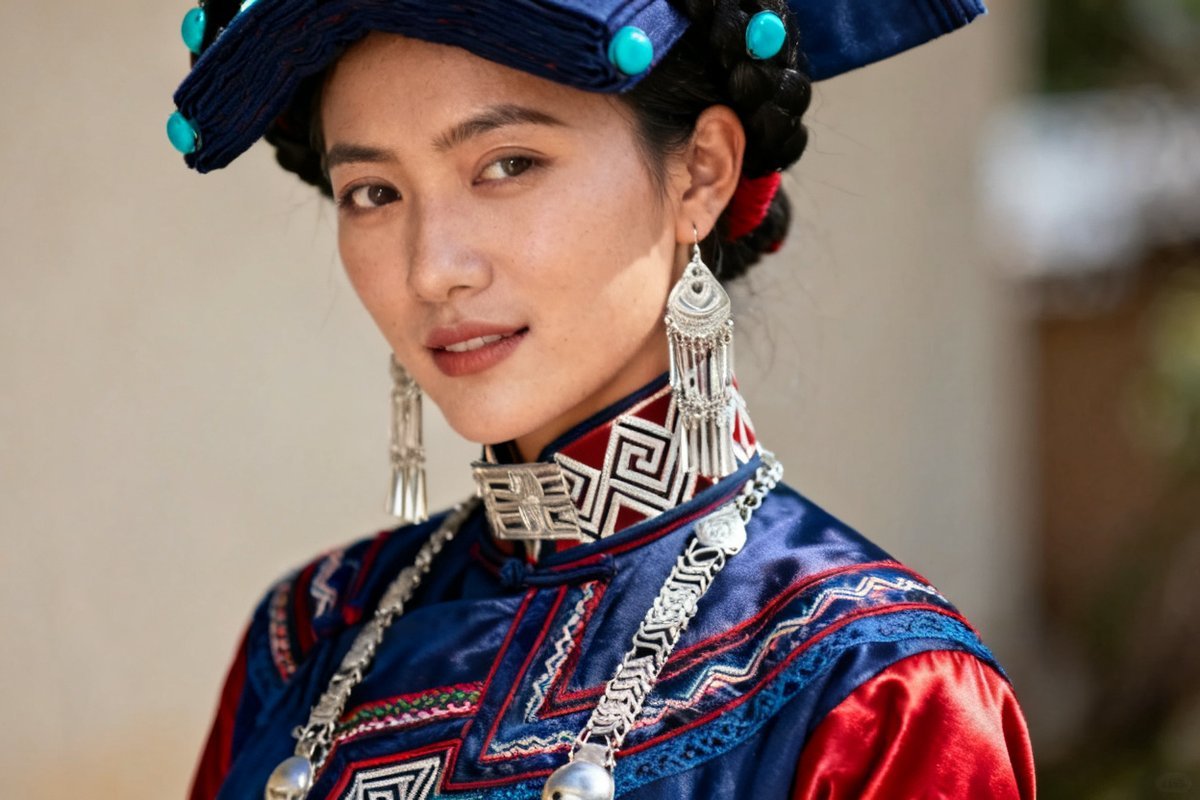
Dark blue, black, and natural hemp tones form the foundation of daily wear, colors that reflect the dark soil of the river gorge and the practical need for clothing that does not show stains from agricultural work. Skirt stripes introduce red (representing life and vitality), blue (the sky above the narrow canyon), white (purity and the river's foam), and green (the dense vegetation of the subtropical gorge). Beadwork employs bright multicolored arrangements without the strict color coding found in other ethnic groups — the Nu approach to color is more intuitive and personal, with individual women choosing bead combinations that please them rather than following fixed symbolic rules. This relative color freedom is characteristic of Nu culture, which has historically been less hierarchical and more individualistic than some neighboring societies.
Festival Attire
During the Nu traditional New Year, celebrated in accordance with the lunar calendar, and the Mountain God Festival, which honors the spirits of the peaks that tower over Nu villages, the best striped skirts and full bead jewelry sets are worn. The Mountain God Festival involves processions to sacred sites in the surrounding mountains, where offerings of food and liquor are made, and traditional circle dances are performed. For these dances, the full visual effect of Nu women's clothing becomes apparent — the horizontal skirt stripes create a rhythmic visual pattern as dancers move in unison, the beaded necklaces swing and catch light, and the colored piping on jackets outlines each dancer's form against the green mountain backdrop.
Wedding attire for Nu brides includes a newly woven skirt with the widest possible striped hem bands, incorporating additional colors beyond the daily three or four. The bridal jacket is also new, often gifted by the groom's family, and features more elaborate piping. The bride wears her family's heirloom bead necklaces, which may include generations-old beads that have been passed from mother to daughter. After the wedding, the bridal skirt becomes the woman's festival skirt, worn for all subsequent celebrations throughout her life. When she grows old, the skirt is passed to a daughter or granddaughter, and its increasingly faded stripes become a record of a life lived in the rhythm of the Nujiang seasons.
Modern Influence and Preservation
Nu hemp-weaving traditions are maintained through cultural preservation programs in the Nujiang region. The local government has supported the establishment of weaving cooperatives in several Nu villages, providing improved looms and connecting weavers with markets for their traditional textiles. The shoulder bag, with its distinctive woven patterns, has become a popular souvenir item among visitors to the Nujiang area, creating economic incentives for younger Nu to learn weaving. However, the cultivation of hemp for fiber has declined as synthetic fabrics have become widely available, and some knowledge of traditional hemp processing — retting, pounding, and spinning the coarse fibers — is at risk of being lost. Cultural documentation projects are recording the techniques of the last generation of women who grew up processing hemp from plant to finished garment, preserving this knowledge even as daily practice shifts toward purchased fabrics.
Did You Know?
The Nu people take their name from the Nujiang River (Salween River), one of the wildest and most remote rivers in the world, along whose gorges they have lived for centuries.
Textile Traditions of the Nu People
The Nu people of Yunnan Province, named after the Nu River valley they inhabit, maintain textile traditions closely connected to their mountainous environment. Cotton and hemp are the primary materials for Nu clothing, with both crops grown in the limited arable land available in the steep river valleys. The fibers are processed by hand using traditional tools, then woven on backstrap looms that can be set up and taken down quickly as families move between seasonal dwellings. The fabric produced is dense and durable, suited to the practical demands of mountain life where clothing must withstand brush, rocks, and frequent washing in cold river water.
Nu women's traditional attire includes a long-sleeved jacket in indigo blue or black, decorated with narrow bands of geometric embroidery at the collar and cuffs. A long wrap skirt in a darker shade completes the ensemble, with the skirt hem falling to the ankle. Nu men traditionally wear a short jacket over loose trousers, with a crossbow and hunting knife carried as both tools and adornments. The crossbow, central to Nu culture as a hunting tool and status symbol, is often decorated with carved patterns that complement the geometric motifs of Nu textiles.