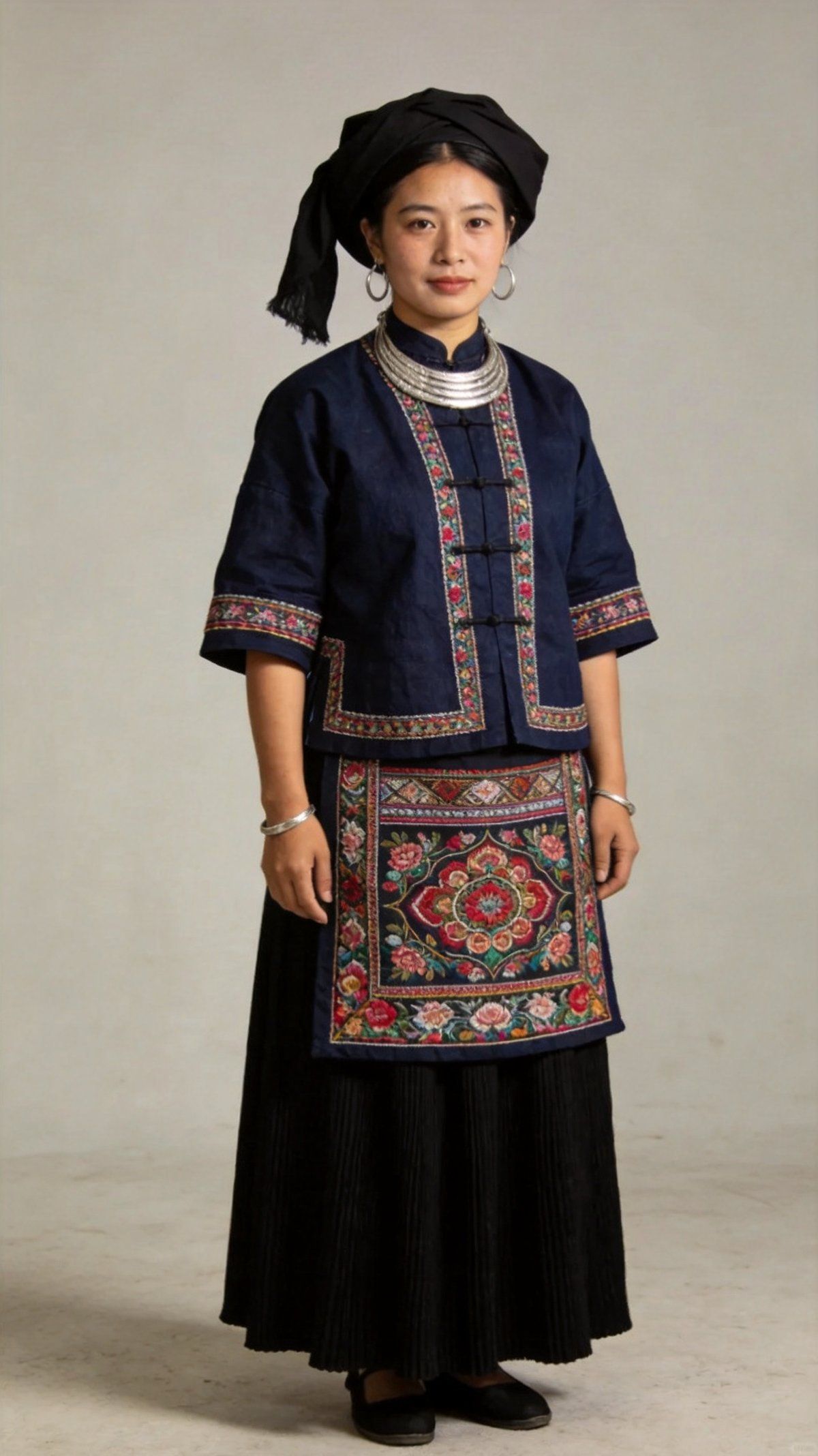
Mulao traditional clothing features deep blue or black handwoven cotton with subtle embroidered accents. Women wear collarless jackets with distinctive silver buckles and wide-leg trousers with embroidered waistbands. The Mulao people, numbering approximately 210,000, live primarily in Luocheng Mulao Autonomous County in the Guangxi Zhuang Autonomous Region of southern China. Their name means "mother" in the Mulao language, reflecting a historically matrilineal social structure. Mulao textile traditions center on indigo dyeing, an ancient craft that produces the characteristically deep blue-black fabrics that define Mulao dress.
Key Features of Mulao Attire
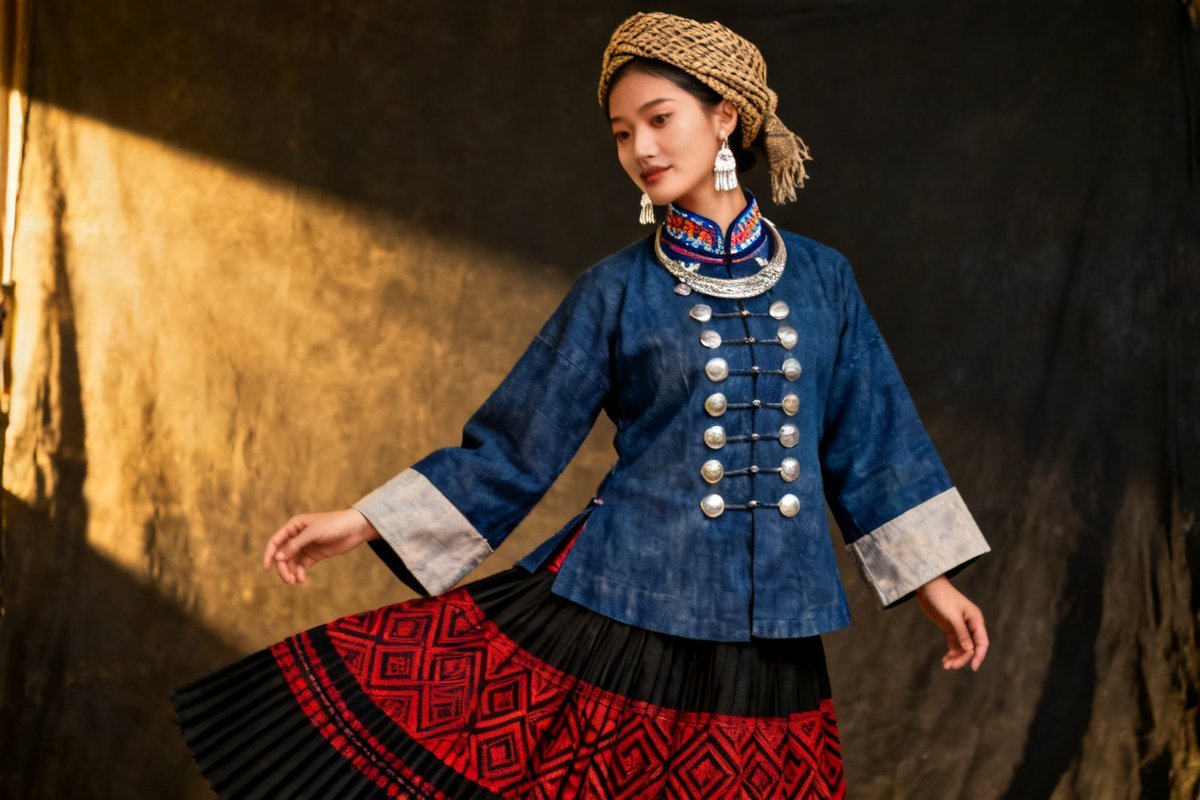
- Deep blue collarless jackets with distinctive silver toggle buttons
- Handwoven cotton fabric in dark indigo tones
- Wide-leg trousers with embroidered waistband panels
- Silver hairpins and earrings with simple elegant designs
- Embroidered cloth shoes with upturned toes for women
Traditional Garments
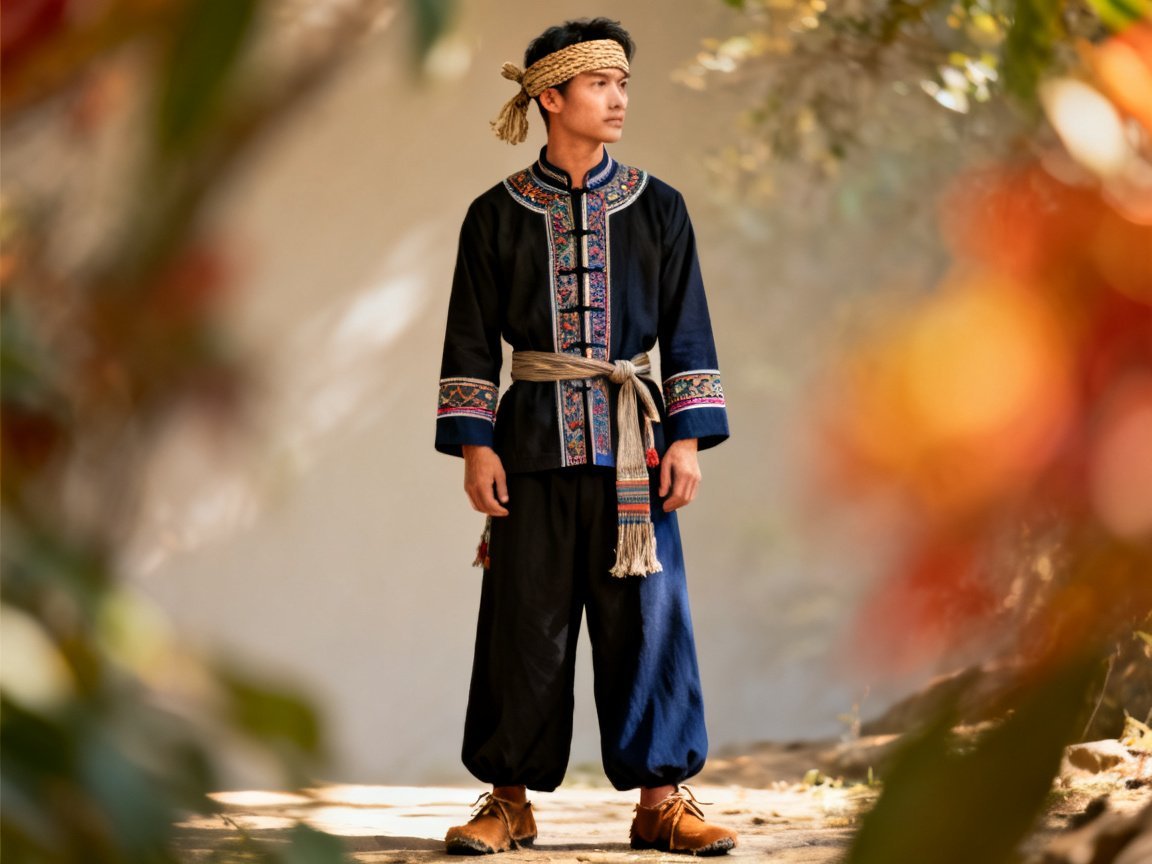
Women wear a collarless, front-fastening jacket in dark blue or black with silver toggle buttons and embroidered trim on the collar and cuffs, paired with wide-leg trousers reaching the ankles. An embroidered waistband peeks out below the jacket, its visible portion acting as a decorative border. The jacket is cut straight with minimal tailoring, allowing freedom of movement for agricultural work in the terraced rice fields that characterize the Mulao homeland. Men wear front-fastening jackets in matching dark tones with cloth buttons and loose trousers, often secured with a simple woven belt.
The indigo dyeing process is central to Mulao textile production. Cotton is hand-spun, woven into fabric on wooden looms, and then repeatedly dipped into fermented indigo vats. Each dip deepens the color, with the finest garments receiving up to twenty immersions to achieve a rich, near-black navy tone. Between dips, the fabric is exposed to air to oxidize the indigo, a process that can take several weeks for a single length of cloth. The resulting fabric is both beautiful and practical — indigo has natural insect-repellent properties that protect the wearer during fieldwork in subtropical Guangxi.
Headwear and Adornments
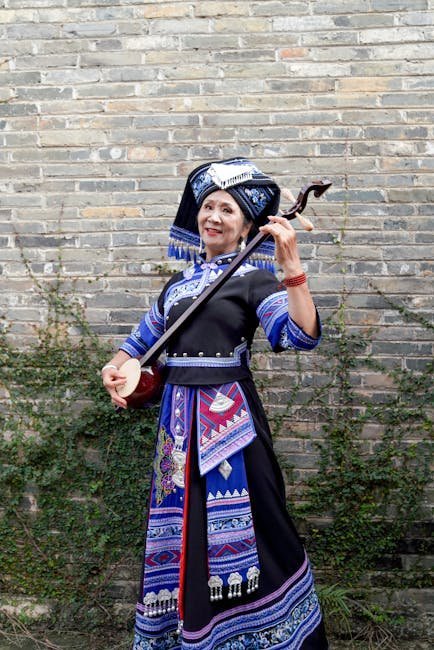
Women traditionally wear their hair in a coiled bun secured with silver hairpins, sometimes covered with a simple cloth headband or a small embroidered cap. The silver hairpins are typically decorated with auspicious symbols — butterflies for happiness, lotus flowers for purity, and fish for abundance. Married women may wear a small embroidered cap that covers only the crown of the head, leaving the hair bun visible at the back. This cap is often the most intricately embroidered item in a Mulao woman's wardrobe, stitched with silk threads in floral patterns against the dark indigo background.
Silver jewelry is understated compared to neighboring ethnic groups — Mulao aesthetic favors simple, elegant designs over elaborate display. Silver earrings are typically small hoops or studs, and necklaces consist of fine silver chains rather than heavy collar pieces. The most distinctive Mulao silver items are the toggle buttons on women's jackets, which are often shaped like small flowers or butterflies and are hand-cast using the lost-wax method. These buttons are functional closures but function equally as a subtle display of the silversmith's skill and the wearer's taste.
Embroidery and Decorative Arts
Mulao embroidery is concentrated on waistbands, cuffs, shoe uppers, and the edges of headwear, featuring small geometric and floral motifs in bright threads on dark fabric. The embroidery uses counted-thread techniques, meaning the embroiderer follows the weave of the base fabric rather than drawing a pattern beforehand. This produces precise, geometric designs that are consistent stitch by stitch. Common motifs include small five-petal flowers, diamond grids, and interlocking triangles that represent mountains.
The embroidered waistband is the most labor-intensive decorative item, sometimes requiring three months of consistent evening work to complete. Women embroider the waistband before it is attached to the trousers, working on a portable embroidery frame that can be held in the lap. Silk threads in bright red, pink, green, yellow, and white stand out dramatically against the dark indigo ground. Men's clothing has minimal embroidery, limited to narrow bands at the collar and cuffs, reflecting the Mulao value of restraint in male presentation. Cloth shoes for both genders feature embroidered toe caps, with women's shoes having more elaborate designs including densely stitched floral medallions on the vamp.
The Mulao people believe that the silver toggles on their jackets chime with each movement, creating a gentle music that wards off ill fortune during festival processions.
Color Symbolism
Dark blue and black dominate daily wear, representing the earth, stability, and the agricultural rhythms of Mulao life. The deep indigo color is achieved through repeated dyeing and is valued for its depth and evenness. Embroidery on the dark ground uses red for happiness and celebration, pink for youth and romance, green for the rice fields central to Mulao livelihood, yellow for prosperity, and white for purity. Silver provides subtle metallic accents that catch light during movement, adding visual interest without overwhelming the restrained overall palette. The dominance of dark colors is also practical — indigo-dyed fabric hides dirt and stains from fieldwork, while the dark surface absorbs heat in winter months. Lighter colors are reserved for undergarments and summer wear.
Festival Attire
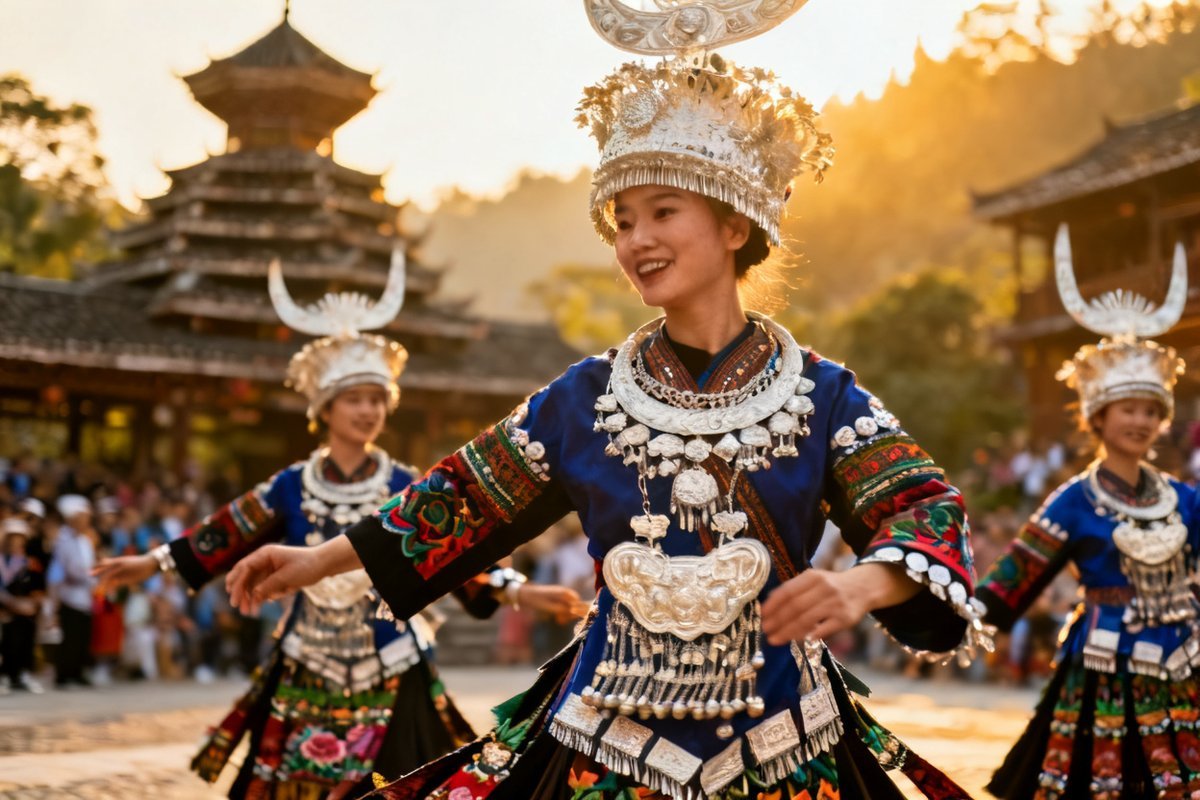
During the Yifan Festival, the Mulao people's most important cultural celebration held every three years, entire villages dress in new dark blue jackets with the finest silver toggles and embroidered details. Yifan is a Thanksgiving-like tradition where the community offers gratitude for the harvest and prays for future prosperity. The festival clothing is prepared months in advance, with women sewing new garments for every family member. The three-year cycle of Yifan creates a rhythm in clothing production — the year before the festival sees a surge in indigo dyeing and embroidery work throughout Mulao villages.
The Spring Festival is also celebrated with new or freshly pressed traditional clothing, though the attire is slightly less formal than Yifan wear. During weddings, the bride wears an entirely new set of indigo clothing, with the embroidered waistband being the centerpiece — its patterns symbolically encode blessings for fertility, prosperity, and household harmony. The groom wears a new dark jacket with silver buttons, often a gift from the bride's family as part of the dowry exchange. Funeral attire, by contrast, is plain undyed cotton without any embroidery or silver decoration, reflecting the Mulao belief that the deceased should return to simplicity.
Modern Influence and Preservation
Mulao indigo dyeing traditions are preserved through community workshops in Luocheng County, where elder women teach younger generations the full process from cotton spinning to the final dye bath. The Luocheng Mulao Autonomous County government has established a cultural heritage center that documents traditional dyeing recipes and embroidery patterns, many of which had never been formally recorded before. While younger Mulao increasingly wear modern clothing for daily life, traditional indigo garments remain essential for festivals, weddings, and funerals. The distinctive deep blue of Mulao indigo has attracted interest from textile artists and sustainable fashion designers in China, creating a modest market for hand-dyed Mulao fabric that provides supplemental income for village women who maintain the tradition. The silver toggle buttons have become a recognized symbol of Mulao identity, appearing on contemporary accessories and cultural products that help fund preservation efforts.
Did You Know?
The Mulao celebrate the Yifan Festival every three years, a unique Thanksgiving-like tradition where entire villages dress in new clothes and offer thanks for the harvest.
Blue Cotton and Festival Dress of the Mulao
The Mulao people of Guangxi Zhuang Autonomous Region have a textile tradition centered on locally grown cotton dyed in shades of blue and black using indigo. The cotton is processed entirely by hand, from planting and harvesting to ginning, spinning, and weaving. Mulao women's daily attire consists of a blue or black jacket with a standing collar, fastened at the right side with cloth buttons, paired with loose trousers in a matching color. The jacket is typically unadorned for daily wear, with decoration reserved for festival garments. This restraint in daily dress creates a visual contrast with elaborately decorated festival clothing.
For festivals, Mulao women wear jackets with embroidered collar panels, cuffs, and front openings. The embroidery uses brightly colored silk threads in floral and butterfly patterns, with each motif carrying auspicious meanings. The embroidered panels are often produced separately and attached to the garment, allowing them to be removed and reused on new jackets as older garments wear out. Silver buttons and clasps replace the plain cloth buttons of daily wear.
Blue Cotton and Festival Dress of the Mulao
The Mulao people of Guangxi Zhuang Autonomous Region have a textile tradition centered on locally grown cotton dyed in shades of blue and black using indigo. The cotton is processed entirely by hand, from planting and harvesting to ginning, spinning, and weaving. Mulao women's daily attire consists of a blue or black jacket with a standing collar, fastened at the right side with cloth buttons, paired with loose trousers in a matching color. The jacket is typically unadorned for daily wear, with decoration reserved for festival garments. This restraint in daily dress creates a visual contrast with elaborately decorated festival clothing.
For festivals, Mulao women wear jackets with embroidered collar panels, cuffs, and front openings. The embroidery uses brightly colored silk threads in floral and butterfly patterns, with each motif carrying auspicious meanings. The embroidered panels are often produced separately and attached to the garment, allowing them to be removed and reused on new jackets as older garments wear out. Silver buttons and clasps replace the plain cloth buttons of daily wear.