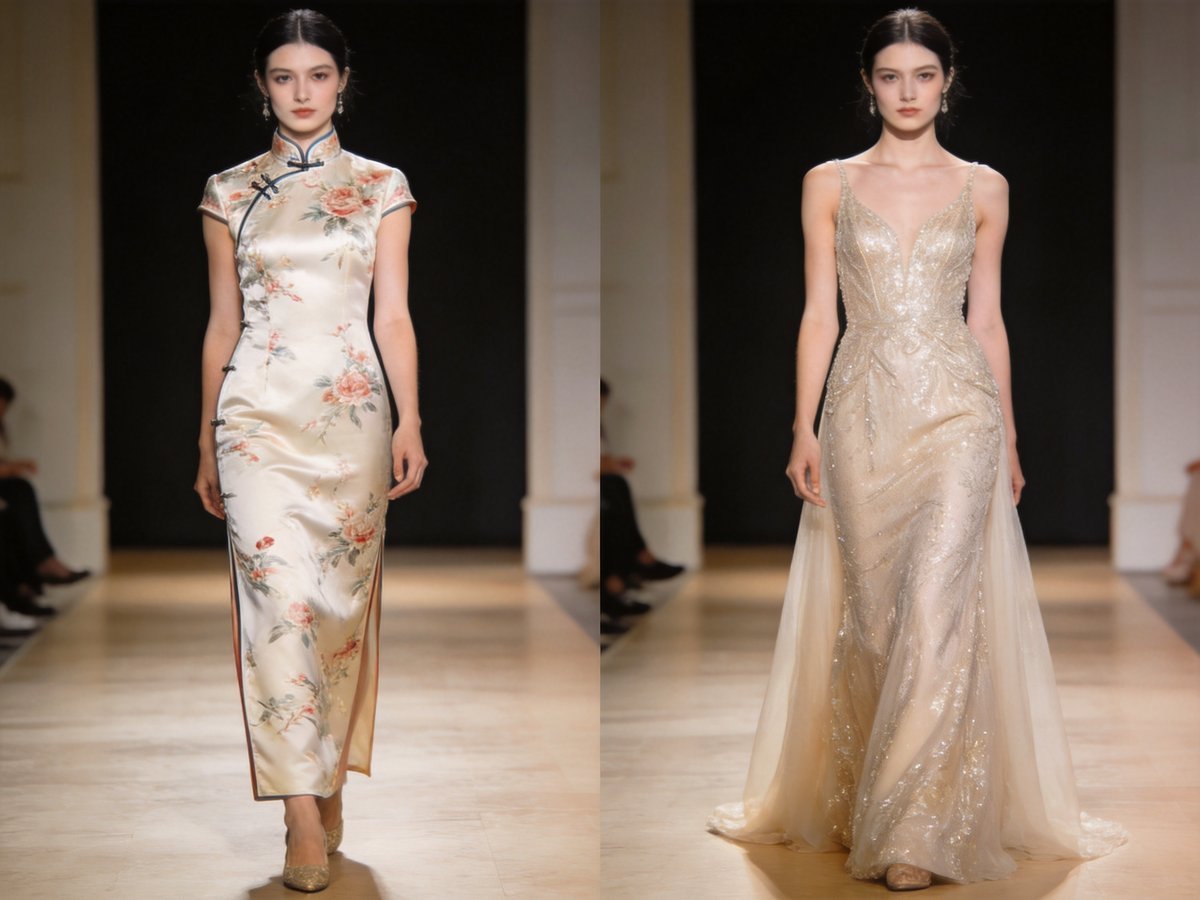
The qipao and the Western evening dress represent two fundamentally different philosophies of formal dress. One emphasizes the body through fitted construction, the other through flowing fabric. One values modesty and restraint, the other celebrates exposure and drama. Comparing these two iconic garments reveals deep cultural differences in how Eastern and Western societies conceptualize femininity, elegance, and the role of clothing in formal settings.
Silhouette: Fitted vs Flowing
The most obvious difference between the qipao and the evening dress is their silhouette. The qipao follows the body's natural contours, fitted from shoulder to hem with side slits that allow movement. Its construction requires precise measurements and perfect tailoring, as there is little room for error when fabric is held so close to the body. The Western evening dress, by contrast, typically uses volume and drape to create its effect. A ball gown may contain twenty feet of fabric, creating a shape that exists independently of the body beneath it.
Cultural Ideals of Femininity
The qipao and evening dress reflect different cultural ideals of feminine beauty. The qipao's approach is one of suggestion rather than display - it reveals the body's shape through fitted fabric but covers the skin, with only the face, hands, and perhaps a glimpse of leg through the side slit visible. This approach aligns with traditional Chinese aesthetics, which value subtlety and indirection. The Western evening dress, particularly in its more revealing forms, takes the opposite approach, using bare shoulders, plunging necklines, and open backs to create impact through exposure.
Fabric and Decoration
- Qipao typically uses silk, brocade, or velvet with intricate embroidery or print
- Evening dresses use a wider range of fabrics including tulle, organza, satin, and chiffon
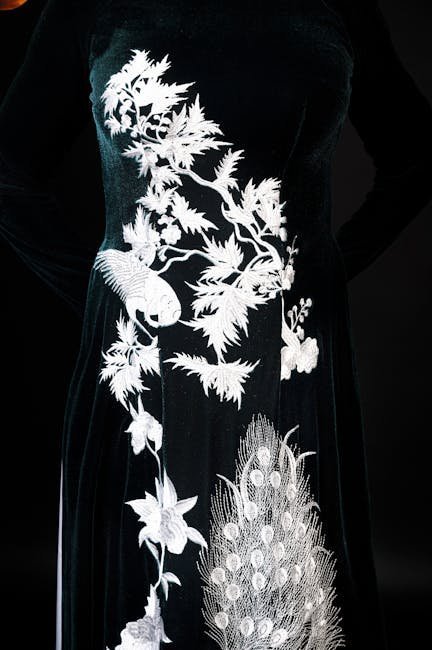
- Qipao decoration is often symbolic - dragons, phoenixes, flowers with meaning
- Evening dress decoration is primarily aesthetic - sequins, beads, lace for beauty
- Qipao construction emphasizes clean lines and perfect fit
- Evening dress construction often prioritizes volume and dramatic effect
The qipao whispers while the evening dress announces. One draws you in through subtle suggestion, the other commands attention through dramatic display. Neither approach is superior - they simply speak different languages of elegance.
Historical Context
The qipao evolved from Manchu court dress and was refined in 1920s Shanghai, a period of cultural fusion and modernity. The Western evening dress has its roots in European court dress of the eighteenth and nineteenth centuries, evolving through the crinoline, the bustle, and the bias-cut gown. Each garment carries the history of its culture's approach to formal dress, from the Chinese emphasis on social harmony and propriety to the Western celebration of individual expression.
Tailoring and Construction Philosophy
The two garments reflect fundamentally different approaches to garment construction. The qipao achieves its effect through precise fit—it succeeds or fails based entirely on how well it has been tailored to the individual body. This means a qipao cannot truly be purchased off the rack; even moderately priced qipaos typically require multiple fitting sessions to adjust the side seams, collar height, and sleeve length to the wearer. The evening dress, by contrast, often achieves its effect through engineering—internal corsetry, crinoline cages, horsehair braid hems, and boned bodices create a silhouette that exists somewhat independently of the body beneath it. This structural approach means an evening dress can be altered to fit a wider range of body types without losing its essential character, while a qipao that has been poorly fitted simply looks wrong. The construction difference extends to the maker's skill: a qipao tailor specializes in one garment and may spend an entire career perfecting it, while a couture evening dress atelier typically employs specialists for different parts of a single gown—one person for the bodice, another for the skirt, and yet another for the beading.
Modern Cross-Cultural Influence
In contemporary fashion, the boundaries between qipao and evening dress have become increasingly blurred. Western designers frequently incorporate qipao elements such as the mandarin collar and frog buttons into their evening collections. Chinese designers have adopted Western silhouettes and reinterpreted them through a Chinese aesthetic lens. The result is a rich cross-cultural exchange that benefits both traditions. Modern women may choose to wear a qipao-inspired evening dress or pair a traditional qipao with Western accessories, creating personal style that transcends cultural boundaries. This cross-pollination is not new: as early as the 1920s, Shanghai designers were adapting Western Art Deco motifs into qipao fabric patterns, and European designers copied Chinese embroidery techniques for their own evening collections. What has changed is the speed and visibility of the exchange, driven by social media, global fashion weeks, and a generation of designers who have grown up equally fluent in multiple aesthetic traditions. The modern fashion consumer has access to both traditions at once and can mix elements in ways that would have been considered jarring or inappropriate just a generation ago, creating personal style vocabularies that draw from both Eastern and Western fashion heritage.
Occasion and Appropriateness
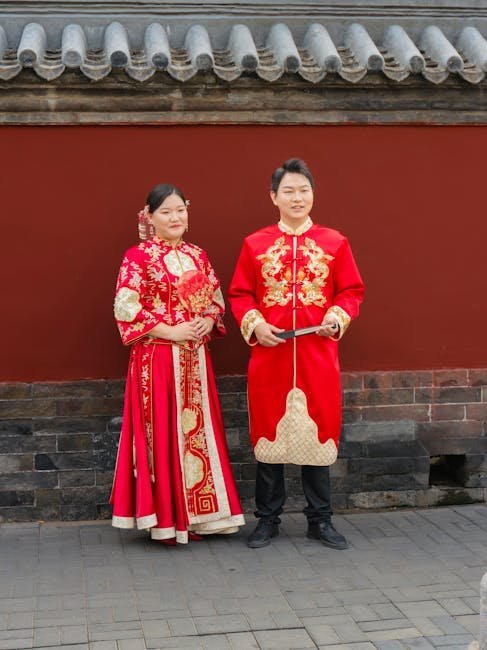
The qipao and evening dress also differ in their conventions of appropriateness. A qipao can be worn to a wide range of formal occasions - weddings, banquets, business dinners - and can be appropriate at any time of day. Western evening dress is more strictly divided by time and occasion, with cocktail dresses for semi-formal events, floor-length gowns for black-tie occasions, and specific conventions for different types of events. This difference reflects broader cultural attitudes: Chinese formal dressing emphasizes versatility and practicality, with one garment serving multiple roles, while Western formal dressing embraces specialization across distinct dress codes. The qipao's adaptability gives it an economic advantage as well—a single well-made qipao can serve a woman for years across many different events, while a Western formal wardrobe may require multiple specialized pieces.
Did You Know?
When Hollywood star Elizabeth Taylor visited Hong Kong in the 1960s, she had dozens of qipaos custom-made. She wore them to formal events worldwide, introducing Western high society to the elegance of Chinese formal wear.
Notable Designers and Their Contributions
Both the qipao and the evening dress have been shaped by visionary designers who brought their unique perspectives to these iconic garments. In China, the Shanghai tailor Zhu Qingshan established standards for qipao cutting that remain influential today, developing a method of cutting the garment in a single piece without shoulder seams that allowed the fabric to drape smoothly over the body. Designer Guo Pei, who created Rihanna's iconic yellow gown for the 2015 Met Gala, has frequently incorporated qipao elements into her couture collections, reimagining the mandarin collar and frog buttons for a global audience. In Western fashion, designers like Yves Saint Laurent and Christian Dior elevated the evening dress to an art form, with Saint Laurent's 1965 Mondrian dress and Dior's 1947 New Look silhouette defining eras of fashion history. Contemporary designers from both traditions increasingly collaborate and cross-pollinate, attending each other's fashion weeks and drawing inspiration from shared textile heritage.
The craftsmanship required for each garment represents different skill sets. A master qipao maker must understand the subtle relationship between the body's curves and the fabric's behavior, knowing how much ease to allow at each point. The collar must fit snugly without choking, the side seam must follow the body's line without pulling, and the slits must fall at exactly the right height. An evening dress couturier, by contrast, must master the engineering of structure: how to build a corset that supports without discomfort, how to distribute the weight of heavy beading and embroidery, and how to create a hem that falls perfectly whether the wearer is standing still or walking. Both disciplines require years of training and a deep understanding of fabric behavior.
Caring for Formal Garments
Proper care significantly extends the life of both qipaos and evening dresses. A qipao made of silk requires dry cleaning or gentle hand washing with specialized silk detergent, and should be stored flat or hung on padded hangers to maintain its shape. The fitted construction means that improper storage can permanently alter the garment's fit, with shoulder seams stretching and collar shapes distorting over time. Evening dresses demand even more careful handling due to their complex construction and delicate embellishments. Beaded and sequined gowns should never be folded, as the weight of the decorations can pull and distort the fabric. A well-maintained qipao or evening dress can last for decades and even be passed down to the next generation, becoming a family heirloom that carries the memory of important celebrations through time. Many vintage qipaos from the 1930s remain in excellent condition today, treasured for their exquisite craftsmanship and timeless design.