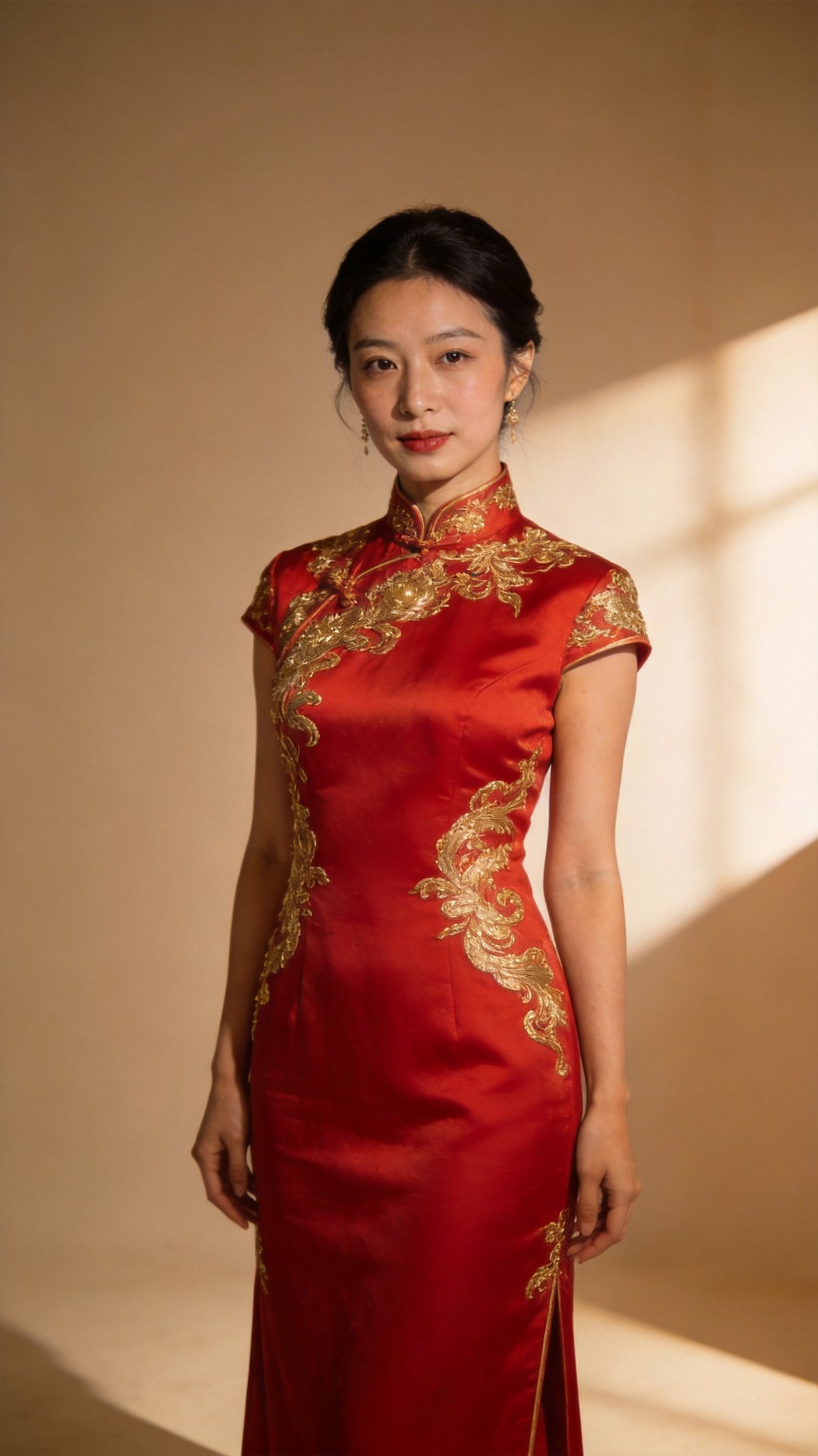
The qipao, also known as the cheongsam, is arguably the most recognizable Chinese garment in the world. Its journey from Manchu court robe to twentieth-century fashion icon is a story of cultural transformation, political upheaval, and creative reinvention. Few garments in world history have undergone such a dramatic evolution while retaining their essential identity.
Manchu Origins
The word qipao literally means 'banner robe,' referring to the Eight Banners system of Manchu military and social organization. The original Manchu women's robe was a loose, straight-cut garment with wide sleeves, worn with a separate skirt underneath. It was practical, modest, and unshaped - very different from the fitted garment we know today. Manchu women also wore distinctive platform shoes with a central heel, called qixie, which elevated them several inches and required a distinctive swaying gait. The fabric choices of the original qipao reflected the Manchu preference for heavy silks and brocades, often in deep blues, purples, and blacks edged with intricate woven borders. Unlike Han Chinese women's clothing, which emphasized flowing lines and layered garments, the Manchu robe prioritized clean, architectural shapes that conveyed authority and restraint.
The Shanghai Transformation
The qipao's transformation from court robe to fashion icon happened in 1920s Shanghai, one of the world's most dynamic and cosmopolitan cities. Shanghai tailors began experimenting with the traditional Manchu robe, fitting it more closely to the body, raising the hemline, and adding side slits. The result was a one-piece dress that was both modern and recognizably Chinese. Shanghai's film stars and socialites adopted the new qipao enthusiastically, and by the 1930s, it had become the standard dress for urban Chinese women. The Shanghai qipao was made in luxurious fabrics like silk and velvet, often embroidered or printed with floral patterns.
Key Features of the Modern Qipao
- Standing collar (Mandarin collar) that frames the neck elegantly
- Fitted bodice following the body's natural curves without being tight
- Side slits of varying heights, traditionally reaching mid-thigh
- Frog buttons (pankou) as decorative closures at the front
- Fabric choices from simple cotton to elaborate silk brocade
- Various sleeve lengths from cap sleeves to three-quarter length
The qipao has been called the 'Chinese little black dress' - a garment so versatile that it can be worn to a wedding, a business meeting, or a cocktail party with only a change of accessories. Its genius lies in its simplicity.
Tailoring Mastery and the Shanghai School
The qipao's fitted silhouette demands exceptional tailoring skill, and Shanghai developed a distinct school of qipao craftsmanship that remains the gold standard. Master tailors at legendary houses like Hongxiang and Longfeng could take over thirty body measurements to achieve a fit that followed every curve without a single wrinkle. The hallmark of a well-made qipao is the continuous piping along the collar, front placket, hem, and side slits—a detail that requires a steady hand and years of practice to execute evenly. Traditional tailoring also incorporates a thin inner facing of silk organza between the outer fabric and the lining, which gives the garment enough structure to maintain its shape while remaining flexible against the body. The bias-cut technique, where fabric is cut at a forty-five-degree angle to the grain, was adopted by Shanghai tailors in the 1930s and allowed the qipao to skim the body with an almost liquid drape.
The Qipao in Communist China
After the Communist Revolution in 1949, the qipao fell out of favor as the new government promoted practical, egalitarian clothing. It was associated with bourgeois decadence and the old society. During the Cultural Revolution, wearing a qipao could attract severe criticism. The garment survived primarily in overseas Chinese communities and in Hong Kong, where it continued to evolve. This period of suppression ironically cemented the qipao's status as a symbol of Chinese cultural identity. In Hong Kong during the 1950s and 1960s, the qipao reached new heights of refinement: local tailors shortened the hemline to just below the knee, narrowed the sleeves, and experimented with Western fabrics like lace and printed cotton alongside traditional silks. The Hong Kong qipao became the uniform of cosmopolitan women—socialites, actresses, and professionals who navigated between Chinese and British cultures with ease. Photographs from Hong Kong's golden era of cinema show actresses like Linda Lin Dai and Betty Loh Ti in exquisitely fitted qipaos that helped define the glamour of mid-century Chinese film.
Modern Revival and Global Influence
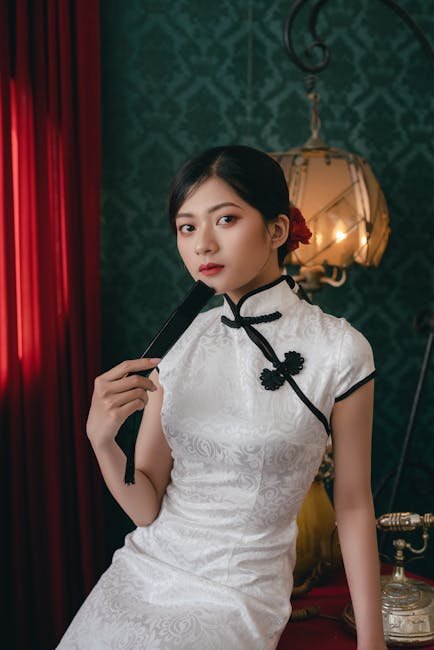
Today, the qipao has experienced a remarkable global revival. It is worn by celebrities on red carpets, by brides as wedding attire, and by fashion-forward women around the world. Designers from both East and West have reinterpreted the qipao, experimenting with new fabrics, lengths, and silhouettes while maintaining its essential character. The qipao appears regularly in fashion collections from New York to Paris, and it remains a powerful symbol of Chinese elegance and sophistication.
The qipao's most iconic moment in global cinema came with Wong Kar-wai's 2000 film In the Mood for Love, in which Maggie Cheung wears over twenty different qipaos, each in a different fabric and pattern, throughout the story. The film's costume designer, William Chang, used the changing qipao as a narrative device, with each dress reflecting a shift in the protagonist's emotional state. The film triggered a worldwide qipao renaissance, with fashion houses from Shanghai to Milan rushing to produce qipao-inspired collections. More recently, Chinese designers like Uma Wang and Guo Pei have incorporated qipao elements into haute couture, presenting the garment at Paris Fashion Week and earning international acclaim. On the red carpet, actresses such as Gemma Chan and Constance Wu have worn modern qipao-inspired gowns at major awards ceremonies, demonstrating the garment's enduring relevance in contemporary fashion.
Did You Know?
In the 1930s, Shanghai's 'qipao wars' saw tailors competing to design the most innovative versions. Hemlines rose and fell with the seasons, and side slits reached daring heights before being moderated by public opinion.
The Qipao in Republican Era Shanghai
The golden age of the qipao occurred in Shanghai during the 1920s and 1930s, when the city was one of the most cosmopolitan centers in Asia. Shanghai tailors transformed the loose Manchu robe into a fitted, figure-flattering garment that reflected the modern spirit of the era. The most significant innovation was the introduction of side slits, which allowed for ease of movement and created a sensual glimpse of the leg that was considered daring at the time. The hemline of the qipao fluctuated with fashion trends, rising to the knee in the late 1920s, dropping to the ankle in the mid-1930s, and then rising again, demonstrating that Chinese fashion was as dynamic as any in the world. The qipao became the uniform of the modern Chinese woman, worn by students, office workers, socialites, and film stars alike.
Shanghai's qipao industry supported a vast ecosystem of specialized artisans. Fabric shops along Nanjing Road stocked silks from Suzhou and Hangzhou, brocades from Nanjing, and imported textiles from Europe and Japan. Tailors who specialized exclusively in qipao could be found in every neighborhood, each with their own patterns and techniques passed down through apprenticeship. The most exclusive ateliers catered to film stars and wealthy socialites, creating custom garments that could cost several months of an average worker's salary. Fashion magazines of the era featured the latest qipao styles alongside Western fashion news, and the most popular designs were quickly copied by less expensive tailors throughout the city. This vibrant fashion ecosystem made Shanghai the undisputed qipao capital of the world.
The Qipao in Contemporary Fashion
The qipao has experienced a significant revival in the twenty-first century, reemerging as a garment of choice for formal occasions and cultural celebrations. Modern interpretations range from faithful reproductions of 1930s Shanghai styles to avant-garde designs that use qipao elements such as the mandarin collar and frog buttons in entirely new silhouettes. Red carpet appearances by Chinese celebrities wearing qipao-inspired gowns have brought the garment to global attention, with international designers increasingly referencing qipao details in their collections. The qipao has become a powerful symbol of Chinese cultural identity in the diaspora, worn by brides for wedding ceremonies, by performers at cultural events, and by women who wish to connect with their heritage through fashion.
Contemporary qipao designers face the challenge of honoring tradition while appealing to modern tastes. The most successful designs maintain the essential elements, the standing collar, the asymmetrical closure, and the fitted bodice, while updating proportions, fabrics, and decorative details. Designers experiment with non-traditional colors, including black, white, and pastels alongside the classic red, gold, and blue. The qipao has also influenced Western fashion, with designers incorporating Mandarin collars, frog closures, and side slits into dresses that bear no other resemblance to the traditional garment. This cross-cultural exchange demonstrates the qipao enduring design power and its ability to transcend its original cultural context to become a genuinely global fashion icon.