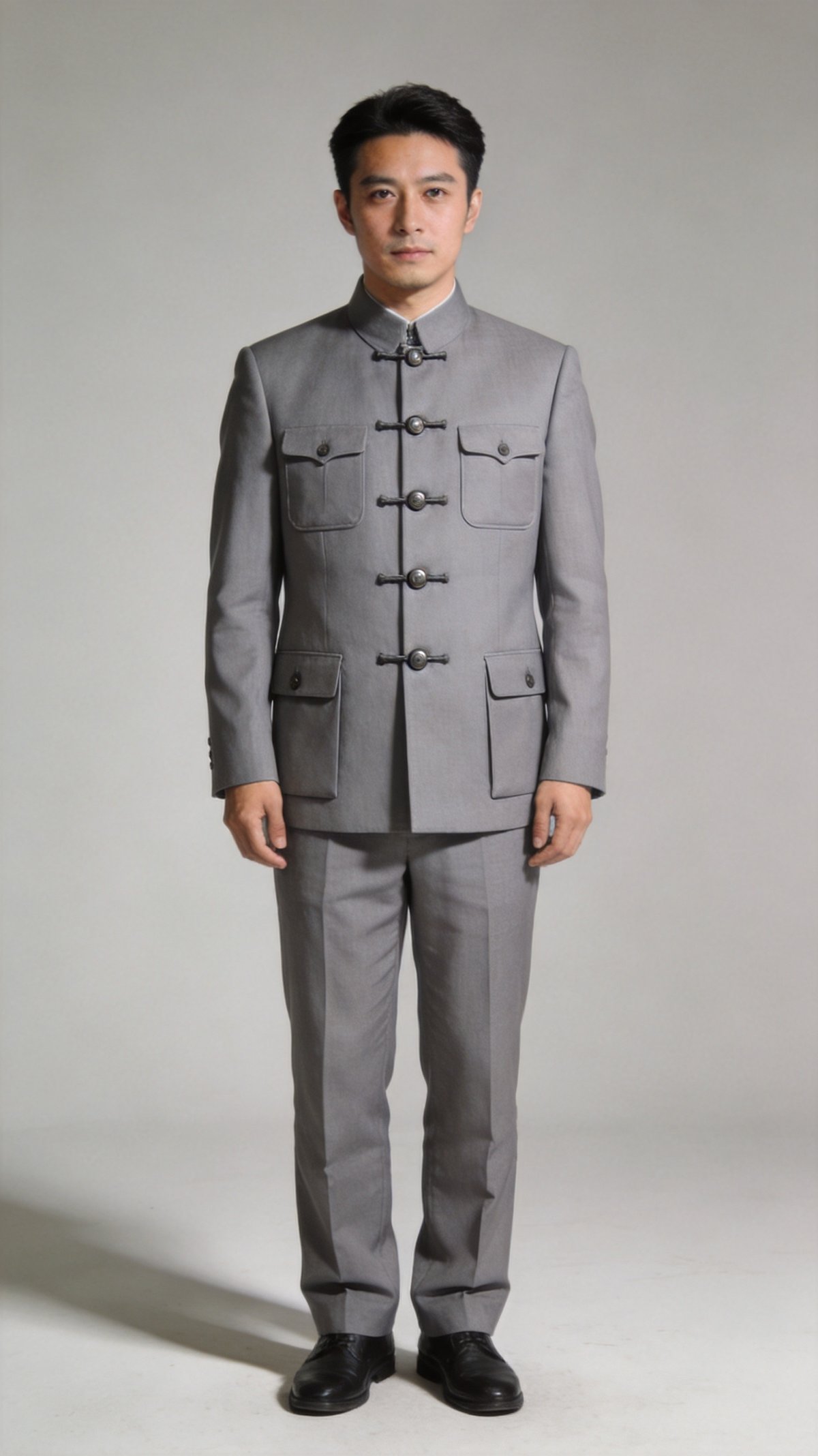
The Zhongshan suit, known in the West as the Mao suit, is one of the most politically significant garments in modern history. Named after Sun Yat-sen, whose courtesy name was Zhongshan, this suit represents a unique fusion of Chinese and Western tailoring traditions. It was designed to be a modern, national dress for China - a garment that symbolized the country's emergence from imperial rule into the modern era.
Sun Yat-sen's Vision
Sun Yat-sen, the founding father of the Republic of China, personally involved himself in the design of the suit that would bear his name. Influenced by the Japanese student uniforms he had seen during his exile in Japan, which were themselves adaptations of Prussian military uniforms, Sun envisioned a garment that was modern, practical, and distinctly Chinese. The Zhongshan suit was designed to be a leveling garment - one that minimized class distinctions and projected an image of professionalism and patriotism. When Sun Yat-sen first appeared in public wearing the suit in the early 1920s, it generated immediate discussion. The suit communicated a break from the elaborate silk robes of the imperial era, signaling that the new Republic valued practicality over ostentation. Sun worked with Shanghai tailors to refine the design through several iterations, adjusting the collar height, pocket placement, and shoulder construction until the garment achieved the exact balance of authority and accessibility he wanted.
Design and Symbolism
- Standing collar that is neat and modest, avoiding the Western necktie
- Four pockets representing the four cardinal virtues of Chinese society
- Five buttons on the front symbolizing the five branches of government
- Three buttons on each cuff representing the Three Principles of the People
- Closed front without visible fastening, projecting a clean appearance
- Structured shoulders that create a dignified, upright silhouette
The Zhongshan suit is a garment designed by a revolutionary with a political purpose. Every detail carries meaning - the four pockets represent virtue, the five front buttons represent the branches of government, the three cuff buttons represent the Three Principles of the People.
From Revolution to Uniform
After the Communist Revolution in 1949, Mao Zedong adopted the Zhongshan suit as his signature garment, which led to its international recognition as the 'Mao suit.' Under Mao, the suit became the de facto uniform for Chinese men, worn by everyone from factory workers to government ministers. The suit's egalitarian nature - it looked similar on everyone regardless of rank - aligned perfectly with Communist ideology. During the Cultural Revolution, the Zhongshan suit in gray or blue was virtually the only acceptable clothing for men. Women also adopted modified versions of the Zhongshan suit, known as the Lenin suit or cadre suit, which featured a similar standing collar and structured silhouette but was cut with a more fitted waist and slightly flared jacket hem. These women's variants became the standard attire for female Party officials and professionals, projecting competence and ideological commitment while maintaining a modest, practical appearance. By the 1970s, photographs of Chinese streets showed a sea of blue, gray, and olive Zhongshan suits and Lenin suits—a visual uniformity that fascinated and perplexed Western observers.
Global Recognition
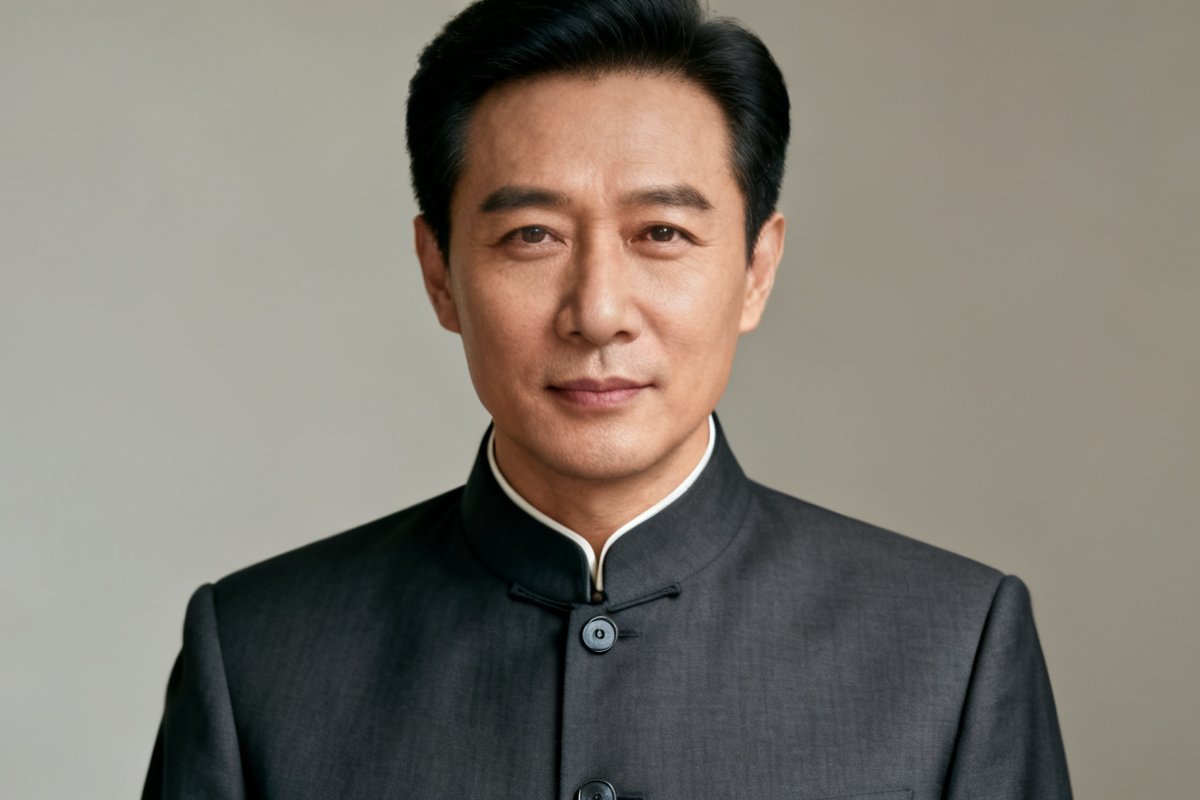
The Zhongshan suit became internationally recognized as the uniform of Chinese leadership. Mao Zedong's meeting with Richard Nixon in 1972, in which both leaders wore their national dress, created one of the twentieth century's most memorable diplomatic images. The suit was worn by Chinese leaders at major international events throughout the Cold War period, becoming as recognizable a symbol of China as the flag or the Great Wall. Even after Mao's death in 1976, his successors continued to wear the Zhongshan suit for formal state occasions well into the 1990s, when Jiang Zemin became the first Chinese leader to regularly appear in a Western-style business suit at international summits. This sartorial shift marked a broader change in China's approach to global diplomacy, signaling a desire to engage with the international community on its own terms.
Construction Details
A well-made Zhongshan suit is a marvel of tailored precision, requiring skills that bridge Chinese and Western garment traditions. The standing collar is the most technically demanding element: it must stand firmly without collapsing, yet remain comfortable against the throat for hours of wear. Traditional tailors achieve this by inserting multiple layers of starched linen interfacing into the collar and shaping it with steam and pressure until it holds its form permanently. The four patch pockets are applied to the outside of the jacket rather than set into seams, making any irregularity in stitching immediately visible—a detail that separates skilled tailors from novices. The shoulders are constructed with a moderate amount of padding, creating a square, authoritative line without the exaggerated bulk of 1980s power shoulders. The back of the jacket typically features a center vent or two side vents, allowing ease of movement when sitting or raising the arms. Modern reproductions often simplify the construction with fusible interfacing in place of hand-padded canvas, but the finest examples still use traditional methods that require fifteen to twenty hours of skilled labor per jacket.
Modern Revival
In recent years, the Zhongshan suit has experienced a revival as a formal alternative to the Western business suit. It is worn by some Chinese leaders at ceremonial occasions and has been adopted by grooms as an alternative to the tuxedo at weddings. Contemporary designers have updated the Zhongshan suit with modern fabrics and slightly adjusted proportions, making it more appealing to a new generation while maintaining its distinctive character. Young men in cities like Shanghai and Beijing have begun commissioning bespoke Zhongshan suits for formal events, drawn to the garment's unique combination of historical significance and contemporary style that sets them apart from peers in standard business suits.
Did You Know?
Mao Zedong's iconic gray Zhongshan suit was so influential that Western observers mistakenly named it the 'Mao suit' - never knowing it was actually designed by his political rival Sun Yat-sen.
Design Features and Symbolism
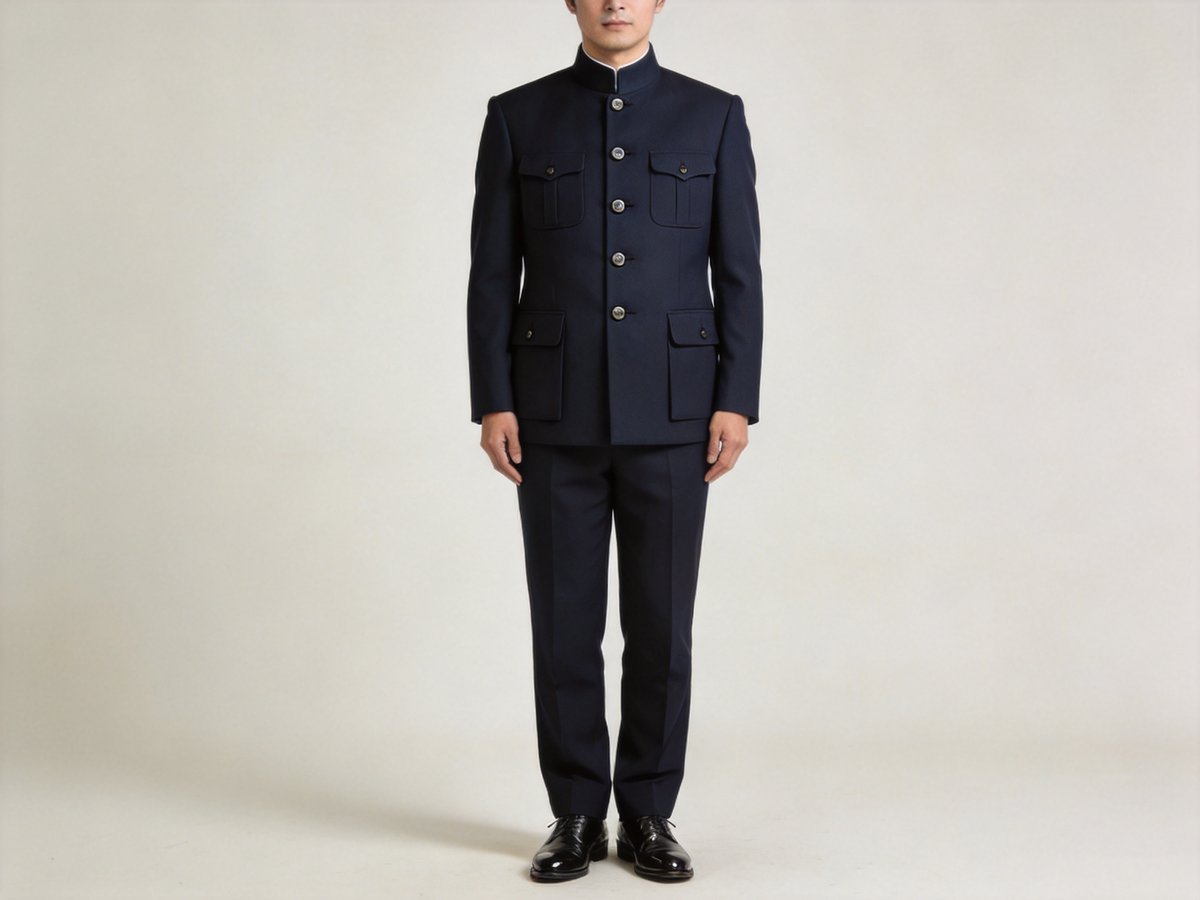
Every design element of the Zhongshan suit carries deliberate symbolic meaning that reflects Sun Yat-sen political philosophy. The four external pockets represent the four cardinal virtues of Chinese governance, propriety, righteousness, integrity, and humility, as well as the four principles of the people. The five center-front buttons symbolize the five branches of government and the five constitutional powers of examination, control, executive, legislative, and judicial authority. The three buttons on each cuff represent the Three Principles of the People, nationalism, democracy, and livelihood, which form the ideological foundation of modern China. The standing collar, unlike the folded collar of Western suits, represents the dignity and self-respect of the Chinese nation, rejecting foreign cultural domination.
The construction of the Zhongshan suit emphasizes practicality and egalitarianism over ornamentation. Unlike traditional Chinese robes that required complex layering and signaled status through fabric quality and embroidery, the Zhongshan suit was designed to be accessible and uniform across social classes. The jacket is cut without darts or waist suppression, creating a straight, boxy silhouette that minimizes body shape differences between wearers. The fabric is typically a solid dark color, most commonly gray, blue, or black, with no patterns or decorative elements that might distinguish rank. This deliberate simplicity made the suit appropriate for everyone from government officials to factory workers, embodying the democratic ideals of the new republic. The suit also eliminated the queue hairstyle requirement, as its modern collar and cut were designed to be worn with short hair.
The Zhongshan Suit in the Modern Era
After the establishment of the People Republic of China in 1949, the Zhongshan suit became the de facto national uniform, worn by political leaders including Chairman Mao Zedong in countless official portraits and public appearances. The association with Mao was so strong that the garment became known internationally as the Mao suit, a name that persists in Western fashion contexts. During the Cultural Revolution, the Zhongshan suit in olive green or blue became virtually mandatory for all citizens, representing revolutionary solidarity and rejection of bourgeois fashion. The suit dominance lasted until the economic reforms of the 1980s, when Western business suits began to replace it in urban centers and government settings, though it remained in use among older officials and in rural areas.
Today the Zhongshan suit occupies a complex position in Chinese fashion. It is no longer everyday wear but retains significance for formal occasions and official ceremonies. Chinese leaders occasionally wear the suit for important state events, and it remains the standard attire for significant political ceremonies. The suit has also found new life in popular culture, worn by grooms at traditional weddings, by performers evoking early twentieth-century China, and by fashion designers who reference its clean lines in contemporary collections. While most Chinese men now wear Western-style clothing daily, the Zhongshan suit remains a powerful sartorial symbol of Chinese political history, national identity, and the enduring influence of Sun Yat-sen vision of a modern, independent China.